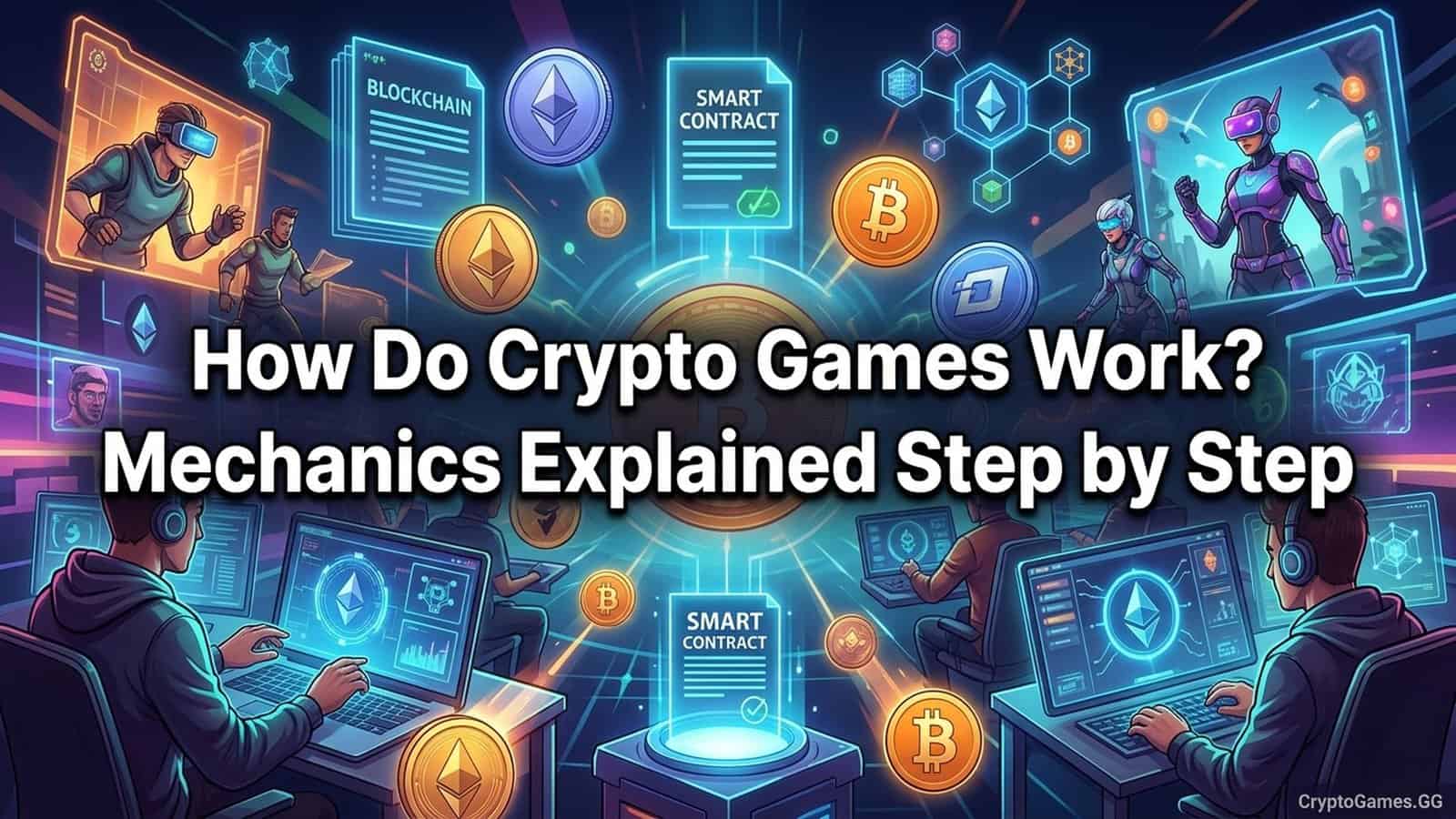





Crypto games combine four technologies that most people have heard of separately but rarely see explained together. A blockchain, smart contracts, NFTs, and a crypto wallet. When these four elements connect through a game, something new emerges: an economy where you own the assets, the rules are public, and your gameplay generates real financial value. This guide walks through exactly how crypto games work, from the moment you set up your wallet to the moment you cash out tokens you earned through play.
Quick Answer: Crypto games work by recording in-game assets on a blockchain as NFTs stored in your personal wallet. Smart contracts automatically handle rewards, trades, and game rules without any company middleman. When you complete qualifying in-game actions, tokens are released to your wallet through smart contract logic. You can then trade those tokens or NFTs on open marketplaces for other cryptocurrencies or cash.
The Four Core Components
Before walking through the steps, it helps to understand the four building blocks and what each one does.
The blockchain is the permanent public record. Every asset ownership, every token transfer, every reward distribution is written to the blockchain permanently. It replaces the game company’s private database with a record no single entity controls. Popular gaming blockchains include Ronin for Axie Infinity and RavenQuest, Immutable X for Gods Unchained, and Solana for Star Atlas.
Smart contracts are programs that live on the blockchain. They execute automatically when conditions are met. A smart contract might say: if a player wins three ranked games today, release 50 GODS tokens to their wallet. When that condition is met, the code runs itself. No human approval is needed. Nobody can alter the outcome.
NFTs are the digital assets themselves. Each in-game item that has value, a character, a weapon, a card, a land plot, is represented as an NFT. A unique token with a permanent ownership record on the blockchain. Your item exists independently of the game’s servers.
Your crypto wallet is the container for everything you own. It stores your NFTs and your earned tokens. When you want to sell, stake, or transfer an asset, you sign the transaction from your wallet. The wallet does not hold your assets directly; it holds the private key that proves on the blockchain that those assets belong to you.
Step 1: Setting Up Your Crypto Wallet
- Identify which blockchain your game uses. Check the game’s official website. Different games run on different blockchains. Axie Infinity AXS $1.17 ▲ +2.4% uses the Ronin Network. Gods Unchained GODS $0.02252 ▼ -7.5% uses Immutable X. Star Atlas ATLAS $0.0001459 ▼ -6.9% uses Solana.
- Download the correct wallet for that blockchain. Ronin Wallet for Ronin-based games. MetaMask for Ethereum and most Ethereum-compatible chains. Phantom for Solana. Each is a free browser extension or mobile app.
- Create a new wallet and save your seed phrase. During setup, you receive a 12-word recovery phrase. Write it on paper. Store the paper somewhere physically secure. Never type it into any website, app, or message. This phrase is the only way to recover your wallet if you lose access. Anyone who has it controls your wallet completely.
- Add funds to your wallet. Buy cryptocurrency on a regulated exchange like Coinbase or Kraken. Transfer a small amount to your new wallet address. You need the correct token for that blockchain: ETH for Ethereum chains, RON or SLP for Ronin, SOL for Solana.
Common mistake: Sending tokens to the wrong wallet type. Ethereum tokens sent to a Solana wallet address are unrecoverable. Always confirm you have the right wallet for the right blockchain before transferring anything.
Step 2: Connecting to a Game
- Go to the game’s official website. Always navigate directly or use a bookmarked URL. Phishing sites that mimic popular game websites steal wallet credentials by tricking players into approving malicious transactions.
- Click the Connect Wallet button. Every web3 game has one, typically in the top right corner of the interface or on a dedicated play page.
- Approve the connection request in your wallet. Your wallet extension will open a popup. Review what permissions you are granting. A basic connection request should only ask to read your wallet address. Never approve connection requests that ask for permissions to transfer tokens or NFTs automatically.
- Your wallet address becomes your game account. You do not create a separate username and password in most crypto games. Your wallet address is your identity in the game. Your items, earnings, and progress are attached to that address on the blockchain.
Common mistake: Approving unlimited spend permissions in connection requests. Legitimate games do not need these permissions at connection time. If you see a permission for unlimited token transfers during a simple connection request, disconnect immediately.
Step 3: How In-Game Assets Become NFTs
Not every item in a crypto game is an NFT. Only items that require true ownership proof are represented on-chain. This is usually the most valuable items in the game: starter characters, rare weapons, land parcels, competitive card collections.
When an NFT item is created in a game, a process called minting occurs. Minting means the smart contract generates a new token with a unique identifier and writes the ownership record to the blockchain. If you breed two Axies, the resulting new Axie is minted as a new NFT and assigned to your wallet. If you win a legendary card pack in Gods Unchained, the cards inside are minted as NFTs and appear in your wallet.
The metadata for each NFT describes what it is. For a game character, metadata might include species, stats, level, and visual appearance. This metadata is typically stored on decentralized storage systems like IPFS or Arweave so it cannot be deleted by the developer either.
Once an NFT is in your wallet, the game developer cannot alter it or remove it. The item exists on the blockchain. The game reads the blockchain to determine what items you own and displays them in-game. The game is essentially a front-end interface for blockchain-recorded assets.
Step 4: How Smart Contracts Handle Game Rewards
This is where the earn in play-to-earn happens. Reward distribution in crypto games runs entirely through smart contracts.
A reward smart contract is programmed with specific conditions. For example: for each ranked victory in Gods Unchained this week, release X GODS tokens to the winner’s wallet. When the condition is met, the contract executes automatically. No game company employee processes the payment. The blockchain verifies the condition was met and transfers the tokens.
This creates several important properties. First, players can verify the reward logic before they start playing. The smart contract code is public. You know exactly what actions earn what rewards before playing. Second, the developer cannot secretly change reward rates without deploying a new contract, which is publicly visible. Third, rewards cannot be withheld due to account bans or disputes. Once a qualifying action occurs, the contract executes regardless of the developer’s wishes.
Token rewards land directly in your wallet, not in a game-controlled account. From the moment the smart contract executes, those tokens are yours. You do not need the game’s permission to withdraw or sell them.
Step 5: How Token Economies Work
Most crypto games have at least two tokens working together in a dual-token model.
The governance token has a fixed or limited maximum supply. It represents ownership stake in the game ecosystem. Holders vote on major game decisions through the game’s DAO. The governance token tends to appreciate over time if the game grows because supply is constrained and demand from new players increases. AXS is Axie Infinity’s governance token. GODS is Gods Unchained’s governance token.
The utility token is earned freely through gameplay. Players spend it on in-game actions: breeding, crafting, upgrading, entering competitions. The spending mechanisms are called token sinks. When sinks absorb tokens at a rate close to the emission rate, the utility token maintains value. When emission outpaces sinks, inflation drives prices down.
In-game currency flows matter too. Game revenue from player spending creates a treasury. That treasury funds game development, token buybacks, or staking rewards, all of which affect token economics. Games with genuine player spending creating genuine treasury revenue have more sustainable economics than those relying purely on new player investment.
Step 6: Trading Assets on Marketplaces
Because your NFT game items live on a public blockchain, any marketplace that supports that blockchain’s NFT standard can list them. You do not need the game’s permission to sell your items. The blockchain proves you own them.
Game-specific marketplaces like the Axie Marketplace or Gods Unchained Marketplace provide the best liquidity for game-specific items because buyers there are specifically looking for those items. General NFT marketplaces like OpenSea or Immutable’s marketplace can also list most game NFTs.
Selling an NFT through a marketplace works like this. You list the item at your asking price. The marketplace’s smart contract holds the NFT in escrow. A buyer pays the asking price. The smart contract simultaneously transfers the NFT to the buyer’s wallet and the payment minus marketplace fees to your wallet. The transaction is final on the blockchain. No chargebacks are possible.
Step 7: Converting Earnings to Cash
- Transfer tokens from your wallet to a centralized exchange. Exchanges like Coinbase, Kraken, or Binance accept most major gaming tokens. Copy your exchange deposit address for the correct token. Send from your wallet to that address.
- Sell the token for a stablecoin or fiat. On the exchange, place a sell order for your tokens. You can sell for USDC (a stablecoin pegged to the dollar) or directly for fiat currency depending on the exchange.
- Withdraw to your bank account. Most exchanges allow bank transfers or debit card withdrawals. Processing times vary from instant to several business days depending on the method and your country.
- Keep records for tax purposes. The value of tokens at the moment of receipt is typically taxable income in most jurisdictions. The sale price minus the original value determines capital gain or loss. Dedicated crypto tax tools like Koinly or CoinTracker can automate much of this tracking.
The Full Flow Illustrated
Here is the complete cycle from new player to earnings:
You download a wallet and connect it to a game. The game reads the blockchain to see what assets your wallet holds. You earn NFT items through gameplay, minted directly to your wallet by smart contracts. You earn token rewards through qualifying actions, also sent automatically to your wallet by smart contracts. You trade NFTs on open marketplaces using the marketplace’s smart contract escrow. You transfer earned tokens to a centralized exchange. You sell tokens for fiat and withdraw to your bank account.
At every step, the blockchain records what happened permanently. At every step, smart contracts execute the mechanics automatically. At no step does the game company have the ability to intercept your assets, block your sale, or confiscate what you earned. That is the fundamental architecture of how crypto games work, and it is what makes them structurally different from every game that came before.
Frequently Asked Questions
How do crypto games generate token rewards if they don’t have a central authority?
Smart contracts on the blockchain handle reward distribution automatically. The game developer programs the reward logic into a smart contract before deployment. Once deployed, the contract executes according to its code whenever conditions are met. The developer sets the rules, but cannot selectively override individual outcomes after deployment.
What happens if there is a bug in a game’s smart contract?
Smart contract bugs can be exploited by attackers to drain funds or manipulate game mechanics. This is why audits by reputable security firms are important. Once a bug is exploited, the damage is often permanent because blockchain transactions cannot be reversed. Most serious games conduct multiple audits and run bug bounty programs to reduce this risk.
Do you need to understand blockchain technology to play crypto games?
No. You need to understand how to use a crypto wallet, which takes an afternoon to learn. The underlying blockchain mechanics run invisibly in the background. Many newer crypto games are designed so you never even think about the blockchain while playing. You interact with a normal-looking game interface while blockchain activity happens automatically.
Can a crypto game change the reward rules after you start playing?
The developer can deploy updated smart contracts that change reward rates going forward. This is publicly visible on-chain and typically requires community governance votes in well-designed games. Once you earn tokens, the developer cannot take them back. But future reward rates can be changed through contract updates, which is why checking governance structures matters before committing to a game.
Why do some crypto games require gas fees for every transaction?
Gas fees compensate the blockchain validators processing your transactions. On Ethereum mainnet, fees can be high. Games on Layer 2 solutions like Immutable X or dedicated gaming chains like Ronin have dramatically lower fees, often near zero for most actions. The choice of blockchain determines the fee environment players experience.
Crypto games work by replacing the game company’s private economy with a public blockchain economy. The technology enables ownership, earnings, and governance that were structurally impossible in traditional gaming. Understanding the mechanics takes an afternoon. The benefits last as long as the games keep running, and in many cases, even after they stop.