
In Brief
- Industry Shift: Blockchain gaming is moving away from its speculative phase toward a focus on sustainable economic practices and quality gameplay.
- Funding Challenges: The sector saw a dramatic reduction in funding from $4 billion in 2021 to $293 million in 2025, prompting a shift towards more financially sustainable operations.
- Recovery Signs: Recent regulatory changes and the increasing use of stablecoins have contributed to the sector’s gradual recovery, alongside a renewed focus on quality game development.
Sustainable Growth in Blockchain Gaming
The blockchain gaming industry, after experiencing tremendous growth followed by significant setbacks, is healing and evolving with a renewed focus on sustainability and product quality. This is one of the key takeaways from the Blockchain Game Alliance’s (BGA) latest annual report.
Shifts in Industry Focus
Originally driven by speculative investment and the play-to-earn model, blockchain gaming saw a peak in 2021. However, the ensuing years brought considerable challenges. The collapse of play-to-earn models, dwindling investor confidence, and a severe drop in funding led many gaming studios to shut down. From a high of $4 billion in total funding accumulated in 2021, the figure tumbled to $293 million by 2025. A large percentage of these ventures failed, unable to sustain operations as external capital dried up.
Regulatory and Economic Adjustments
Adjustments in U.S. regulations have been cited as positive for the industry. Yat Siu, co-founder of Animoca Brands, highlighted the importance of these changes, noting that companies can now launch tokens without establishing nonprofit foundations, easing some operational challenges.
Moreover, the introduction and growth of stablecoins have been pivotal. These digital currencies offer the advantages of quick, cost-effective, and stable transactions, essential for real-world commerce applications within games. The BGA report emphasizes that stablecoins help reduce the volatility typically associated with other cryptocurrencies, making financial aspects of gaming more reliable.
Focus on Quality and Infrastructure
Recent data show an uptick in optimism among industry professionals, with a survey revealing that current sentiment stands at 65.8% optimism, significantly rebounding from previous years. This positive shift can largely be attributed to the industry’s pivot towards developing high-quality gaming experiences and robust revenue models rather than solely relying on token economics.
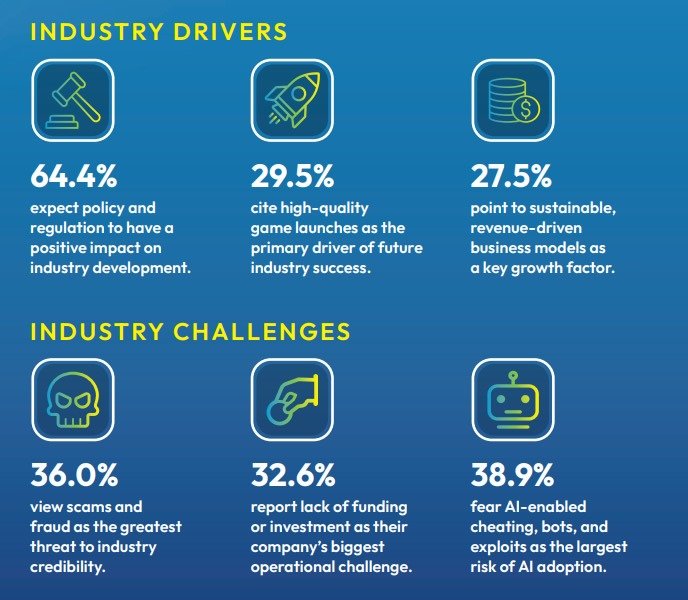
The resilience of the blockchain gaming market is also starting to show through the launch of high-quality games. Nearly 30% of survey respondents pointed to these releases as the most critical factor for growth. Andrew Sorokovsky, vice president of global sales at Immutable, asserts, “Despite the negative headlines, blockchain gaming is now one of crypto’s most proven sectors — where quality projects are thriving and real adoption is taking hold.”
Conclusion
As blockchain gaming navigates through its recovery phase, the focus has distinctly moved towards creating a sustainable and product-oriented future. The industry aims to distance itself from the speculative roots of the past and build a foundation that could pave the way for long-term viability and success.