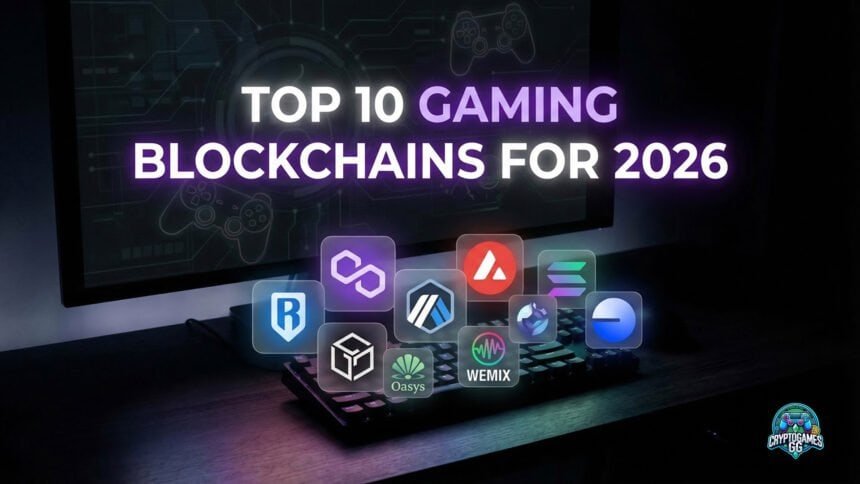
Welcome to my latest review, today I’m exploring the Top 10 Gaming Blockchains for 2026. In this review, you will find useful information regarding the Best Gaming Blockchains at the moment, including why these Top 10 Gaming Blockchains stand out.
Never miss content like this, and important gaming news. Join our New Telegram Channel.
Web3 gaming has grown up. The days of chasing whitepaper promises and inflated “player count” metrics are behind us. What matters now is whether a blockchain can actually ship a game that people want to play and keep playing.
In 2026, the question studios are asking isn’t “Should we use blockchain?” Instead, it’s “Which blockchain gives our game the best shot at distribution, retention, and a sustainable economy?” That’s a fundamentally different question, and it demands a fundamentally different kind of analysis.
This Top 10 Gaming Blockchains for 2026 Review is written for developers, investors, and serious players who need to understand the real landscape, not a recycled ranking of chain speeds.
We cover:
- What actually differentiates the top gaming blockchains in production environments
- Chain-by-chain breakdowns: architecture, fees, tooling, security, and ecosystem
- The most played games on each network
- An honest look at bridge risk, the single biggest threat to multichain game economies
- A selection framework for choosing the right chain for your specific game type
Let’s get into it.
What Makes a Blockchain Good for Gaming?
Gaming blockchains are blockchain networks optimized for video games. They enable fast, cheap transactions, NFT ownership, and scalable on-chain economies. The best gaming blockchains combine low fees, reliable developer tooling, seamless player onboarding, and robust bridge security to support live, high-traffic game environments.
Raw throughput matters less than it used to. A chain can quote impressive TPS numbers but still fail game studios on the fundamentals: unpredictable fees that spike mid-session, brittle wallet onboarding that turns new players away, bridge contracts that concentrate hundreds of millions of dollars of risk in a single exploit surface.
When evaluating gaming blockchains in 2026, the metrics that actually predict shipping success break down into five categories:
- Fee predictability, not just “cheap,” but consistent. A game economy breaks if transaction costs fluctuate 10x during congestion windows.
- Onboarding ergonomics, such as embedded wallets, gas sponsorship, and session keys. Players tolerate zero blockchain friction. Any friction is a funnel leak.
- Developer tooling surface, including SDKs, indexers, identity primitives, and marketplace APIs. Assembling all of this from scratch costs months; having it pre-built is a real competitive advantage.
- Bridge risk exposure, the most important and most underappreciated factor. Billions of dollars have been stolen from cross-chain bridge contracts. Game economies that require frequent bridging inherit that risk.
- Ecosystem liquidity, including wallets, marketplaces, collector communities, and DeFi integrations that give players a reason to value in-game assets beyond the game itself.
With that framework in mind, here are the Top 10 Gaming Blockchain Fro 2026.
1. Immutable X & Immutable zkEVM
Immutable is the closest thing to a complete operating system for Web3 games. The original Immutable X focused on scaling NFT operations via ZK-rollup technology, inheriting Ethereum’s security guarantees while enabling gasless NFT minting and trading. The subsequent launch of Immutable zkEVM expanded that foundation to full EVM compatibility, meaning studios can now deploy complex on-chain game logic alongside their asset infrastructure on the same network.
What distinguishes Immutable from every general-purpose chain that later added “gaming support” is the product philosophy: every developer-facing primitive is designed around the realities of shipping a game, not managing a DeFi protocol. Authentication, embedded wallets, checkout flows, marketplace orderbooks, and asset indexing are first-class products, not afterthoughts.
Key Features
Immutable Passport is the centerpiece of the onboarding stack. It allows players to authenticate with email or social login, generates an embedded wallet behind the scenes, and removes any need to interact with a browser extension on first launch. For studios trying to convert a Web2 audience, this is the difference between a 10% and a 40% funnel conversion rate.
Immutable provides a production-grade trading layer with maker/taker mechanics that studios can surface directly in-game without building a custom exchange. Combined with the Checkout module, which handles on-ramps, payments, and asset purchases in a single flow, it gives teams a complete commerce stack out of the box.
ZK-rollup scaling means NFT operations carry near-zero fees for players, and the cryptographic proof model provides stronger security guarantees than optimistic rollups for high-value asset settlements.
Pros
- Full-stack gaming infrastructure (identity, payments, trading, indexing) that reduces time-to-market significantly
- Gasless NFT operations for players: no wallet confusion, no “I need ETH to do that”.
- Ethereum-backed security via ZK proofs
- Unity SDK support for studios using mainstream game engines
Cons
- Ecosystem is deeply NFT-centric; games with minimal on-chain asset models gain less from Immutable’s stack than others
- Bridged TVL rather than traditional DeFi TVL means comparisons to general-purpose chains look different on standard dashboards
- Cross-chain movement of assets carries the same bridge risks as any EVM ecosystem
Notable Games
- Gods Unchained remains one of the most enduring blockchain card games, with a player base that predates the current market cycle and a trading economy that benefits directly from Immutable’s gasless infrastructure.
- Illuvium is Immutable’s flagship AAA bet: an open-world RPG with high-fidelity visuals and auto-battler combat that has become a reference point for what “quality Web3 game” can mean.
- Guild of Guardians targets mobile-first players with cooperative RPG mechanics, demonstrating that Immutable’s audience ambitions extend well beyond the core crypto demographic.
Why It Matters in 2026
Immutable X is the most credible answer to the “frictionless Web2 to Web3 onboarding” problem. Every other chain talks about reducing user friction. Immutable’s entire product roadmap is built around it. For studios building NFT gaming platforms where asset trading is a core mechanic, no chain offers a more complete infrastructure layer.
2. Ronin
Ronin began as the infrastructure layer for Axie Infinity, a purpose-built sidechain designed to handle the kind of transaction volumes a live game generates at scale. After surviving one of the most consequential security incidents in crypto history (more on that below), the chain has matured into a multi-game ecosystem with some of the highest genuine daily engagement in the entire Web3 gaming industry.
The key to understanding Ronin is that its design philosophy has always prioritized gameplay experience over decentralization purity. That’s a deliberate trade-off, and it produces measurable results: players actually log in every day, economies generate real activity, and games on Ronin feel alive rather than dormant between speculative waves.
Key Features
Ronin Waypoint is the chain’s answer to the fragility of onboarding. It combines account creation, gas sponsorship, and session management into a single integration layer, allowing studios to offer a free-to-play experience in which all transaction costs are absorbed by the game operator rather than passed to players.
The gas sponsorship model is technically precise: Waypoint documentation describes a payer wallet system in which developers cover users’ fees and manage their own budget for that coverage. This is not just “gasless by default”; it’s a production-grade tool for controlling user acquisition costs in the same mental model as Web2 UA budgeting.
Ronin’s move to EIP-1559-style fee mechanics (introduced via a documented hard fork with an explicit block reference) also signals that the chain is maturing its economics beyond its original fixed-fee design and improving fee predictability for studios modeling long-term operational costs.
An Android SDK for Waypoint rounds out the mobile-native surface, acknowledging that the most meaningful gaming distribution in 2026 runs through app stores, not desktop browsers.
Pros
- Genuinely high daily active engagement; Ronin games show real retention metrics, not just wallet holdings
- Best-in-class consumer onboarding with sponsored gas and embedded account management
- Mobile-native SDK support
- Transparent roadmap for fee model modernization
Cons
- The 2022 Ronin bridge exploit (approximately $600M, linked by U.S. government reports to North Korea’s Lazarus Group) is a permanent part of the chain’s security history. Studios must address this proactively in risk communications.
- As a gaming-first sidechain, Ronin offers less composability with broad DeFi liquidity than EVM rollups
- Chain activity metrics are less straightforward to benchmark against major EVM chains on standard dashboards.
Notable Games
Axie Infinity continues to evolve its core creature battler mechanics, with economic reforms addressing the sustainability issues that plagued earlier iterations.
Pixels has become one of the most-played games in Web3, demonstrating that light social mechanics, regular content drops, and a low barrier to entry can generate more sustained engagement than complex tokenomics.
Other popular Ronin Games are Fishing Frenzy and Cambria.
Why It Matters in 2026
Ronin is proof that “best blockchain for gaming” sometimes means prioritizing user experience over technical prestige. No other chain has consistently demonstrated the ability to retain a meaningful daily active user base in a live game context. That track record is worth more than any benchmark.
In continuation of our Top 10 Gaming Blockchains for 2026 Review, the next Gaming Blockchain is Polygon.
3. Polygon
Exploring the unique features of the Top 10 Gaming Blockchains is crucial for developers looking to make informed choices.
Each of the Top 10 Gaming Blockchains offers distinct advantages tailored to different gaming experiences.
Polygon PoS is the dominant pragmatic choice for Web3 gaming. It is a high-throughput EVM-compatible sidechain that checkpoints state roots to Ethereum, offering cheap transactions, broad wallet support, and a genuinely mature ecosystem of infrastructure tooling. It is not gaming-specialized, but that breadth is precisely what makes it attractive to studios that want established wallet integrations, marketplace liquidity, and NFT standards without configuring custom infrastructure.
As we delve deeper into the Top 10 Gaming Blockchains, it’s essential to understand the unique features that each blockchain brings to the gaming ecosystem.
Its on-chain metrics tell a straightforward story: over 860,000 active addresses and 10 million transactions in a single 24-hour window represent one of the busiest EVM environments in existence. Chain-wide fees in the same window totaled around $72,000, implying an average transaction cost well under one cent. For games with high-frequency, low-value interactions (item crafting, quest completion, resource generation), that economic profile is genuinely viable.
Key Features
The EVM compatibility story is Polygon’s core selling point. A studio that has already written Solidity contracts for Ethereum or another EVM chain can deploy to Polygon with minimal changes. Every major NFT standard (ERC-721, ERC-1155), every major wallet, and every major marketplace integration already works. That reduces time-to-deployment and eliminates infrastructure risk that gaming-specific chains sometimes introduce.
Polygon’s sidechain model means it manages its own validator set separately from Ethereum, with state checkpointing serving as an anchor rather than a full enforcement mechanism. That security model is appropriate for games, where most assets have moderate economic value — but studios holding large treasuries or very high-value assets should explicitly model the differences between sidechain and rollup security.
Pros
- Massive activity footprint with sub-cent average transaction costs
- Broadest possible EVM tooling and wallet compatibility
- Enterprise-grade partnerships and stable infrastructure
- Straightforward deployment path for studios already in the Ethereum ecosystem
Cons
- Not gaming-specific: studios building for Web2 audiences will still need to build their own onboarding and gas abstraction solutions.
- Sidechain security assumptions differ from rollups, which is important for high-value asset custody.
- Fragmentation across Polygon’s multiple scaling products (PoS, zkEVM, CDK chains) can create decision fatigue.
Notable Games
Sunflower Land has built one of the most engaged farming sim communities in Web3, with a large NFT supply that functions as a “player pass” model. This creates a low barrier to entry and high repeat engagement.
Phantom Galaxies pushes toward AAA space combat, demonstrating that Polygon’s infrastructure can support more than casual titles.
Why It Matters in 2026
Polygon is the pragmatist’s answer. If your game doesn’t need the bespoke onboarding of Ronin, the NFT infrastructure of Immutable, or the dedicated chain control of Avalanche, Polygon offers more production-ready tools per dollar of development effort than almost anything else.
4. Arbitrum
Arbitrum One is an Optimistic Rollup on Ethereum developed by Offchain Labs, with governance via the Arbitrum DAO. It has become one of the highest-value Ethereum scaling solutions, with total value secured at $16–17 billion by independent security monitors. Its gaming profile is somewhat different from the chains above. Arbitrum’s strength lies in composability, DeFi integration, and the rise of interconnected game economies rather than gaming-specialized onboarding.
The most strategically important development in Arbitrum’s gaming story is Stylus: a technology that allows developers to write EVM-compatible smart contracts in Rust or C/C++ and deploy them alongside Solidity contracts. For game studios with Rust backends, increasingly common as Web3 game engines mature, this is a meaningful reduction in the translation cost between game server and on-chain logic.
Key Features
Arbitrum’s rollup architecture publishes transaction data to Ethereum, providing a stronger security foundation than sidechains. The fraud-proof/dispute mechanism gives high-value asset settlements a credible security story that holds up under scrutiny from players, auditors, and potential partners.
The custom chain offering, Orbit, allows studios to deploy dedicated Arbitrum L3 chains that settle to Arbitrum One. Several gaming projects have already launched Orbit chains, creating a pattern in which high-frequency in-game interactions run on a cheap, game-specific L3 while economic settlement flows up to the more secure L2. That architecture is appropriate for studios that need predictable blockspace and bespoke fee rules but want to stay within the Ethereum security umbrella.
Arbitrum’s security transparency is also worth noting: multiple audit reports for Nitro and Stylus are publicly available, which matters when explaining your smart contract risk model to publishers, investors, or platform partners.
Pros
In continuation of our exploration of the Top 10 Gaming Blockchains, we will dive into Polygon.
- Strong security posture with published audits and rollup-based data availability
- Stylus enables Rust/C++ contract development — a real advantage for game studios.
- Clear path to dedicated L3 chains via Orbit for games that outgrow shared blockspace
- Deep DeFi liquidity for open in-game economies
Cons
In the realm of Top 10 Gaming Blockchains, players will find a variety of gaming environments catering to diverse preferences.
The following sections will explore the Top 10 Gaming Blockchains in detail, providing insights into their functionalities and opportunities.
- Not gaming-first: teams must design their own onboarding stack or use third-party wallet/AA providers.
- Optimistic rollup withdrawal delays (typically 7 days for a full L1 withdrawal) need to be clearly communicated to players.
- Sequencer centralization assumptions are an ongoing area of rollup decentralization work.
Notable Games
The Treasure ecosystem, anchored by the MAGIC token and including games like The Beacon and MyPetHooling, represents the most coherent “shared economy” model in Arbitrum Web3 gaming, where assets and currencies flow across multiple interconnected experiences. Orbit chains like Xai demonstrate the L3 appchain model in production.
Why It Matters in 2026
Arbitrum is the strongest choice when your game requires deep DeFi composability, you have a Rust-heavy development team, or you are planning a multi-game ecosystem with shared economic primitives. The Stylus differentiation alone puts it in a category of its own for certain studio profiles.
5. Avalanche
Avalanche occupies a distinct position in the gaming blockchain landscape: it is the most credible platform for AAA studios that need dedicated, controlled infrastructure rather than a timeshare on a general-purpose chain. The Avalanche L1 (formerly Subnet) architecture allows a studio to deploy an independent blockchain, running Subnet-EVM, a fork of go-ethereum, with its own validator set, fee policy, and blockspace allocation.
That level of control has real production implications. A game running on a dedicated Avalanche L1 does not compete with DeFi bots for block space during high-demand windows. It can implement custom fee structures (including zero fees for players). It can configure its own tokenomics at the infrastructure level rather than working around a shared chain’s rules. These are not theoretical advantages, they are the difference between shipping a live-service game and shipping a game that breaks under load.
With over 600,000 active addresses and 2.5 million transactions in a single 24-hour window on the C-Chain alone, Avalanche demonstrates that the underlying network has production-scale activity, while the Subnet model allows individual games to operate independently of that shared congestion.
Key Features
The Subnet-EVM framework means studios inherit full Solidity compatibility while customizing the chain behavior. EIP-1559-style dynamic fees on the C-Chain provide a familiar mental model for fee estimation, and L1 configurations can go further, offering fixed fees, zero fees, or custom fee tokens entirely.
Avalanche’s official L1 toolbox documentation explicitly describes the deployment and management surface, reducing the “mystery” cost of operating dedicated infrastructure. For studios with DevOps capability, this is a tractable problem, not an exotic one.
Pros
- Best-in-class dedicated chain model for games requiring controlled blockspace and custom economics
- EVM compatibility means existing Solidity tooling, wallets, and standards work without modification
- Strong fit for AAA multiplayer titles where predictable performance is non-negotiable
- High C-Chain activity footprint provides ecosystem liquidity and wallet support
Cons
- Dedicated chain operation increases engineering and infrastructure overhead significantly
- Bridging between a game L1 and the broader ecosystem introduces the same high-risk bridge surface as every other cross-chain model
- Less appropriate for small teams without dedicated infrastructure capability
Notable Games
Off The Grid: is a cyberpunk battle royale shooter developed by Gunzilla Games, blending PvP and narrative-driven gameplay in a dystopian future. Players drop into a high-tech warzone where cybernetic enhancements, customizable loadouts, and tactical decisions shape every encounter.
The Top 10 Gaming Blockchains are evolving rapidly to meet the needs of developers and players alike.
Unlike traditional battle royales, the game integrates a story campaign alongside multiplayer, creating a hybrid experience where player choices can influence the world. With blockchain-powered assets, players can truly own, trade, and customize in-game items within a dynamic economy.
Domi Online is a hardcore medieval MMORPG on Avalanche that delivers a true old-school RPG experience in a dark fantasy world. Players explore, fight, and progress freely with no level or skill caps, where every action—and every death—matters.
The game features player-owned assets (NFTs), PvE and PvP combat, guild wars, and a player-driven economy powered by the $DOMI token, creating a competitive and immersive sandbox experience.
Why It Matters in 2026
Avalanche is the serious answer to AAA Web3 gaming infrastructure. If your game expects peak concurrent users in the hundreds of thousands and your economy cannot tolerate fee spikes or blockspace competition, the dedicated L1 path is not optional — and Avalanche makes it tractable.
6. Solana
Solana‘s value proposition is simple and has not changed: it is one of the fastest, cheapest Layer 1 blockchains available. The base fee of 5,000 lamports per signature gives studios a deterministic, documented baseline for transaction cost modeling, and the chain’s high throughput makes it viable for game interactions that would be economically impractical on slower networks. Moreover, Solana uses its own token, $SOL.
With over $7 billion in DeFi TVL, Solana also offers deep ecosystem liquidity, which matters for open game economies where players need to convert in-game assets to other tokens and back. That liquidity profile is significantly stronger than most gaming-specialized chains.
The questions that matter operationally are not about fees, they are about RPC reliability under load, indexing infrastructure maturity, and the behavior of the network during congestion events. Studios that have shipped on Solana in production describe investing meaningfully in data infrastructure (custom RPC providers, dedicated indexers) rather than relying on public endpoints. Budget for that from day one.
Key Features
The fixed base fee model makes Solana unusually legible from a cost-modeling perspective. Unlike EVM chains where fee estimates require gas price oracles and complex calculations, Solana’s signature fee is explicitly documented and consistent, with prioritization fees layered on top only when needed.
Solscan and other analytics tools provide transaction, account, and program-level data surfaces that can be integrated into game telemetry pipelines, useful for studios that need on-chain activity data feeding into their analytics stack.
Pros
- Explicitly documented low base fees with deterministic cost modeling
- High DeFi TVL supports open, liquid game economies
- High-throughput architecture designed for frequent, low-value transactions
- Large and active developer community with mature tooling
Cons
- Historical network outages, though less frequent in recent iterations, remain part of the risk model
- Wormhole exploit (reported at approximately $320M) is a canonical reference point for bridge risk in Solana-adjacent ecosystems
- Production-grade data infrastructure requires investment beyond public RPC endpoints
Notable Games
- Star Atlas is one of the most ambitious space MMO projects in Web3, with an in-game NFT supply that numbers in the millions, reflecting broad asset issuance across its economy.
- Aurory brings JRPG-style mechanics with a tight NFT collection (10,001 Aurorians) that anchors the ecosystem’s identity layer.
- Mini Royale offers browser-based FPS gameplay that demonstrates Solana’s viability for real-time competitive experiences.
Why It Matters in 2026
Solana is the right answer when your game design requires genuine high-frequency, low-cost interactions and you have the engineering capacity to invest in production-grade data infrastructure. It is not a set-and-forget deployment — but for teams that can operate it properly, it remains one of the most capable chains for certain game loop architectures.
7. GalaChain
GalaChain, by Gala Games, takes a different approach to every chain above. Rather than being an infrastructure layer hoping games build on it, it is a vertically integrated entertainment network that controls the chain, the distribution platform, and a roster of first-party games simultaneously. That top-down model creates a coherent user experience and a predictable developer onboarding path, at the cost of decentralization and permissionless composability. Moreover, GalaChain uses $GALA as its native token.
The chain uses a Proof of Authority consensus model with a “channel” architecture. These are independent ledgers of blockchain data configurable per application, with blocks written at throughput thresholds (documented as 200 transactions or a 1-second timeout in the technical reference). PoA means performance is predictable and governance is clear, but it introduces authority assumptions that studios and players should evaluate explicitly.
Key Features
GalaChain Connect is documented as a developer library comparable in interface to ethers.js — meaning studios familiar with EVM tooling can integrate with meaningful familiarity. The CLI tooling provides scaffolding for new chain integrations.
The channel model allows the chain to partition game traffic from general network activity, which has practical performance benefits for specific game deployments. Gala’s public analytics dashboard exposes chain-level metrics including transactions, active wallets, and node counts — a meaningful transparency gesture for studios evaluating adoption health.
Pros
- Vertically integrated “entertainment OS” model reduces the number of vendors a studio must coordinate
- Developer tooling with familiar EVM-adjacent interfaces
- First-party game catalog demonstrates Gala’s commitment as an operator, not just infrastructure
Cons
- Proof of Authority consensus introduces governance centralization that must be disclosed to players and partners
- DeFi TVL is modest (approximately $8–9M), limiting open-economy composability compared to major EVM chains
- Live chain metrics require direct dashboard verification — snapshot consistency is harder than standard analytics aggregators
Notable Games
Shrapnel is a AAA, free-to-play, team-based first-person shooter set in a near-future world devastated by a lunar asteroid impact. Players enter the hostile “Sacrifice Zone” in 4v4 squads, competing to collect and extract a powerful resource known as Sigma while battling rival teams and surviving dynamic environmental threats.
Combining tactical FPS gameplay with evolving Operator abilities, Shrapnel emphasizes strategy, coordination, and risk-reward decision-making in every match. The more Sigma your team secures, the stronger your abilities become, creating constantly shifting combat scenarios.
Mirandus is an open-world fantasy MMORPG developed by Gala Games, where players are given complete freedom to shape their own journey in a vast, player-driven world. Set in a realm ruled by five monarchs, the game removes traditional quests and linear progression, allowing players to explore, trade, fight monsters, or build their own settlements and cities.
At its core, Mirandus is built around true ownership and a decentralized economy, where players can own land, buildings, and in-game assets as NFTs, influencing the world’s economy and governance.
Why It Matters in 2026
GalaChain matters for studios that want to launch within an existing distribution network rather than build their own from scratch. The trade-off is autonomy — but for certain publishing relationships, that trade-off is acceptable.
8. Oasys
Oasys is purpose-built for one goal: eliminating gas fees for game players entirely. Its Hub-and-Verse architecture separates the base settlement layer (Hub) from application-specific game chains (Verses), and the documented design is explicit, on Verse, users pay no gas because Verse operators absorb the cost, charging developers instead. This is not an optional feature; it is the chain’s primary design constraint.
For studios building mainstream consumer titles, this architecture aligns directly with the retention reality of gaming: players who encounter an unexpected cost at any point in the tutorial funnel churn immediately. Gasless UX eliminates that vector entirely. Oasys has particularly strong backing from Japanese gaming companies, making it the strongest candidate for studios looking to reach that market — where traditional gaming culture is deeply established and blockchain integration needs to be invisible to succeed.
Key Features
Verse layers function as optimistic-rollup L2s within the Oasys ecosystem, giving each game its own dedicated chain while maintaining settlement connections to the Hub. The MCH Verse — home to the legendary game, My Crypto Heroes, is an example of a Verse chain that has deployed a roster of games within the Oasys ecosystem with their own explorer and analytics.
The Hub DeFi TVL understates the network’s gaming activity, since Verse-level transactions are not always reflected in standard DeFi aggregator views. Studios evaluating Oasys should look at Verse-level explorer data rather than Hub DeFi metrics alone.
Pros
- Explicit gasless player UX at the architecture level — not a workaround, a design choice
- Verse model provides dedicated chain performance without requiring studios to run their own validators
- Strong alignment with Japanese gaming market and major studio partnerships
Cons
- Hub TVL metrics significantly underrepresent actual Verse-level activity on standard dashboards
- Verse operator economics require studios to model fee absorption sustainability carefully
- Global ecosystem reach is still expanding beyond its core Asian market strength
Notable Games
Champions Tactics: Grimoria Chronicles is a PvP tactical RPG developed by Ubisoft, set in a dark fantasy world where players assemble teams of collectible Champions and engage in strategic, turn-based battles. Each Champion has unique abilities, encouraging deep strategy and team composition.
Set in the war-torn realm of Grimoria, divided into rival factions led by powerful Warlords—the game blends tactical gameplay with Web3 elements, allowing players to own, trade, and craft Champions as NFTs within a player-driven economy.
The MCH Verse ecosystem includes My Crypto Heroes and a growing catalog of titles published through Double Jump Tokyo’s infrastructure. Sega-backed projects add enterprise gaming credibility to the ecosystem’s positioning.
Why It Matters in 2026
Oasys is the clearest answer to “best blockchain for gaming” when gasless player experience is non-negotiable. If your game is targeting console-adjacent audiences who have never held cryptocurrency, Oasys’s architecture eliminates the friction vector most other chains ask you to work around.
9. WEMIX
WEMIX represents a publisher-first blockchain model: rather than building general-purpose infrastructure and hoping games arrive, Wemade built a chain ecosystem specifically to support its own AAA MMO portfolio — then opened it to third-party titles. The result is a network with some of the strongest real-revenue benchmarks in Web3 gaming history, anchored by titles that have generated tens of millions of dollars in player spending within days of launch.
WEMIX PLAY functions as both a distribution platform and an ecosystem hub, listing games with explicit release dates and featured positioning. That publisher-grade launch infrastructure distinguishes WEMIX from chains where discovery and distribution remain unsolved problems.
Key Features
The headline metric is Night Crows: Wemade reported that the title surpassed $10 million in global sales within three days of launch. That is a business-grade KPI that most Web3 gaming ecosystems cannot reference — it reflects a live-service design philosophy where player spending is driven by compelling game content, not just asset speculation.
WEMIX3.0 provides the chain-level infrastructure, with DeFi TVL in the $6M range — modest for financial applications but consistent with a gaming-first rather than DeFi-first positioning.
Pros
- Publisher-grade launch track record with real revenue benchmarks
- WEMIX PLAY provides platform-level distribution that removes the discovery problem for partnered studios
- Flagship MMORPG catalog (MIR4, Night Crows) demonstrates live-service economy design at scale
Cons
- Centralized publisher model means governance and economics are tied to Wemade’s strategic decisions
- On-chain metrics require dynamic dashboard verification — snapshot consistency varies
- Less composable with broader DeFi ecosystems than major EVM chains
Notable Games
Legend of Ymir is a next-generation MMORPG inspired by Norse mythology, developed by Wemade. Built with high-end visuals and large-scale battles, the game immerses players in a mythological world filled with gods, giants, and epic warfare.
It combines traditional MMO systems, such as PvE, PvP, and massive guild conflicts with blockchain integration, allowing players to own and trade in-game assets while participating in a player-driven economy. Read news about Legend of Ymir.
MIR4 is a global MMORPG by Wemade that blends classic Eastern fantasy with modern gameplay systems and Web3 mechanics. Players explore a vast open world, complete quests, engage in PvP battles, and participate in large-scale clan wars.
The game is known for its play-to-earn features, where players can mine resources like Darksteel and convert them into tradable tokens, creating a unique fusion of traditional MMORPG progression and blockchain-powered economy.
Why It Matters in 2026
WEMIX demonstrates that “best blockchain for gaming” can also mean “best publisher relationship for your game.” For studios building MMOs or live-service titles targeting Asian markets, WEMIX’s combination of chain infrastructure and publishing reach is a package that no purely technical chain can replicate.
10. Base
Base is an Optimistic Rollup built on the OP Stack and launched by Coinbase. It has grown into one of the largest Ethereum L2s by total value secured, around $11.5 billion on independent security monitor snapshots, and its daily activity metrics are among the highest of any L2: over 560,000 active addresses and 9 million transactions in a 24-hour window, with chain-wide fees implying average costs well under a cent per transaction.
Base is not gaming-specialized. But it is the strongest candidate for what might be called “consumer crypto” distribution: Coinbase’s user base provides an onboarding surface that no other L2 can match, and the chain’s account abstraction documentation makes ERC-4337 smart wallets and session keys a first-class part of the developer story.
For game studios that want to reach players who already have Coinbase accounts — meaning they have already passed KYC, have an established crypto identity, and are comfortable with on-chain assets. Base is a uniquely positioned distribution channel.
Key Features
Base’s fee model documentation correctly separates L2 execution fees from L1 data publication costs, giving studios an accurate mental model for cost estimation rather than an oversimplified “very cheap” promise. For games with calldata-heavy operations (complex crafting, batch minting), this distinction matters for production cost modeling.
The account abstraction for games story is compelling: documented ERC-4337 support and integrations for major smart wallet providers enable session key designs where players sign into a game session once and execute subsequent transactions without repeated wallet prompts. That UX pattern is essential for competitive and action-oriented game loops.
Base’s engineering team publishes detailed technical content on rollup security model evolution and cross-chain bridging considerations, which matters for studios that need to explain their security architecture to publishers, investors, or platform partners.
Pros
- Largest distribution advantage of any L2: Coinbase user base as a natural acquisition channel
- Very high daily activity metrics with sub-cent average transaction costs
- Strong account abstraction tooling for game-appropriate UX patterns (session keys, paymasters)
- Transparent fee model and rollup security documentation
Cons
- Not gaming-specialized: studios must assemble their own onboarding stack from component tools
- L1 data fee component creates cost variability for calldata-heavy operations
- Optimistic rollup withdrawal mechanics and sequencer assumptions require proactive communication to players
Notable Games
Parallel is a sci-fi trading card game that blends strategic deck-building with rich worldbuilding and competitive gameplay. Players collect NFT-based cards representing different factions and battle in turn-based matches that reward skill, strategy, and adaptability. Built on Ethereum, Parallel combines traditional TCG mechanics with true asset ownership, allowing players to trade and build value through their collections.
Heroes of Mavia is a mobile strategy game inspired by classic base-building titles, where players construct armies, defend their bases, and raid others for resources. Set on a fantasy island, the game integrates Web3 elements by allowing players to own land, heroes, and in-game assets as NFTs. With a focus on competitive gameplay and player-driven economies, Mavia aims to bring blockchain gaming to a broader mobile audience.
Why It Matters in 2026
Base is the right answer when your primary acquisition strategy targets crypto-native consumers already in the Coinbase ecosystem. Combined with modern account abstraction tooling, it offers a path to Web3 gaming experiences that feel genuinely closer to Web2 — without giving up on-chain asset ownership.
Cross-Chain Gaming and Bridge Risk
Cross-chain gaming allows players to use assets, identities, and currencies across multiple blockchains. Technologies like LayerZero and Wormhole enable this interoperability — but bridge contracts represent the single largest loss category in crypto history, making bridge-minimized game design a core best practice for production studios.
The multichain future for gaming is real, but the path there is genuinely dangerous. DeFiLlama’s incident database tracks billions of dollars in bridge-related thefts. The Ronin bridge exploit (~$600M, 2022) and the Wormhole exploit (~$320M, 2022) are the most famous examples, but they are not outliers — they represent a structural vulnerability that affects every game economy requiring cross-chain asset movement.
For game studios, the practical implications are clear:
Keep core gameplay on a single chain. Every cross-chain interaction adds a bridge hop, and every bridge hop is a concentrated risk surface. If your core game loop runs on one chain, your attack surface is dramatically smaller.
Use canonical bridges where they exist. For EVM rollups with official Ethereum bridges (Base, Arbitrum), canonical routes carry the security credibility of the rollup’s own audit history. Third-party bridges offer speed and liquidity but introduce additional smart contract and operational risk. See bridge security best practices for a deeper breakdown.
The Top 10 Gaming Blockchains are paving the way for innovative gaming solutions.
Implement rate limits and circuit breakers. Bridge exploits are often catastrophic because they are unbounded — an attacker can drain the entire bridge in a single transaction sequence. Game economies that implement maximum withdrawal limits, time delays, and automatic pauses reduce the blast radius of any single incident.
As we discuss the Top 10 Gaming Blockchains, we will highlight their potential for future growth.
Gas abstraction helps cross-chain UX. One reason players avoid bridging is cost and complexity. Paymasters, session keys, and sponsored transactions reduce the UX friction of any cross-chain interaction that is genuinely necessary.
The underlying standards worth understanding: ERC-721 and ERC-1155 are the baseline NFT primitives for EVM ecosystems. IBC provides a sovereign chain messaging standard for interoperating chains that implement the protocol. Wormhole’s lock-and-mint model is the most common pattern for moving tokens across heterogeneous chains, but it requires trusting the guardian set’s operational security — the 2022 exploit was a signature verification vulnerability in exactly that component.
Comparison Table
| Blockchain | Architecture | Activity Signal | TVL Signal | Fee Posture | Best Fit | Security Notes |
| Immutable X | ZK-rollup + gaming stack | NFT/trading focused | Bridged TVL visible | Gasless for NFTs | NFT-heavy, trading economies | Bridge/integration risk |
| Ronin | Gaming sidechain | High daily retention | Bridged TVL ~$23M | Sponsored gas | Consumer onboarding, social MMOs | Historical bridge exploit (~$600M) |
| Polygon | EVM sidechain | 860K+ addresses, 10M+ txs/day | DeFi TVL ~$1.27B | Sub-cent average | High-volume casual, enterprise | Sidechain validator assumptions |
| Arbitrum | Optimistic rollup | 190K addresses, 1.9M txs/day | DeFi TVL ~$2.1B, TVS ~$16.7B | Low fees + rollup | DeFi-composable games, appchains | Rollup + sequencer assumptions |
| Avalanche | L1 + dedicated Subnets | 600K+ addresses, 2.5M txs/day | DeFi TVL ~$828M | EIP-1559 style | AAA, dedicated chain | Appchain ops + bridge risk |
| Solana | High-perf L1 | High throughput ecosystem | DeFi TVL ~$7.1B | 5,000 lamports/signature | High-frequency, competitive | Wormhole history; RPC investment needed |
| GalaChain | Entertainment L1 (PoA) | Live dashboard stats | DeFi TVL ~$8.7M | PoA + channels | Vertically integrated studios | PoA centralization assumptions |
| Oasys | Hub + Verse layers | Verse-level, fragmented | Hub TVL ~$300K | Gasless on Verse | Consumer UX-first, Asia focus | Operator trust + bridge risk |
| WEMIX | Platform + chain | Platform KPIs + explorer | DeFi TVL ~$6.3M | Platform-led | MMO/live-service, Asian markets | Publisher custody + bridge risk |
| Base | Optimistic rollup | 565K addresses, 9M txs/day | DeFi TVL ~$4.3B, TVS ~$11.5B | L2+L1 fee separation | Consumer onboarding, casual | Rollup + bridge assumptions |
How to Choose the Right Gaming Blockchain
The best gaming blockchain depends on your game type, team size, and UX priorities. Choose EVM rollups (Base, Arbitrum) for tooling and liquidity, gaming-first chains (Ronin, Immutable) for onboarding, Avalanche Subnets for AAA infrastructure, and Oasys for gasless consumer UX. Minimize bridge exposure in all cases.
Building an indie game with limited infrastructure resources?
Polygon, Base, or Arbitrum offer the most mature EVM tooling with the lowest deployment friction. For Web2-like onboarding, pair any of these with a third-party smart wallet provider — ERC-4337 infrastructure is increasingly commoditized. For NFT-heavy mechanics, Immutable X provides the most complete out-of-the-box trading infrastructure.
Building a AAA or live-service title with predictable performance requirements?
Avalanche L1/Subnet or Oasys Verse are the credible dedicated-chain options. Both provide the infrastructure control needed to guarantee blockspace and eliminate fee volatility for players. Factor in the operational cost: dedicated chains require validator management, observability, and incident response capabilities that shared chains do not.
Building a high-frequency, competitive multiplayer game?
Solana’s performance profile and documented base fee model are strong here, but budget for production-grade data infrastructure from day one. Alternatively, an Avalanche or Arbitrum Orbit dedicated chain provides similar performance with more control over validator set.
Focused on mainstream consumer distribution?
Base’s Coinbase distribution advantage is unmatched among EVM L2s. Pair it with ERC-4337 account abstraction for session keys and sponsored transactions, and you have the strongest current path to reaching crypto-curious consumers who are not already in the Web3 gaming trends ecosystem.
Prioritizing player retention and daily engagement over technical prestige?
The evidence from Ronin’s ecosystem is compelling: gasless UX, embedded accounts, and consumer-first onboarding produce measurably better retention than technically superior chains with more friction. If your game’s primary KPI is daily active users — not wallet counts — weight onboarding ergonomics heavily in your chain selection.
The single most important question to answer before choosing a chain is: where does your target audience already have a wallet? Distribution follows identity, and the chain where your audience’s crypto identity lives is the chain with the lowest acquisition friction.
Future Trends
Gas abstraction becomes baseline, not premium. Ronin’s sponsored gas model and Oasys’s gasless Verse are shifting player expectations: studios that still require players to hold gas tokens in 2026 face a UX disadvantage that is increasingly difficult to justify. ERC-4337 smart wallets and paymasters are commoditizing this pattern across EVM chains, and the next 12–18 months will see it become the default rather than a differentiator.
Account abstraction unlocks session-based gameplay. Session keys — where a player authorizes a time-limited set of on-chain actions with a single signature — are becoming standard for action-oriented games. This pattern makes Web3 game loops feel like Web2 for players while maintaining genuine on-chain asset ownership. Base’s documentation of ERC-4337 smart wallets and Arbitrum’s Stylus smart contract model are both pointing in this direction.
Rollup decentralization is a roadmap, not a destination. Base’s public engineering updates on sequencer decentralization and security council governance signal that rollup trust assumptions are not static — they are improving. Studios that commit to rollup ecosystems today are betting on a trajectory toward stronger security guarantees over time, which is a reasonable bet given the development velocity.
Bridge risk drives single-chain game design. Counter-intuitively, the multichain narrative is pushing studios toward single-chain designs for core gameplay. The operational complexity and security risk of bridging are now well-documented, and most studios choose to localize their economy on one chain and treat bridges as optional off-ramps rather than structural requirements.
AAA adoption stress-tests the infrastructure thesis. Shrapnel on Avalanche and Off The Grid on its own chain represent the first real stress tests of dedicated gaming blockchain infrastructure at AAA production scale. The lessons from those launches — performance under concurrent load, cold-start economics, player conversion from Web2 to Web3 ownership — will shape chain selection for the next generation of major studios entering the space.
Final Words
The top gaming blockchains in 2026 have each carved out a defensible position, and the market is no longer converging on a single winner. The better frame is specialization: Immutable for NFT economies, Ronin for player retention, Polygon for EVM pragmatism, Arbitrum for composability and Rust-native development, Avalanche for AAA infrastructure, Solana for high-frequency performance, GalaChain for vertical integration, Oasys for gasless consumer UX, WEMIX for live-service publishing, and Base for consumer distribution.
What cuts across all ten is the imperative to minimize bridge exposure. The industry’s worst incidents have all involved cross-chain asset movement. Studios that keep their core economy on a single chain, invest in gas abstraction for players, and treat bridging as an exception rather than a default are building on a more defensible foundation than those chasing multichain novelty.
The chains that will matter most in 2027 are the ones currently shipping live games with real daily active users, not the ones with the best benchmarks. Watch the retention curves, not the TPS claims.
FAQ
What are gaming blockchains?
Gaming blockchains are networks optimized for video games, offering fast, cheap transactions, NFT ownership, scalable on-chain economies, and developer tooling for game-specific use cases. The best options combine low fees, reliable onboarding, and robust security, not just high throughput.
What is the best blockchain for gaming in 2026?
There is no single best option. Immutable X leads for NFT-heavy trading economies. Ronin leads for consumer retention and daily engagement. Avalanche leads for AAA dedicated infrastructure. Solana leads for high-frequency performance. Base leads for consumer distribution. The right choice depends on your game type and team capabilities.
Do players need to pay gas fees in Web3 games?
Not necessarily. Ronin’s Waypoint system allows studios to sponsor gas on behalf of players. Oasys Verse documents gasless UX as an architecture-level feature. ERC-4337 paymasters on EVM chains achieve the same result. Gas abstraction is increasingly the expected default for mainstream gaming audiences.
What is the biggest risk in Web3 gaming?
Other than players loosing money, its bridges. Cross-chain bridge contracts have been exploited for billions of dollars cumulatively, and the Ronin (~$600M) and Wormhole (~$320M) incidents demonstrate that even well-resourced ecosystems are not immune. Minimizing bridge exposure in core gameplay loops is the single most impactful risk management decision a studio can make.
What is cross-chain gaming?
Cross-chain gaming allows assets, currencies, and player identities to move across multiple blockchain networks. Technologies like LayerZero and Wormhole enable this, but introduce significant bridge security risk. Most production studios treat cross-chain as an exception for specific asset flows (marketplace liquidity, treasury management) rather than a default game architecture.
Is Arbitrum or Base better for a Web3 game?
It depends on priorities. Base offers stronger consumer distribution via the Coinbase ecosystem and first-class account abstraction tooling. Arbitrum offers deeper DeFi composability, advanced development options via Stylus (Rust/C++ contracts), and a proven custom chain path via Orbit. Compare your target audience’s wallet distribution, your team’s language preferences, and your ecosystem partnership priorities before deciding.
Are L2 rollups safer than sidechains for game assets?
Generally yes, rollups publish data to Ethereum and rely on L1 enforcement mechanics, providing a stronger security foundation than sidechains that manage their own validator sets. However, the most catastrophic losses in Web3 gaming history have come from bridge contracts and infrastructure attacks rather than base-layer consensus failures. Security posture must account for the entire stack, not just the settlement layer.
Metrics referenced in this article reflect on-chain snapshots and documentation available as of early 2026. TVL, transaction counts, and active address figures are dynamic — verify against live sources (DefiLlama, L2Beat, chain explorers) before using in financial or investment contexts.
This was the Top 10 Gaming Blockchains for 2026 Review, I hope you like it. Understanding the Top 10 Gaming Blockchains enables studios to strategize effectively for their projects.