



In every major traditional game, the items you buy belong to the publisher, not you. When the game shuts down or the developer changes the rules, your investment disappears without recourse. Blockchain gaming solves this by recording ownership on a distributed ledger no single company controls. The blockchain gaming market was valued at approximately $37.55 billion in 2025 and attracted 4.66 million daily unique active wallets in Q3 2025 according to DappRadar. This guide explains exactly how the technology works, which platforms lead the space, and what the honest limitations are.
Quick Answer: Blockchain gaming refers to video games that use blockchain technology to record in-game asset ownership permanently and transparently on a distributed ledger. Players hold their items as NFTs in personal crypto wallets. Game rules run on public smart contracts. Players can earn cryptocurrency through gameplay and trade assets on open markets without developer permission.
The Problem That Blockchain Gaming Solves
Traditional online games have a structural ownership problem. Every item, character, and currency you acquire exists on a company’s private servers. The company sets all rules and can change them unilaterally. They can nerf your items, ban your account, shut down servers, or alter drop rates. You paid real money for access. The company retained all the rights.
This creates real frustrations. Items purchased for hundreds of dollars can be made worthless with a patch. Years of accumulated in-game wealth can vanish when servers go offline. Reselling items you earned through hundreds of hours of gameplay typically violates terms of service.
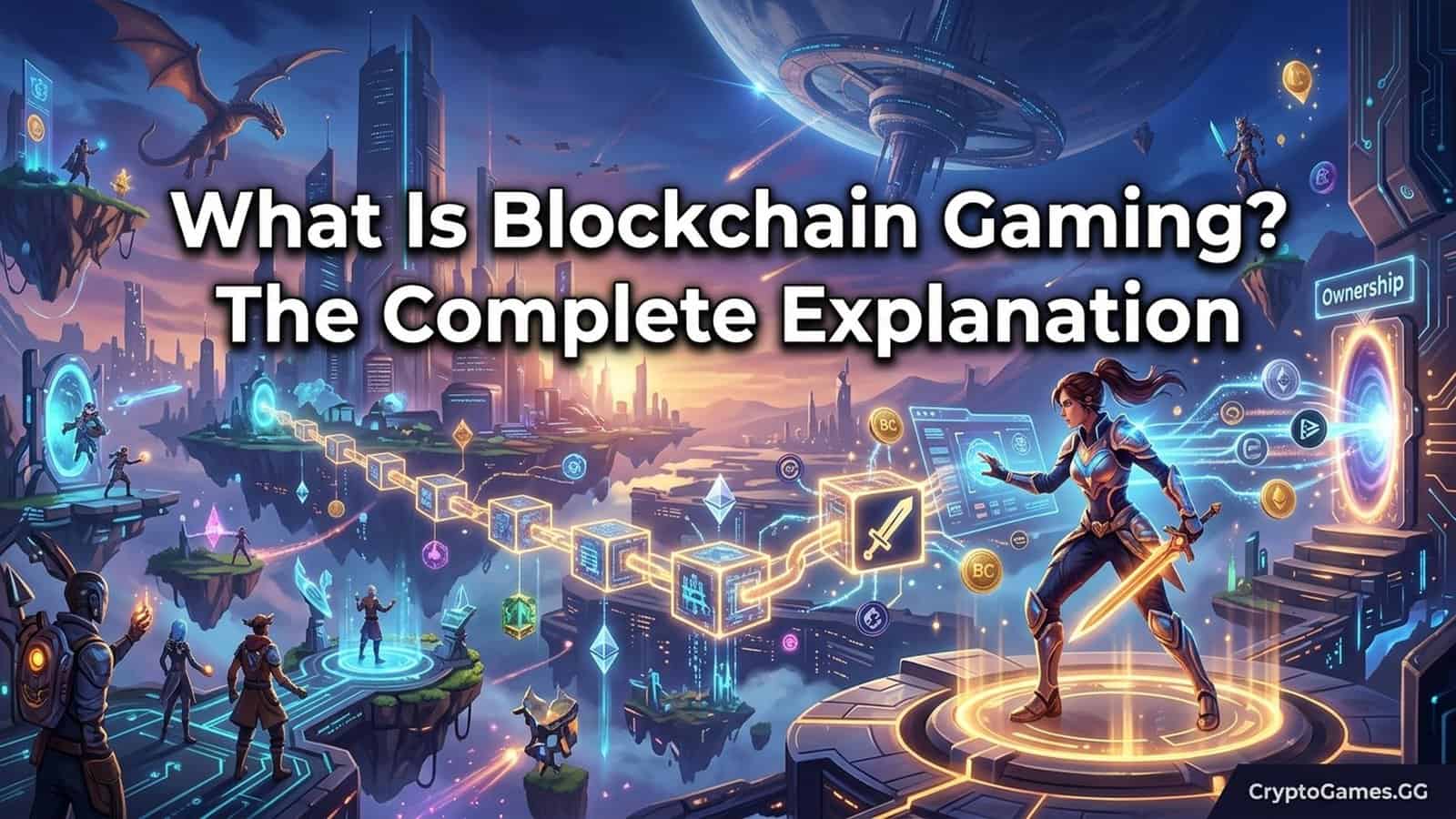
Blockchain gaming shifts ownership from the company’s private database to a public, distributed ledger. Your sword, your character, your virtual land plot are recorded on the blockchain under your wallet address. The company cannot remove them. No patch can delete them. If the game shuts down, the NFTs remain in your wallet permanently. The problem of digital item impermanence is structurally resolved.
How Blockchain Technology Works in Games
A blockchain is a distributed database replicated across thousands of computers. No single entity controls it. Every transaction is recorded permanently in sequential blocks that chain together cryptographically. Once a block is confirmed, it cannot be altered without redoing all subsequent blocks, which is computationally infeasible. This is what makes blockchain records immutable.
When your in-game item is recorded on a blockchain, that record is permanent and publicly verifiable. Anyone can look up your wallet address and see exactly what you own. The game developer cannot alter that record. Third-party marketplaces can recognize it independently. Other games on the same blockchain can potentially recognize it too, enabling genuine asset interoperability.
Transaction speeds and costs vary significantly by blockchain. Ethereum, the most widely used blockchain for NFTs, processes around 15 transactions per second. Layer 2 solutions like Immutable X solve the throughput problem for gaming by batching thousands of transactions off-chain and submitting proofs to Ethereum. Dedicated gaming chains like Ronin process gaming transactions much faster at near-zero cost.
Smart Contracts: The Game Rules Engine
Smart contracts are self-executing programs stored permanently on the blockchain. They run automatically when predefined conditions are met. In blockchain gaming, smart contracts manage everything from item drops to marketplace trades to token reward distribution.
The key property is transparency. The code of a smart contract is public. Players can read the exact rules governing any aspect of a game’s economy. Item drop rates, token emission schedules, marketplace fee structures, breeding formulas. None of these need to be taken on faith. Players can verify independently that the game works as claimed.
This transparency changes the trust relationship between players and developers. In traditional gaming, a developer can secretly reduce item drop rates without players ever knowing. In blockchain gaming, any change to drop rate logic requires deploying a new smart contract, which is publicly visible on-chain. Community scrutiny acts as a check on developer behavior.
Smart contracts also enable composability. A token earned in one game can be used in a DeFi protocol on the same blockchain without any developer coordination required. The open nature of smart contracts allows an ecosystem of applications to build on top of each other.
NFTs as In-Game Assets
NFT stands for non-fungible token. Non-fungible means unique, unlike fungible assets like currencies where each unit is interchangeable with another. An NFT has a unique identifier, a permanent on-chain ownership history, and metadata that can describe any digital asset.
In blockchain gaming, NFTs represent individual in-game items. Your Axie creature, your Gods Unchained card, your Star Atlas ATLAS $0.0001502 ▼ -1.6% ship, your land parcel in The Sandbox SAND $0.06568 ▼ -12.4%. Each is an NFT with verifiable scarcity, proven ownership, and open tradability. The ERC-721 standard on Ethereum established the technical foundation. The newer ERC-721C standard enforced creator royalties on secondary sales, ensuring developers earn from resales on any marketplace.
NFT game items have three properties traditional gaming never offered. First, real scarcity. If a developer says only 500 of a rare item exist, you can verify that number independently on-chain. Second, open tradability. Because NFTs live on the blockchain, any marketplace can list them without developer permission. Third, persistence. An NFT stays in your wallet even if the game shuts down. The item exists as long as the blockchain exists.
The Leading Blockchain Gaming Networks in 2026
Ronin Network was engineered by Sky Mavis specifically for gaming. It handles high transaction volumes at near-zero cost per transaction, essential for games where players make dozens of on-chain actions per session. Ronin hosts Axie Infinity, RavenQuest QUEST $0.001029 ▼ -6.5%, and Pixels PIXEL $0.00614 ▼ -2.7%. Its focused gaming infrastructure has made it one of the most active gaming chains in 2025 and 2026.
Immutable X is the leading infrastructure for NFT-heavy gaming. It processes NFT trades gas-free for users using zero-knowledge proof technology. Gods Unchained and Guild of Guardians run on Immutable. The platform generated $330 million in NFT trading volume in 2024, outperforming Ethereum for gaming NFTs according to DappRadar’s year-end report.
opBNB is BNB Chain’s Layer 2 network optimized for gaming applications. It leads all chains by daily active gaming wallet count in 2025. Its low fees support games with very high on-chain activity frequencies. World of Dypians and Seraph: In the Darkness are among the leading titles on opBNB.
Solana processes transactions at high speed and low cost through its unique proof-of-history consensus mechanism. Star Atlas is the flagship Solana gaming title, though still completing its full development. The Phantom wallet is the standard Solana gaming wallet and the Solana ecosystem attracted multiple new studios in 2025.
Blockchain Gaming Market Size and Growth
Blockchain gaming is the largest category in Web3 by active engagement. According to DappRadar’s Q3 2025 State of Blockchain Gaming report, the sector attracted 4.66 million daily unique active wallets and held 25% of all dapp activity. That market share increased from 20.1% in Q2 2025, demonstrating growth even as other Web3 categories declined.
The global blockchain gaming market was valued at approximately $37.55 billion in 2025 and is projected to reach approximately $183 billion by 2034, growing at a CAGR of roughly 19% according to Straits Research. The play-to-earn segment leads by revenue with approximately 42% market share. North America holds 36.84% of global market share. Asia Pacific is growing fastest at a projected 21.72% CAGR through 2034.
Investment activity reflects confidence in the space. In Q2 2024, blockchain gaming investment totaled $1.1 billion, a 314% increase from the previous quarter according to DappRadar’s quarterly investment tracking. More than 2,000 game developers shifted focus to Web3 gaming in the two years leading into 2025. In 2024, the Epic Games Store added 81 new blockchain titles, signaling mainstream distribution channels are opening to blockchain games.
The Main Blockchain Game Categories
Play-to-earn RPGs and MMORPGs are the largest category by active player count. Players own characters, weapons, and land as NFTs within large online worlds. Earnings come from quests, battles, crafting, and seasonal competitive events. RavenQuest, Axie Infinity, and Pixels represent this category on Ronin Network.
Blockchain card games operate like physical trading card games except every card is a tradeable NFT. Gods Unchained on Immutable X is the most established example with consistent secondary market volume. Parallel TCG is a newer competitor with a strong competitive scene and growing community.
Metaverse platforms let players own virtual land as NFTs within digital worlds. The Sandbox and Decentraland are the most recognized names. Land ownership enables building, hosting, and developing virtual real estate. These titles involve the most speculative economics of any blockchain game category.
Strategy and simulation games use blockchain to record resource ownership and economic activity on-chain. Players own production facilities, trade raw materials, and build manufacturing chains that generate token income through economic activity rather than combat or questing.
Benefits and Limitations
| Aspect | Benefit | Real Limitation |
|---|---|---|
| Asset ownership | Permanent, on-chain verifiable | Value still depends on game popularity |
| Earning potential | Real crypto rewards for all players | Token prices are volatile and unpredictable |
| Transparency | Public smart contracts anyone can verify | Code can contain bugs or exploits |
| Trading assets | Open markets, no permission needed | Marketplaces charge fees, liquidity varies |
| Governance | Token holders vote on game decisions | Low voter participation is common |
| Onboarding | Improving with embedded wallets | Still more complex than traditional gaming |
| Game quality | Improving rapidly year on year | Most titles still lag behind Web2 games |
| Interoperability | Possible on same blockchain | Cross-chain asset portability still limited |
Frequently Asked Questions
What is the difference between blockchain gaming and NFT gaming?
NFT gaming is a subset of blockchain gaming. All NFT games require a blockchain to function, since NFTs exist on blockchains. Blockchain gaming is the broader term that includes any game using blockchain technology, including those with token-based economies but without NFT-based item ownership.
Do blockchain games work on mobile?
Many do. Axie Infinity and Pixels have mobile apps. Blockchain gaming on mobile is growing fast, with the mobile segment holding approximately 56% of the Web3 gaming market in 2025 according to market research. Embedded wallets are making mobile onboarding significantly easier in 2025 and 2026.
How do blockchain game developers make money?
Blockchain game studios earn through initial NFT sales during launches, marketplace fees on secondary NFT trading, premium game content sales, token sales, and sometimes through staking protocol fees. The open economy model means players can also earn, but developers capture ongoing revenue from the activity their games generate.
Is blockchain gaming just speculation or real gaming?
It’s both. Some blockchain games have shallow gameplay and are primarily speculative vehicles for token and NFT trading. Others, like Gods Unchained and RavenQuest, are genuine games with competitive depth and engaged player communities. The quality range is wide. Research specific games rather than making blanket judgments about the category.
What are the biggest blockchain games in 2026?
By daily active wallets, the leading games in 2025 and into 2026 include World of Dypians on opBNB, Lumiterra on Ronin Network, Token Tails, RavenQuest, and Axie Infinity. Gods Unchained maintains strong NFT trading volume on Immutable X. Rankings shift regularly as new titles launch and player interest evolves.
Blockchain gaming has moved well beyond its experimental phase. The infrastructure is mature. The player base is real. The games are improving rapidly. Whether you approach it as a gamer, an investor, or simply someone curious about where digital ownership is heading, understanding how it works puts you ahead of a shift that is still in its early chapters.