

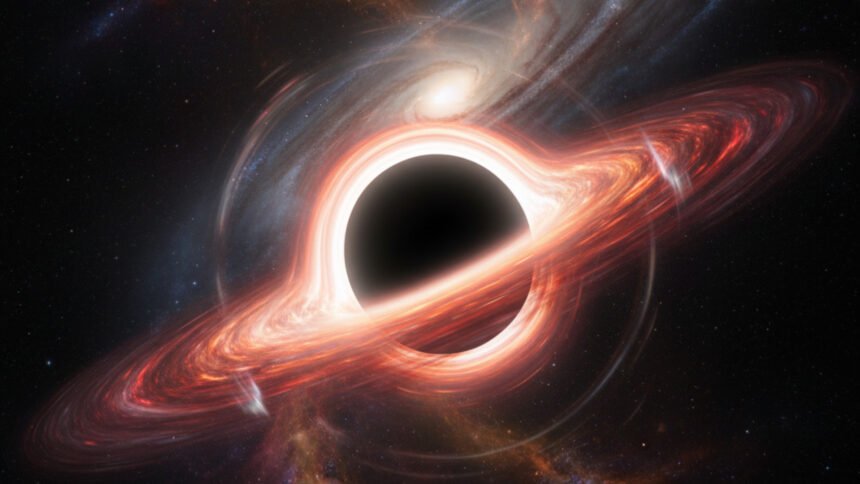
Astronomers rarely get to watch a black hole eat. This time, they did.
The James Webb Space Telescope stared at the center of a distant galaxy for nearly eight hours and traced something most observations never catch: the full path a black hole’s next meal takes on its way in. Not the aftermath. The delivery route itself.
The target was the biggest galaxy in its cluster
The observations focused on NGC 4696, the largest central galaxy in the Centaurus Cluster. It sits roughly 145 million light-years from Earth, which makes the level of detail here more surprising than the distance alone would suggest.

An international team of scientists pointed Webb’s NIRSpec instrument at the galaxy and watched. NIRSpec reads infrared light, and that’s the trick. By breaking down that light, researchers can work out how gas is moving, not just where it sits.
That weird S-shape wasn’t what it looked like
Near the galaxy’s core, there’s an odd structure shaped like an S. For a while it was just that: a shape.
The data reworked it. What looked like an S turned out to be a massive rotating disk of gas wrapped around the black hole. The disk stretches nearly 800 light-years across. And some of the gas inside it is moving fast, clocking speeds of up to 600 kilometers per second.
Following the food to its last stop
Here’s the part the astronomers found most interesting. The disk appears to connect directly to a huge filament of colder gas.
Material travels along that filament and lands in the rotating disk, where it pools before it feeds the black hole. In plain terms, the team tracked the route the meal follows all the way to its final stop.
It’s one thing to know black holes grow by pulling in gas. It’s another to map the specific pipeline feeding one, from the cold filament to the spinning disk to the point of no return.
The research was published in The Astrophysical Journal Letters.

![Linus Torvalds told AI holdouts to fork off or leave [2026]](https://cryptogames.gg/wp-content/uploads/2026/07/linus-torvalds-told-ai-holdouts-to-fork-off-or-leave-2026-150x150.jpg "Linus Torvalds told AI holdouts to fork off or leave [2026]")