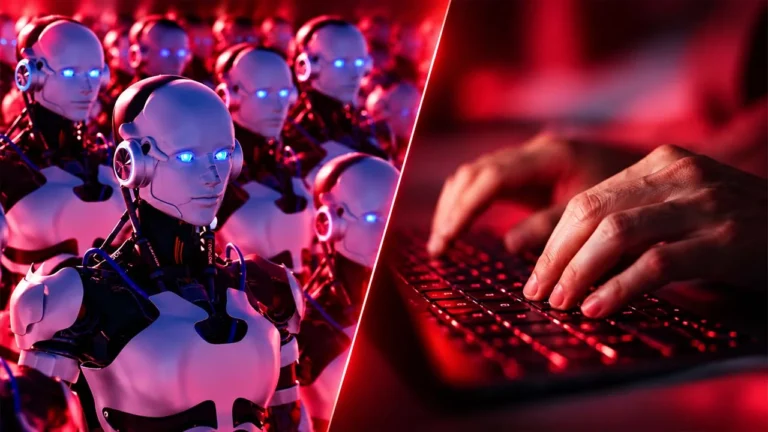
![China's robot MMA 'world first' crowned a headless winner [2026]](https://cryptogames.gg/wp-content/uploads/2026/07/chinas-robot-mma-world-first-crowned-a-headless-winner-2026.jpg "China's robot MMA 'world first' crowned a headless winner [2026]")

The winner of China’s first commercial robot fight was lying on the mat with its head knocked clean off. The loser was still standing.

That’s not a metaphor. On July 16, at the Nanshan Culture and Sports Center in Shenzhen, a black humanoid called the Bullfighter beat a white one called the Eagle 3-2 across five rounds. And in the final round, the Eagle landed a strike hard enough to pop the Bullfighter’s head off its shoulders. The scorecards had already settled it. So the crowd got the odd sight of a decapitated champion on the floor and a beaten robot upright beside it.

Welcome to URKL, which its organizers bill as the first commercial, industrial-scale free-fighting league for humanoid robots.
Two robots, one octagon
Both fighters were T800 units from the Chinese firm EngineAI. They stand 1.73 meters tall, weigh 75 to 85 kg and can hit a maximum joint torque of 450 Nm. Put simply, these aren’t tabletop toys. They’re adult-sized machines throwing punches and kicks at each other in front of a live audience.
The format borrows from MMA. Five rounds, five minutes each. Points for landed strikes and knockdowns. And, in a detail that tells you exactly what kind of show this is, points for theatrical taunts aimed at the opponent.

So the machines weren’t just fighting. They were performing. Fight nights are as much about the swagger between strikes as the strikes themselves, and URKL wrote that into the rulebook.
The knockout that didn’t count
The Bullfighter took the decision, but the Eagle owned the highlight reel. That head-removing shot is the clip everyone’s sharing, and it’s easy to see why.
“The world’s first robot MMA event just went down in China. Kicked his head clean off,” one widely circulated post read. Another summed up the disbelief in five words: “Not AI, this actually happened.”

You can watch the moment yourself. It holds up. A metal skull skittering across the canvas is the sort of thing that reads as CGI until you remember there was a paying crowd in the room.
Nobody was fighting on their own
Here’s the part the highlight clips leave out. These weren’t two autonomous fighters trading blows by their own judgment.
URKL’s rules allowed any control method. That means human commands and remote control were fair game. Autonomous systems handled the supporting jobs, things like keeping balance and getting a robot back on its feet after a fall. So the fight itself owed a lot to whoever was working the controls.
None of that makes it pointless. A brawl like this pushes balance, material durability, motion control and the ability to recover from a knockdown right to their limits. Those are hard problems, and a five-round beating is a brutal way to test them. Just don’t mistake the show for a demo of robots thinking for themselves.

About that ‘world first’ claim
Treat the “world first” label with some caution. Back in May 2025, Hangzhou hosted a boxing tournament using smaller, remote-controlled Unitree G1 robots. So humanoids have punched each other in a ring before.
What sets URKL apart is the packaging: a standing commercial league, full-size humanoids and free-fight rules, rather than a one-off exhibition. That’s the genuine claim here, and it’s a narrower one than the viral posts suggest.
The season, and the belt
URKL says the season runs on with 32 teams. The finals are scheduled for December 2026 through January 2027.
The prize the organizers are advertising is a gold belt weighing 10 kg, which they value at roughly 10 million yuan. Whether the fights stay this watchable once the novelty wears off is the open question. But if you want to know where full-size humanoid robotics is right now, skip the polished stage demos and watch the one where a champion won the belt with its head on the floor.