
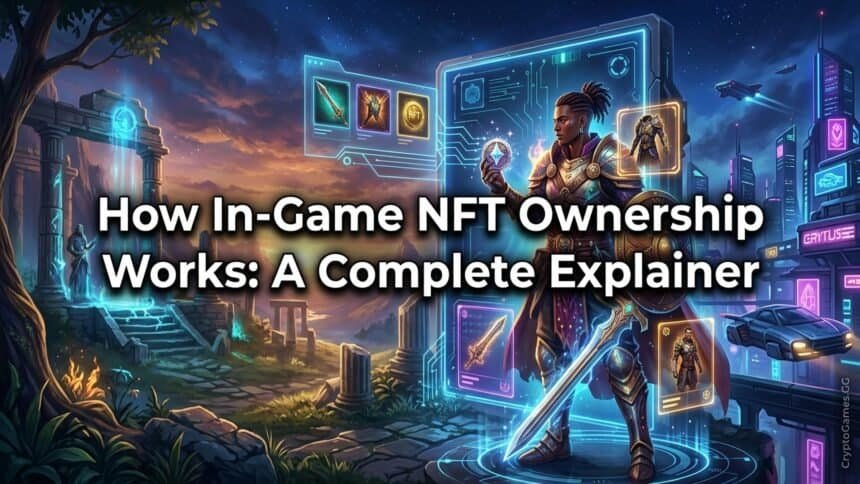
When a game says you own your in-game items as NFTs, what does that actually mean? NFT game ownership is more nuanced than most marketing suggests. You genuinely own something real. The blockchain record is permanent and the developer cannot take it away. But what you own has more limits than a physical object you could hold in your hand. This guide explains exactly how in-game NFT ownership works, what you can do with it, where the limits are, and how to verify your ownership independently.
Quick Answer: In-game NFT ownership means a blockchain record permanently associates a specific digital asset with your wallet address. Nobody can alter that record without your cryptographic signature. You can sell, transfer, or hold the NFT indefinitely. However, ownership of the token does not automatically mean ownership of the game’s source code, artwork copyright, or guaranteed in-game utility if the game shuts down. You own the token. The game developer still owns the intellectual property.
What an NFT Actually Is
NFT stands for non-fungible token. Non-fungible means unique. Unlike a dollar bill, which is interchangeable with any other dollar bill, each NFT has a unique identifier on the blockchain that distinguishes it from every other token.

An NFT is a record on a blockchain containing a unique token ID, the wallet address that currently owns it, a complete history of every previous owner, and a pointer to the asset’s metadata. The metadata describes what the NFT represents: a character’s name and stats, a card’s name and abilities, or a piece of land’s coordinates and attributes.
The token itself is what lives on the blockchain. The visual representation, the game mechanics, and the audio associated with an NFT are typically stored off-chain, often on decentralized storage systems like IPFS or Arweave. The blockchain record proves ownership and tracks transfers. The off-chain metadata describes what is owned.
What You Own When You Own a Game NFT
The blockchain token itself. The unique token ID recorded on the blockchain under your wallet address is permanently yours until you transfer or sell it. No developer can alter that ownership record. No company can take the token away. The blockchain is the authoritative record, and it is public, permanent, and independently verifiable.
The right to transfer it. Because the NFT lives in your wallet rather than a game’s database, you can send it to any compatible wallet, list it on any marketplace that supports the token standard, or include it in any smart contract interaction. You do not need the game developer’s permission to trade your NFT.
The provable history of ownership. Every previous owner of your NFT is visible on the blockchain. If your in-game character was previously owned by a famous player or won a major tournament, that history is permanently recorded and publicly verifiable. This provenance can affect an NFT’s value the same way an original owner affects the value of a physical collectible.
The metadata pointer. Your NFT contains a reference to its metadata file, which describes what the NFT actually is. For well-built games that store metadata on decentralized storage like IPFS or Arweave, this reference is permanent. For poorly built games that store metadata on centralized servers, the description can be altered by the developer, though the token ownership record remains.
What You Do Not Own
The underlying intellectual property. Your Axie NFT character is not a license for you to use the Axie brand or create derivative works with the Axie character design. The copyright for the art, characters, and game world remains with Sky Mavis. What you own is a specific token on the blockchain, not a license to the underlying creative work.
The game itself. Your ownership of in-game NFTs does not give you any rights to the game’s source code, server infrastructure, or game design. The developer still controls what the game does, how it updates, and what changes to make to game mechanics that affect your NFTs’ in-game utility.
Guaranteed in-game utility. If the game shuts down, your NFT continues to exist on the blockchain. But the game that gave it utility no longer runs. The asset is yours, but it has lost the context that made it valuable. Ownership of the token is permanent. The game utility the token provides depends on the game continuing to operate.
Fixed rarity or stats. While the token itself is immutable, a game can update the off-chain metadata that describes your token’s stats or abilities if the metadata is stored in a centralized location the developer controls. Well-designed games store metadata on decentralized storage to prevent this. Always check where a game stores its NFT metadata before assuming your assets’ properties are fixed.
How to Verify Your NFT Ownership On-Chain
Blockchain ownership verification is one of NFT gaming’s most powerful features. You can confirm your ownership independently without relying on any company or platform.
- Find your blockchain explorer. For Ethereum-based NFTs, use Etherscan (etherscan.io). For Ronin, use the Ronin explorer. For Solana, use Solscan.
- Search your wallet address. Enter your wallet’s public address in the explorer’s search bar.
- View your token holdings. The explorer will show all tokens associated with your address, including ERC-721 NFTs.
- Verify specific token ownership. You can also look up a specific NFT by its contract address and token ID to see who currently owns it. The current owner field shows the wallet address that holds it.
- Check ownership history. The transaction history for any token shows every owner since the token was minted, confirming the full provenance chain.
This verification is public. Anyone can confirm who owns any NFT on any public blockchain. This transparency is both the strength and the limitation of on-chain ownership: your ownership is permanently verifiable, and so is every transaction you have ever made.
How NFT Ownership Differs by Asset Type
Character NFTs like Axie Infinity’s Axies are among the most complex because they have evolving properties. Breeding creates new NFTs. The parent Axie’s breeding count changes. These state changes are recorded on-chain, but they mean the NFT’s on-chain record can change over its lifetime even though ownership remains constant.
Card NFTs like Gods Unchained cards are typically static once minted. Each card has fixed stats and properties written into its metadata at creation. The card cannot be modified after minting. This makes card NFTs among the most straightforward form of game NFT ownership because what you own today is the same asset you will own in five years.
Land NFTs like those in The Sandbox represent coordinates in a virtual world map encoded in the smart contract. The land’s position is immutable. What can be built on that land changes based on in-game mechanics and the platform’s continuing operation. The coordinate ownership is permanent. The utility of that ownership depends on the platform.
Equipment NFTs like weapons and armor in games like Illuvium typically have fixed properties at minting. Enhancement systems that upgrade equipment may create new NFTs or modify existing ones depending on the game’s design. Always understand whether upgrading changes the existing NFT or creates a new one, as this affects how you account for costs and potential gains.
What Happens to Your NFTs When a Game Shuts Down
When a blockchain game shuts down, the game servers stop running but the blockchain continues operating. Your NFTs remain in your wallet with the same ownership record as before the shutdown. The token still exists. The transfer history still exists. Your ownership still exists.
What changes is utility. An NFT that gave you access to a game now gives you access to nothing because the game no longer runs. An NFT that had marketplace value because players needed it to compete now has marketplace value only if someone believes the game will revive, or if another game recognizes and supports the asset.
In practice, most NFTs from dead games become worthless in financial terms while remaining permanently in their holders’ wallets. The blockchain ownership record is permanent. The economic value is not.
Several games have implemented token migration programs after shutdowns or pivots, allowing holders to exchange old NFTs for new ones in a successor product. This is not guaranteed and depends entirely on the development team’s decision to honor the transition. It represents good practice but not a contractual right.
How Developers Can Still Affect Your NFTs
Understanding where developer control ends is as important as understanding what you own. Despite blockchain ownership, developers retain significant influence over your NFT’s value and utility.
Game mechanics changes. A developer can change how an NFT functions within the game through updates to the game code. If your character’s ability is nerfed in a balance patch, the NFT itself is unchanged on-chain, but its competitive value drops. You cannot prevent this any more than you can prevent a traditional game developer from changing game balance.
Centralized metadata control. If metadata lives on developer-controlled servers rather than decentralized storage, the developer can change what your NFT is described as. This is rare and reputation-destroying if done maliciously, but it is technically possible when metadata is not stored on decentralized infrastructure.
Marketplace control. If the only marketplace for a game’s NFTs is the developer’s own platform, the developer controls trading rules, fees, and visibility. Open marketplaces give you more trading freedom, but not all games support fully open trading.
Game continuation. The most significant developer influence on NFT value is simply whether they continue operating the game. A game shutdown turns your valuable gaming NFTs into permanently owned but practically worthless tokens. No blockchain mechanism prevents a developer from shutting down their servers.
NFT Ownership vs Traditional Game Item Ownership
| Aspect | Traditional Game Items | Game NFTs |
|---|---|---|
| Ownership record | Company database, can be deleted | Public blockchain, permanent |
| Transfer rights | Typically prohibited by ToS | Open, no permission needed |
| If game shuts down | Items vanish completely | Token remains in wallet |
| Verifiable scarcity | Trust developer’s claims | Verify independently on-chain |
| Secondary market | Prohibited or unofficial | Open marketplace trading |
| Developer can remove | Yes, entirely | No, ownership record permanent |
| Developer can nerf | Yes | Yes, game mechanics can change |
| Copyright ownership | Developer retains | Developer retains |
| Art/IP rights | None to player | None to player (typically) |
Frequently Asked Questions
Do you truly own NFTs in games?
You truly own the blockchain token. That ownership is permanent and no developer can override it. What you do not own is the game’s intellectual property, guaranteed in-game utility, or the game’s continued operation. NFT game ownership is real and meaningfully different from traditional game item access, but it has specific limitations that traditional ownership language might not imply.
Can a developer take back your game NFTs?
No. A developer cannot alter the blockchain ownership record. Your NFTs stay in your wallet regardless of what the developer does. However, a developer can stop running the game that gives those NFTs utility, can change the game mechanics that affect how those NFTs perform, or can revoke a player’s access to their own platform interface. The token ownership is permanent. The game utility it provides is not.
What happens to in-game NFTs if the blockchain shuts down?
Major blockchains like Ethereum, Solana, and the Ronin Network are not controlled by single companies and have no realistic shutdown scenario. A specific game can shut down, but the blockchain it runs on continues operating. Your NFTs remain accessible and transferable as long as the underlying blockchain operates, which for major chains is effectively indefinite.
How do I know my game NFTs are safe?
Your NFTs are safe in your wallet as long as your seed phrase is secure. The security risk is not the blockchain itself, which is extremely robust. The risk is personal wallet security. Keep your seed phrase offline and secure, use hardware wallets for significant holdings, and never approve unknown smart contract interactions. Wallet security is entirely your responsibility.
Can you sell game NFTs without the developer’s permission?
Yes. Because the NFT lives on the blockchain rather than the developer’s database, you can list it on any compatible marketplace without needing developer approval. The developer cannot block you from selling your NFT, though they can choose not to integrate third-party marketplaces into their game’s interface. The ability to trade exists at the blockchain level regardless of what the developer does with their platform.
In-game NFT ownership is a genuine innovation in the relationship between players and games. The permanence of blockchain ownership records, the freedom to trade without developer permission, and the verifiability of asset scarcity are all real improvements over traditional game item systems. Understanding precisely what you own and where the limits are lets you engage with NFT gaming with accurate expectations rather than marketing-inflated ones. That clarity is the foundation for making good decisions in the space.