

Bitcoin stands at a pivotal juncture as analysts warn that its growing correlation with traditional financial markets could amplify downside risk. With macroeconomic uncertainty looming and equities faltering, some experts caution that Bitcoin could suffer corrections as steep as 50% if broader conditions deteriorate.
While this outlook may appear bearish in the short term, it also reflects a broader shift in how the crypto market is evolving. Investors are not only tracking Bitcoin’s direction but also exploring emerging sectors within Web3 that are less dependent on macro-driven narratives.
Among these, ecosystems built around continuous user activity, such as Playnance and its utility token G Coin, are beginning to attract attention for different reasons.

Bitcoin’s Growing Correlation With Traditional Markets
For years, Bitcoin was touted as a digital hedge against the failings of conventional finance. But recent data shows its price action is increasingly mirroring that of major US stock indices, eroding its status as an uncorrelated asset.
This correlation introduces new risks.
When stock markets slide amid interest rate hikes, recession fears, or tightening liquidity, Bitcoin is no longer immune—often following equities into the red. This growing synchronicity, analysts note, challenges the view of Bitcoin as an independent asset class and cements its place among risk assets.
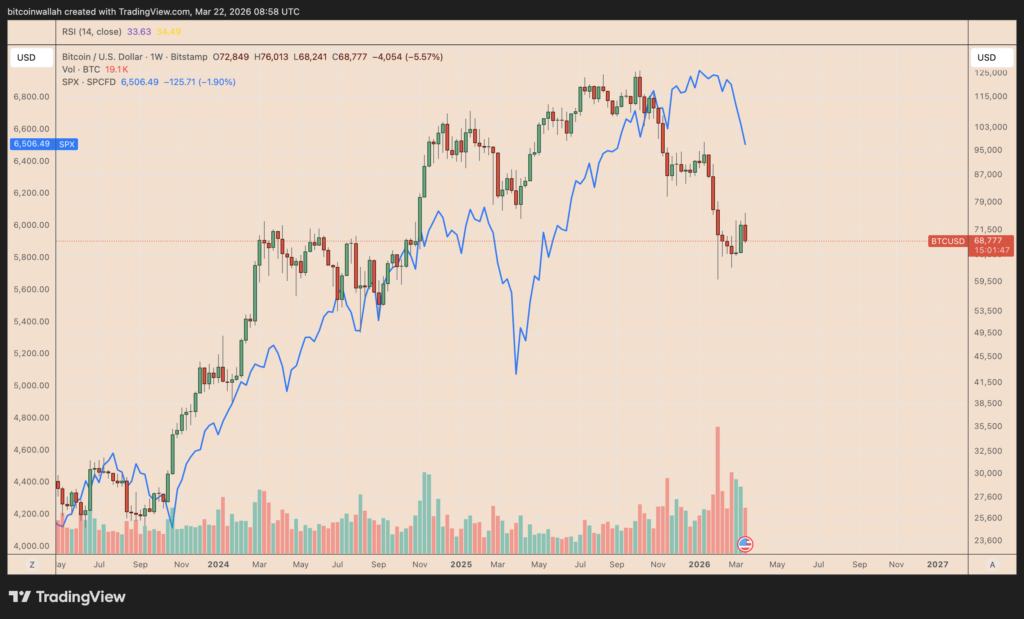
In this context, scenarios where equities experience sharp corrections could translate into significant downside pressure for BTC.
Some models indicate that, under extreme conditions, Bitcoin could revisit substantially lower price levels, especially if liquidity tightens further and investor sentiment deteriorates.
Market Uncertainty and Capital Rotation
Periods of uncertainty often lead to shifts in capital allocation within the crypto market.
When Bitcoin enters consolidation or downside phases, attention typically moves toward:
- Altcoins with strong narratives
- Infrastructure projects with long-term potential
- Ecosystems showing real usage and engagement
This capital migration doesn’t diminish Bitcoin’s relevance; rather, it underscores the crypto market’s evolution and growing appetite for projects with tangible use cases.
Recent cycles have seen a marked shift: investors are placing greater emphasis on real on-chain activity over hype and speculation.
The Rise of Activity as a Value Metric
Earlier phases of crypto were dominated by expectations.
Projects were valued based on:
- Whitepapers
- Roadmaps
- Future potential
Now, the market is asking a different question:
Which ecosystems are already being used at scale?
This shift is leading to increased attention on platforms that generate:
- High transaction volumes
- Repeat user engagement
- Continuous economic activity
Against this backdrop, platforms like Playnance are beginning to distinguish themselves.
Playnance and a Different Growth Model
Playnance represents an approach to Web3 that focuses on live, high-frequency user interaction rather than long-term speculative adoption.
The ecosystem operates across multiple digital entertainment verticals, including:
- On-chain gaming
- Prediction markets
- Sports-based interactive systems
- Real-time trading-style experiences
Instead of relying on future user onboarding, the platform is built around existing participation and ongoing activity.
At the center of this ecosystem is G Coin, which functions as the transactional layer connecting all interactions.
Every action within the platform is executed through G Coin, making it a constantly utilized asset rather than a passive store of value.
A Usage-Driven Economic Structure
One of the key distinctions of G Coin is that its demand is generated internally.
Within the Playnance ecosystem, usage comes from:
- Game participation
- Predictions and event outcomes
- Reward distribution systems
- Transaction flows across integrated platforms
This creates a self-sustaining loop where activity directly influences token demand.
As participation increases, so does the need for G Coin within the system.
This model contrasts with assets like Bitcoin, where demand is often influenced by macroeconomic conditions, institutional flows, and investor sentiment.
Infrastructure Designed for Continuous Activity
G Coin operates on PlayBlock, an infrastructure layer designed to support large-scale interaction without the friction commonly associated with blockchain systems.
Key characteristics include:
- Gasless transactions
- Fast execution speeds
- Non-custodial architecture
- A simplified user experience comparable to traditional digital platforms
This design allows users to interact with the ecosystem seamlessly, without needing to navigate complex blockchain processes.
The result is an environment where participation is easier, faster, and more consistent.
Scale and Existing Network Activity
Perhaps most striking about Playnance is its current scale of operations.
Current activity levels include:
- Around 2 million transactions per day
- Thousands of active games running continuously
- Millions of interactions across prediction and entertainment formats
- A global network of partners, affiliates, and platforms
This level of engagement places it among a smaller group of Web3 ecosystems that are already functioning at high capacity.
Instead of chasing future adoption, Playnance is already operating at scale—a rare feat in the Web3 world.
Token Design and Supply Dynamics
G Coin is structured with a fixed total supply of 77 billion tokens, with no additional minting planned.
Instead of traditional burn mechanisms, the ecosystem uses a time-based lock model.
When tokens are used within gameplay or platform interactions, they are temporarily removed from circulation before being gradually reintroduced.
This creates a dynamic where supply availability is influenced by real usage patterns rather than arbitrary reductions.
The approach aims to balance liquidity, stability, and long-term ecosystem growth.
Bitcoin and Activity-Based Ecosystems: Two Different Narratives
Bitcoin and ecosystems like Playnance represent fundamentally different narratives within the crypto market.
Bitcoin:
- Driven by macroeconomic factors
- Influenced by institutional investment
- Increasingly correlated with traditional markets
- Viewed as a store of value or risk asset
Playnance:
- Driven by user participation
- Built around continuous engagement
- Demand tied to ecosystem activity
- Focused on digital entertainment and interaction
These models do not compete directly, but they reflect the expanding scope of what blockchain technology is being used for.
Bitcoin remains the dominant asset in the crypto market, but its growing correlation with traditional financial systems introduces new variables that investors must consider.
Potential downside scenarios highlight the importance of diversification within the digital asset space.
At the same time, the rise of ecosystems built on real, measurable activity is reshaping how value is perceived in Web3.
Playnance and G Coin illustrate this shift, showing how continuous user engagement can create a different kind of demand model, one that is less dependent on macro trends and more closely tied to participation.
As the market evolves, both narratives may continue to coexist.
Bitcoin as a macro-driven asset.
And activity-driven ecosystems as a new layer of growth within the broader Web3 economy.