

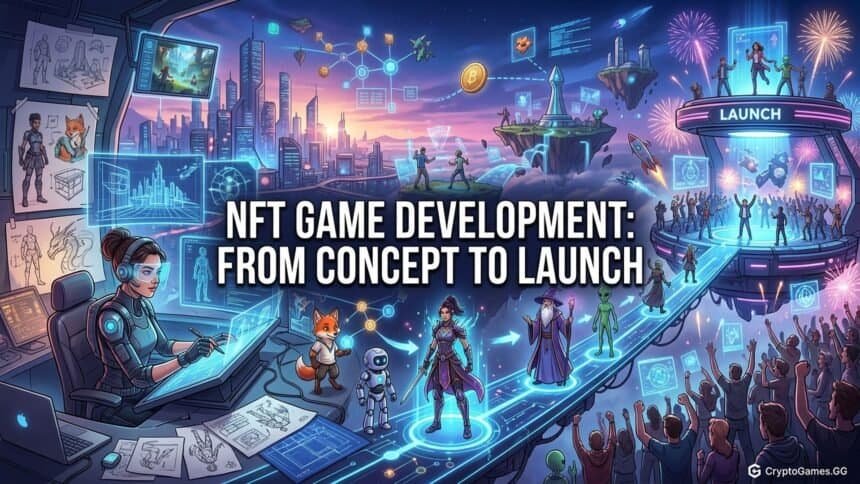
NFT game development is the process of building a video game where in-game items exist as blockchain-based non-fungible tokens that players genuinely own. The process combines traditional game design and engineering with smart contract programming, NFT standards, wallet integration, and tokenomics design. This guide walks through the complete development process from initial concept to public launch.
Quick Answer: NFT game development follows eight stages: concept and design (including tokenomics), technology stack selection, game client development, smart contract development, wallet and NFT integration, internal testing, security auditing, and staged public launch. The most common mistakes are skipping tokenomics design until late in development and launching without security audits. A minimal viable NFT game typically takes 6 to 12 months for a small team with relevant experience.
Stage 1: Concept and Design
NFT game development starts with two parallel design tracks that must integrate before any code is written: game design and economic design.

Game design covers the core gameplay loop, genre, target audience, and what in-game items will be NFTs versus non-NFT assets. Not everything should be an NFT. Items that require genuine scarcity and player ownership to create value should be NFTs. Items that are pure progression markers or temporary consumables often do not need to be on-chain, and making them NFTs adds unnecessary complexity and cost.
Economic design covers how the token economy works: what tokens exist, how they are earned, how they are spent, how supply is managed, and how developer and investor allocations vest over time. Design this before writing any contracts. Changing token economic parameters after launch requires new contract deployments and governance processes that are costly and slow.
The integration question is critical: how does gameplay generate token earnings in ways that are fun rather than feeling like work? Games where earning mechanics are designed around engaging gameplay loops are fundamentally more sustainable than games where earning mechanics are bolted onto otherwise dull activity designed primarily to distribute tokens.
Stage 2: Technology Stack Selection
Game engine. Unity for most 2D and mobile games. Unreal Engine for high-end 3D. Godot for indie teams prioritizing open-source tools. Web-based frameworks for browser games. The game engine choice affects available blockchain SDKs — Unity has the best blockchain integration tool coverage with Unity-specific SDKs from Immutable, Sequence, Thirdweb, and Alchemy.
Blockchain. The selection criteria from Stage 1 inform this choice. For most new NFT game projects in 2026, the practical shortlist is Ronin Network (gaming ecosystem focus, active player base), Immutable X (gas-free NFT trading, strong Unity SDK), Polygon (established infrastructure, Ethereum security, moderate costs), or an Avalanche Subnet for teams wanting custom chain parameters.
Smart contract language. Solidity for EVM-compatible chains. Rust for Solana. The majority of NFT games use EVM-compatible chains, making Solidity proficiency the most practically valuable blockchain development skill.
Backend infrastructure. Traditional game backend systems handle matchmaking, game state, player profiles, and analytics. These are separate from blockchain infrastructure. Most teams run standard backend infrastructure (Node.js, PostgreSQL, Redis) alongside their blockchain layer rather than putting all game state on-chain.
Stage 3: Game Client Development
Game client development for NFT games follows the same processes as traditional game development with one important addition: the game must communicate with blockchain infrastructure throughout.
The core game loop, art assets, sound design, and gameplay mechanics are built using standard game development practices. The blockchain layer is integrated progressively rather than built first and wrapped in a game later.
Inventory display requires fetching NFT data from the blockchain for each player session. This should use a fast indexing API (Alchemy NFT API, Moralis, or chain-specific equivalents) rather than direct blockchain queries, which are too slow for real-time game interfaces.
Transaction flows within the game need careful UX design. Every time a player mints an NFT, completes a trade, or burns a token, a blockchain transaction occurs. Designing transaction confirmation feedback, error handling, and transaction pending states affects game feel significantly. Players who wait for transactions without feedback assume the game has crashed.
Stage 4: Smart Contract Development
NFT game smart contracts fall into four categories. Each requires careful design before implementation.
NFT contracts. Define how in-game items are minted, transferred, and burned. Use OpenZeppelin’s ERC-721 or ERC-1155 base contracts. Add game-specific metadata standards and royalty enforcement through ERC-2981 or ERC-721C depending on the chain. Test minting, transfer, batch operations, and royalty calculations exhaustively in a local environment before deployment.
Token contracts. Governance token contract with fixed or controlled supply. Utility token contract with minting controlled by reward distribution contracts. Both use OpenZeppelin ERC-20 base. Implement access control so only authorized contracts can mint new tokens. Unconstrained minting access is a critical security vulnerability.
Game economy contracts. Staking, crafting, breeding, tournament management, and reward distribution contracts. These are where game-specific logic lives. Use a proxy pattern to enable bug fixes post-launch without migrating user data. Document the proxy upgrade process clearly in governance terms so players understand how upgrades are controlled.
Marketplace contracts. If building a custom marketplace, escrow contracts must handle the atomic swap of NFT ownership and payment simultaneously. Both sides of the trade must execute or neither does. Use existing audited marketplace infrastructure (Seaport, OpenSea’s protocol) where possible rather than building custom escrow from scratch.
Stage 5: Wallet and NFT Integration
Wallet integration determines how players authenticate and interact with on-chain features. Choose between external wallet integration (MetaMask, Phantom), embedded wallet SDK (Sequence, Privy), or a combination that supports both.
NFT display in-game requires fetching token ownership data efficiently. Implement a polling mechanism that refreshes inventory data after each transaction rather than querying continuously. Cache NFT metadata client-side to minimize redundant network calls.
Marketplace integration, if using a built-in marketplace, requires listing flow UI, offer management, and transaction completion handling. If using an external marketplace, provide deep links to the player’s items on that marketplace from within the game.
Test all wallet interaction flows with multiple wallet types, network conditions, and edge cases: transaction rejection, network congestion, insufficient gas, pending transactions, and wallet disconnection mid-flow. These edge cases cause the majority of player-facing bugs in NFT game launches.
Stage 6: Testing
NFT game testing covers three domains. Game client testing follows standard QA practices: functional testing, performance testing, and user experience testing across target platforms and hardware configurations.
Smart contract testing uses dedicated blockchain testing frameworks: Hardhat or Foundry for EVM contracts, Anchor for Solana. Test every function with edge cases, adversarial inputs, and reentrancy scenarios. Use formal verification tools like Certora for the most critical contract functions handling significant value.
Integration testing covers the full flow from game action to on-chain execution to result display. Test on testnet environments that mirror production before launching. Most chains have free testnets with faucet tokens for testing. Identify the point in your development process where you switch from local blockchain to testnet to mainnet and plan your testing phases accordingly.
Stage 7: Security Auditing
Security auditing is non-negotiable for any NFT game handling real player assets. The basic process involves selecting a reputable audit firm, preparing documentation, completing the audit, remediating findings, and conducting a follow-up review of fixes.
Submit a complete audit package: all contract source code, documentation of expected behavior, unit tests, and deployment scripts. The more complete your documentation, the more efficiently auditors can find actual vulnerabilities rather than spending time understanding intent.
Common NFT game vulnerabilities auditors look for: reentrancy attacks in contracts that transfer tokens, integer overflow in reward calculations, access control failures that allow unauthorized minting, signature replay attacks in meta-transaction systems, and oracle manipulation in contracts that use price data for calculations.
After the audit, prioritize and fix all high and critical findings before launch. Do not launch with unresolved critical vulnerabilities. Medium findings should also be addressed before launch where feasible. Low-risk informational findings can be addressed in post-launch updates per the audit firm’s guidance.
Stage 8: Launch Strategy
NFT game launches require coordination between the technical deployment and the community/marketing launch. Deploy smart contracts and verify them on the chain’s block explorer before the public launch. Share the verified contract addresses publicly so players and security researchers can review the code independently.
Staged launch reduces risk. A closed alpha with trusted players tests core mechanics under real conditions with limited exposure. An open beta expands to a broader audience. Full launch follows after beta issues are resolved. Rushing to full public launch without beta testing is how preventable bugs become public scandals.
Establish a public security disclosure policy and a bug bounty program. Community security researchers who find vulnerabilities should have a clear, rewarded path to report them. Bug bounty platforms like Immunefi specialize in smart contract bug bounties for blockchain projects.
NFT Game Development Cost Estimates
| Project Type | Team Size | Timeline | Estimated Cost |
|---|---|---|---|
| Simple NFT integration into existing game | 1-2 developers | 2-6 months | $20K-$80K |
| Indie NFT game from scratch | 3-5 developers | 6-12 months | $150K-$500K |
| Mid-tier NFT game (card game, RPG) | 10-20 team members | 12-24 months | $1M-$5M |
| AAA NFT game (Illuvium tier) | 50+ team members | 24-48 months | $10M+ |
Frequently Asked Questions
How much does it cost to develop an NFT game?
Costs range from $20,000 for simple NFT integration into existing games to over $10 million for AAA-quality blockchain games. The primary cost drivers are team size, development timeline, smart contract auditing costs, and whether you are building on existing game code or starting from scratch. Security auditing alone costs $10,000 to $150,000 depending on contract complexity.
Do you need to code smart contracts to build an NFT game?
Not necessarily for basic integration. Platforms like Thirdweb provide pre-audited contract templates that game developers can deploy without writing custom Solidity. For unique game mechanics, custom rewards distribution, or specialized tokenomics, smart contract development expertise is required. Hybrid approaches use templates for standard token functions and custom code only for game-specific logic.
What is the hardest part of NFT game development?
Most experienced NFT game developers identify tokenomics design as the hardest part, not technical implementation. Getting the technical stack working is achievable with sufficient investment. Designing an economy that remains sustainable as player counts, token prices, and market conditions change is the problem that most failed NFT games did not solve adequately.
NFT game development is genuinely challenging and genuinely rewarding. The games that launch in 2026 and sustain player communities through multiple market cycles will be the ones that treated both the game design and the economic design with the rigor those disciplines deserve. The technical tools exist. The real differentiator is the quality of thinking that goes into using them.








[…] play-to-earn game development guides focus on the technical stack. This guide focuses on the decision that determines whether […]