
In Brief:
- At least nine web3 games have paused operations or pivoted to web2 this year, following 18 studio and game closures in the first five months of 2025. Wildcard, once one of the sector’s highest-profile titles, shut down multiplayer on April 27 after burning through $55 million.
- Venture capital funding in gaming has been dry for years, according to Sandbox CEO Robby Yung, and crypto funds largely stopped writing checks in mid- to late 2023.
- A 200% year-over-year rise in web3 gaming token launches hasn’t translated to sustainability, with the average project lifespan sitting at roughly four months.
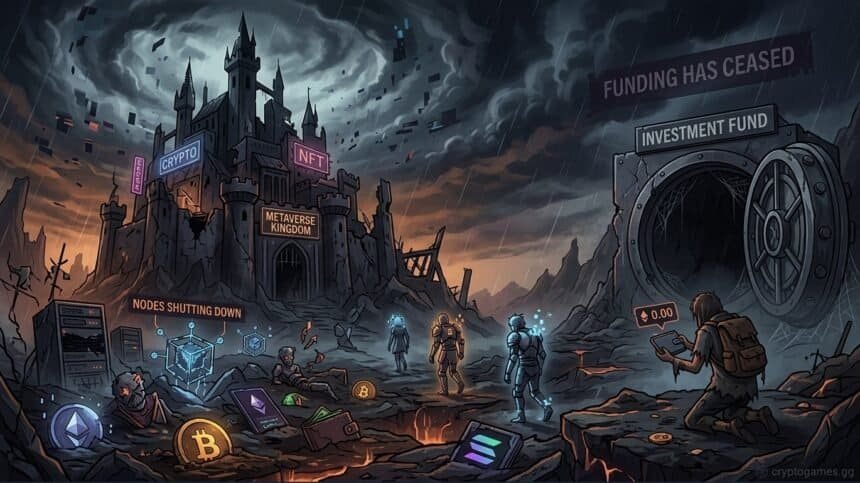
The list of dead and dying web3 games keeps growing. Nine titles have either halted operations or pivoted to web2 this year alone, and the funding environment that might have kept them alive has all but evaporated.
Wildcard’s $55M collapse
The most high-profile closure this year is Wildcard, the 2v2 card MOBA that shut down all multiplayer operations on April 27 alongside its Thousands Network prediction market and the Wildcard Premier League.

Wildcard raised approximately $55 million: a $46 million Series A in 2022 led by Paradigm with Framework and Benchmark, followed by another $9 million in May 2025 from Arbitrum Gaming Ventures and Paradigm. The Thousands Network prediction market pulled roughly $800,000 from the community on top of that.
What $55 million built was a game with one map, mixed Steam reviews (63% positive from 115 reviews), and zero crypto integrations in the actual product. The Wildcard Alliance, operating under Playful Corp, spent six years in development as a US-based studio targeting AAA production values. The development effort was real and substantial. But the gameplay direction didn’t land; the game shipped at an estimated 40% completion in October 2025, with early access, and it lasted six months.
The team acknowledged the outcome directly: neither the game nor the protocol was profitable. Remaining $WC tokens will be burned. Franchise managers in the WPL will receive USDC from whatever’s left in the treasury. The Thousands Network keeps KYC services running until May 7, with Season 1 prize payouts beginning May 8 and a KYC deadline of May 10.
The casualties keep stacking
Wildcard isn’t alone. Pixel Heroes Adventure laid off its entire team, citing “unavoidable circumstances.” 77-Bit paused development over infrastructure challenges. XOCIETY suspended its live service NFT game, with developer NDUS Interactive exploring a potential sale or merger. Sidus Heroes shut down entirely after more than four years, citing an unsustainable market shift and the broader collapse of NFT and metaverse demand, alongside the rise of AI-driven competition.
Earlier this year, Bloktopia, Pixiland, Forgotten Runiverse, GENSO Online, and KTTY World also shut down or shifted gears. And the pattern isn’t new. Crypto poster @StarPlatinum_ tracked over 30 different web3 studios and games that shuttered operations across the last months of 2025.
The money dried up
The core problem is straightforward: venture capital stopped flowing and never came back.
“Venture capital funding in gaming has been dry for years,” Robby Yung, CEO of The Sandbox, said, adding that many studios’ resources are reaching their limits.
Theodore Agranat, web3 director at Gunzilla Games, echoed the point, acknowledging a widespread lack of funding among his venture-capital contacts. Gunzilla itself, known for Off The Grid, faced employee payment delays earlier this month, with some staff reporting unpaid wages after months of work.
Chris Heatherly, formerly of Great Big Beautiful Tomorrow, traced the freeze to 2023. “Towards the end of 2023, mid-2023, crypto funds stopped deploying and writing checks,” Heatherly said, pointing to unrealistic return expectations that bred impatience among investors.
The mainstream games industry isn’t faring much better. Epic Games, Ubisoft and EA have all made significant staff reductions. Meta shut down its virtual reality project Horizon Worlds earlier this year.
Tokens launch, games don’t last
Web3 gaming saw a 200% year-over-year rise in token launches, but that volume hasn’t translated into viability. The average web3 game project lasts about four months.
The reasons are familiar. Developers focus on promoting tokens with minimal utility rather than building games people want to play. Tokenomics get designed before gameplay loops are proven. Communities get treated as liquidity sources rather than player bases. Wildcard’s Thousands Network illustrated the pattern clearly: a prediction market built around one unfinished game where viewers spent real money on match outcomes and received $WC tokens for a product with no live economy. The community never got meaningful token utility while the game was running.
The consequences are compound. Poor user experience, thin gameplay, broken economic models and security risks all erode trust. The $615 million Ronin Network hack remains the most visible example, but smaller failures chip away at confidence daily. Bots exploiting earn mechanics hollow out whatever organic player activity exists.
A “build it, and they’ll come” approach has proven ineffective. The broader games industry confirms this: a 2023 survey showed 83% of mobile games fail within three years of launch. Building a game that lasts is hard even without a blockchain attached.
Some projects survive
Not every web3 game has collapsed. Alien Worlds has maintained operations since 2020, evolving from an NFT trading card game into a broader ecosystem with mini-games, tournaments, and player-run DAOs. Splinterlands, live since 2018, has sustained itself through regular gameplay updates and community-driven governance via a DAO. Its $500,000 Crypto Gaming Recovery Fund was set up to support players affected by failures elsewhere in the sector.
What separates the survivors from the dead isn’t complicated on paper: engaging gameplay, genuine community investment, and economic models that don’t depend on a constant influx of new money. In practice, very few teams manage all three.
The web3 gaming sector launched hundreds of tokens this year. Most of the games behind them won’t be around to see 2027.