

Account Abstraction (AA) is an approach to redesigning how accounts work on Ethereum. Its goal is to make crypto wallets more flexible, programmable, and user-friendly, closer to the seamless experience people expect from traditional Web2 applications. Instead of forcing users to manage rigid, key-based wallets, Account Abstraction allows accounts to behave like smart contracts, enabling new functionality and significantly improving usability.
Understanding the Current Account Model
Ethereum currently supports two types of accounts, each with distinct limitations.
Externally Owned Accounts (EOAs) are controlled by private keys. These are the standard wallets most users interact with today, such as MetaMask. EOAs can initiate transactions, but they cannot include custom logic or automation.

Smart Contract Accounts, on the other hand, are controlled by code. They can include complex logic such as multi-signature approval, spending limits, or automated actions. However, they cannot initiate transactions on their own.
This separation creates friction. EOAs are simple but limited, while smart contracts are powerful but dependent on EOAs to function.
What Account Abstraction Changes
Account Abstraction aims to unify these two account types into a single, more flexible model. Instead of relying on EOAs to initiate transactions and separate contracts to execute logic, users can interact through smart contract-based accounts that do both.
This means accounts can:
- Execute transactions
- Contain custom logic
- Interact directly with applications without relying on traditional wallet behavior
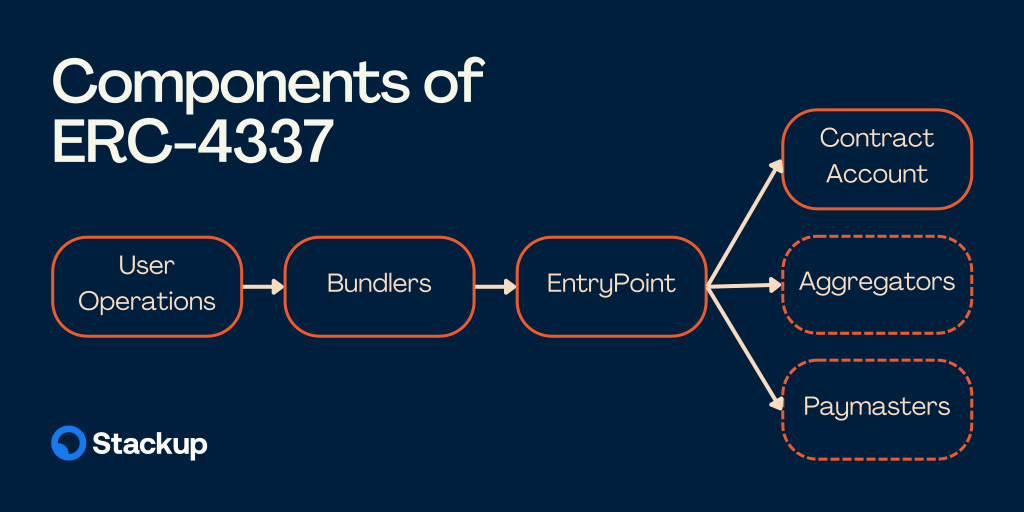
The most widely used implementation of this concept today is ERC-4337, which introduces a standardized way to enable Account Abstraction without requiring changes to Ethereum’s core protocol.
Is Account Abstraction Just ERC-4337?
Account Abstraction is a broader concept, while ERC-4337 is a specific implementation that makes it practical on Ethereum today.
Before ERC-4337, projects like Safe and Argent already used smart contract wallets to enable features such as multi-signature transactions and social recovery. However, these solutions were not standardized and often required custom infrastructure or protocol-level changes.
ERC-4337 introduces a common framework that allows smart accounts to behave like traditional wallets while maintaining compatibility across applications, wallets, and services. This standardization is what makes Account Abstraction scalable across the ecosystem.
How It Improves User Experience
Traditional Web3 interactions often involve multiple steps. For example, a user might need to approve a token, confirm a transaction, and pay gas fees in ETH. Each step requires separate confirmations, creating friction and confusion.
With Account Abstraction, these steps can be combined into a single interaction. Transactions can be bundled together, reducing the number of approvals required. Users can also pay fees in tokens other than ETH, or have those fees covered by an application.
This results in a smoother, more intuitive experience that reduces the complexity typically associated with blockchain interactions.
Key Capabilities Enabled by Account Abstraction
One of the most important features is transaction bundling. Multiple actions can be executed in a single transaction, eliminating the need for repeated confirmations.
Another key feature is gas abstraction. Applications can sponsor transaction fees or allow users to pay fees in different tokens, removing the requirement to hold ETH.
Session-based permissions are also possible. Users can grant temporary access to applications, allowing actions to be performed without repeated wallet confirmations. This is particularly useful in gaming environments.
Account recovery becomes more flexible as well. Instead of relying solely on private keys, users can recover access through social mechanisms or predefined recovery rules.
Finally, delegation allows users to separate risk. A secondary account can interact with applications while the primary account securely holds valuable assets.
Why Account Abstraction Matters for Gaming
Web3 gaming has struggled with onboarding due to the complexity of wallets and transactions. Players are often required to install a wallet, store private keys, fund accounts, and approve multiple transactions before they can even begin playing.
Account Abstraction changes this dynamic by enabling a more seamless experience. Players can log in using familiar methods such as social accounts, interact with the game without constant confirmations, and avoid direct exposure to blockchain complexity.
In many cases, the wallet becomes invisible to the user. This allows developers to design experiences that feel similar to traditional games, which is essential for mainstream adoption.
Addressing a Common Misunderstanding
A common question is whether Account Abstraction simply combines wallets and contracts into one.
Conceptually, this is close to the truth. However, the more accurate explanation is that Account Abstraction introduces a new type of account that is both programmable and capable of initiating transactions.
Rather than merging two systems, it replaces them with a more flexible model that supports both behaviors natively.
Account Abstraction represents a fundamental shift in how users interact with blockchain systems. By replacing rigid, key-controlled accounts with programmable smart accounts, it enables more powerful applications and significantly improves user experience.
While the concept has existed in various forms for years, the introduction of standards like ERC-4337 makes it practical at scale. This opens the door to more intuitive applications, better security models, and broader adoption, especially in areas like gaming, where user experience is critical.