
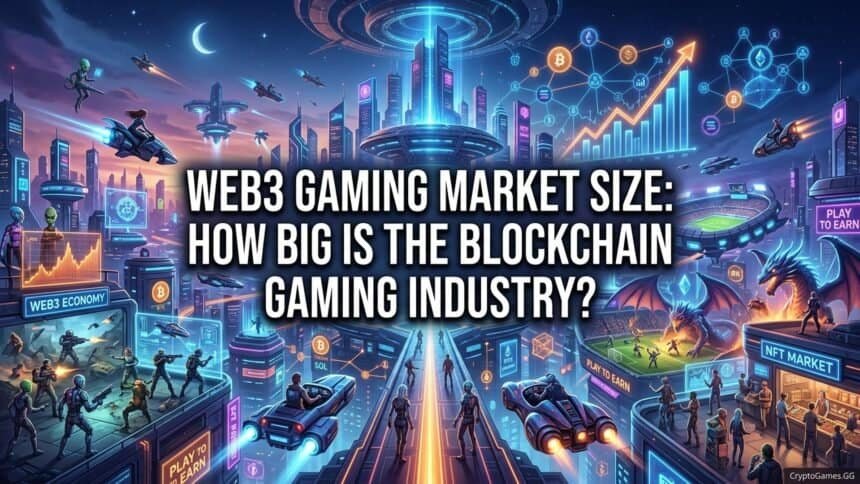
The web3 gaming market size reached approximately $37.55 billion in 2025 and is projected to exceed $180 billion by 2034. Blockchain gaming now holds 25% of all dapp industry activity by daily active wallet count, making it the largest category in the entire Web3 ecosystem. These numbers reflect a genuine market with real players, real investment, and real economic activity. This article breaks down exactly what the data shows, what drives the growth, and where the market is heading.
Quick Answer: The global web3 gaming market size was approximately $37.55 billion in 2025, growing from $31.49 billion in 2024. Independent research firms project it to reach between $117 billion and $214 billion by 2034, depending on the methodology. Blockchain gaming attracted 4.66 million daily unique active wallets in Q3 2025, representing 25% of all Web3 dapp activity. The play-to-earn segment leads with 42% to 46% revenue share.
Current Market Size: What the Data Shows
The global web3 gaming market was valued at approximately $37.55 billion in 2025 according to Straits Research, up from $31.49 billion in 2024. This represents year-over-year growth of approximately 19%. Multiple independent research firms have produced estimates in a similar range, with variation based on what each includes in their market definition.

A comparison of major research estimates for 2025:
| Research Firm | 2025 Market Value | Forecast Year | Projected Value | CAGR |
|---|---|---|---|---|
| Straits Research | $37.55 billion | 2034 | $182.98 billion | 19.24% |
| Research and Markets | $39.65 billion | 2030 | $108.08 billion | 22.1% |
| Fundamental Business | $35.74 billion | 2035 | $214.03 billion | 19.6% |
| SNS Insider | ~$41.99 billion | 2032 | $124.74 billion | 17.8% |
| Market Research Future | ~$38 billion | 2035 | ~$170 billion | ~19% |
The range reflects different market definitions, methodologies, and what each firm includes. All point in the same direction: sustained, rapid growth over the next decade driven by rising player engagement and mainstream gaming adoption of blockchain infrastructure.
Market Growth Projections to 2034
Straits Research, one of the more frequently cited sources, projects the global web3 gaming market will reach approximately $183 billion by 2034 at a compound annual growth rate of 19.24%. This projection is based on continued growth in blockchain adoption among game developers, rising NFT trading activity, expanding play-to-earn ecosystems in emerging markets, and increasing integration of blockchain mechanics into mainstream gaming distribution platforms.
The most aggressive projections, reaching over $200 billion by 2035, assume faster-than-expected quality improvements in blockchain game production and broader mainstream gaming platform adoption. The more conservative projections assume the quality and onboarding barriers remain significant through the forecast period.
What most projections agree on is the direction and approximate pace of growth. A market expanding at roughly 19% annually will roughly double every four years. By any reasonable projection, the web3 gaming market of 2030 will be several times larger than the web3 gaming market of 2025.
Daily Active Users and Engagement Metrics
Revenue-based market size figures are one way to measure the industry. Player engagement metrics often tell a more granular story about real market health.
According to DappRadar’s Q3 2025 State of Blockchain Gaming report, blockchain gaming attracted 4.66 million daily unique active wallets during Q3 2025. That represented 25% of all dapp industry activity across all Web3 categories combined. This share grew from 20.1% in Q2 2025, a meaningful increase that came even as total dapp activity declined by 22.4%.
The implication is significant: blockchain gaming was gaining market share within Web3 even during a period of broader contraction. Players were continuing to engage with blockchain games while other Web3 applications saw declining wallet activity.
Leading games by daily active wallet count in 2025 included World of Dypians on opBNB, Lumiterra, Token Tails, RavenQuest on Ronin, and Axie Infinity. The leading gaming blockchains by player activity were opBNB, Ronin Network, Sei Network, and Immutable X.
Regional Market Breakdown
North America held the largest regional market share in 2025 at 36.84% of global revenue, according to Straits Research. The US alone accounted for approximately $10.42 billion in 2024 and was projected to reach $12.89 billion in 2025. North America’s strength comes from its established gaming industry, mature cryptocurrency infrastructure, and high disposable income for digital entertainment spending.
Asia Pacific is the fastest-growing region and represents the largest player base in absolute terms. The region held roughly 45% of global market share in 2025 by some estimates, driven by 1.5 billion gamers across the region, high smartphone penetration, and strong cultural familiarity with digital economies and virtual currencies. Blockchain gaming’s economic opportunity is particularly significant in countries where average wages make crypto earnings from P2E games relatively impactful. Countries like the Philippines, Vietnam, and Indonesia were early adopters of play-to-earn gaming during the Axie Infinity era and maintain significant blockchain gaming communities.
Europe and the Middle East represent growing markets, with regulatory clarity on cryptocurrency improving in several jurisdictions, which increases confidence among both players and developers in those regions.
Market Segmentation by Game Type
The play-to-earn segment consistently leads the web3 gaming market by revenue share. Estimates range from 42% to 46% P2E revenue share in 2025, depending on the research source.
P2E games attract players who engage actively and spend more within game economies, both as participants seeking earnings and as buyers of in-game assets. This creates higher average revenue per user compared to pure collectible or metaverse games where player intent is more passive.
Hybrid models, combining P2E mechanics with subscription elements or traditional game monetization, are projected to grow at the fastest rate through 2033 and 2034. These models address the tokenomics sustainability problems that plagued pure P2E games while retaining the earning mechanics that attract and retain players.
Free-to-play blockchain games represent a growing segment as more projects remove upfront entry barriers. The shift toward free entry, combined with earning mechanics as a retention and reward tool rather than the primary attraction, reflects the industry’s evolution from the 2021 P2E boom model.
Market Segmentation by Device
Mobile devices led the web3 gaming market with a 56.65% share in 2025, driven by widespread smartphone adoption enabling accessible blockchain gaming globally. Mobile’s dominance reflects global gaming patterns more broadly. Crypto gaming is not immune to the long-term mobile migration that has characterized traditional gaming for a decade.
PC and desktop platforms held approximately 40% of revenue in 2025. Desktop’s continued strength relates to the technical complexity of many blockchain gaming experiences, wallet management, and marketplace interaction, which remains easier on desktop interfaces than mobile. Embedded wallets and better mobile UX are expected to accelerate mobile growth through the forecast period.
VR and AR represent the smallest current segment but are projected to grow fastest, with some estimates showing a CAGR above 22% through 2033. The immersive potential of virtual reality combined with blockchain ownership of virtual world assets represents an emerging convergence that several studios are actively building toward.
Investment and Funding Data
Q2 2024 was the strongest quarter for blockchain gaming investment since Q3 2022. According to DappRadar’s quarterly investment tracking, blockchain gaming attracted $1.1 billion in investment during Q2 2024, a 314% increase from the previous quarter. This surge reflected renewed institutional confidence after the post-2022 reconstruction period.
The investment went primarily to projects with proven gameplay and existing player bases, not to early-stage token sales. Immutable raised significant capital to expand its gaming blockchain ecosystem. Sky Mavis continued investing in the Ronin Network infrastructure. Several traditional game studios announced blockchain gaming investments backed by established gaming industry funds.
In 2024, the Epic Games Store added 81 new blockchain gaming titles, representing a form of market endorsement from one of the world’s largest game distribution platforms. More than 2,000 game developers shifted focus to Web3 gaming over the two years leading into 2025. Both signals indicate increasing mainstream industry acceptance beyond the crypto-native community.
Key Growth Drivers
Improving game quality. The 2021 generation of blockchain games prioritized earning mechanics over gameplay. Games like Illuvium, RavenQuest, and Off The Grid in 2025 and 2026 demonstrate that high-quality gameplay and blockchain ownership are compatible. As game quality improves, the addressable market expands beyond crypto-native players to mainstream gamers.
Embedded wallet adoption. New blockchain games increasingly embed wallet functionality directly into the game client, allowing players to sign up with Google or email. The blockchain runs invisibly. This dramatically reduces onboarding friction, expanding the accessible player base substantially.
Mainstream platform integration. The Epic Games Store’s 81-title addition in 2024 signals that major distribution channels are opening. As more blockchain games reach mainstream distribution, the audience grows far beyond the current crypto-gaming community.
Emerging market growth. Asia Pacific’s projected 21.72% CAGR through 2034 reflects the region’s large gaming population and its history of strong adoption of digital economies. Rising incomes combined with established gaming infrastructure in countries like South Korea, Japan, and increasingly Southeast Asia will expand the market substantially.
Cross-chain interoperability. Infrastructure allowing assets to move between blockchains is developing rapidly. True cross-game asset portability, still limited in 2026, could unlock a significantly larger market as players invest in assets that work across multiple games rather than being locked in single ecosystems.
Frequently Asked Questions
How big is the blockchain gaming market?
The global blockchain gaming market was approximately $37.55 billion in 2025, according to Straits Research. Multiple research firms project it to reach between $117 billion and $214 billion by 2034, growing at a compound annual rate of roughly 18% to 22%. By player engagement, blockchain gaming holds 25% of all Web3 dapp activity with 4.66 million daily active wallets as of Q3 2025.
Is the blockchain gaming market growing or shrinking?
Growing. The market increased from approximately $31.49 billion in 2024 to $37.55 billion in 2025. Daily active wallet counts grew in Q3 2025 even as other Web3 categories declined. Investment returned to record-high levels in Q2 2024. All major metrics point to continued growth rather than contraction.
Which country has the most blockchain gamers?
Asia Pacific leads by player count, with 1.5 billion gamers in the region as of 2024 per market research. The Philippines, Vietnam, and Indonesia have historically had some of the highest concentrations of active blockchain gamers relative to total population. North America leads by revenue market share at 36.84% in 2025.
What percentage of gaming is blockchain gaming?
The traditional gaming market is valued at over $200 billion annually. Blockchain gaming at roughly $37.55 billion represents approximately 15% to 18% of comparable market definitions. However, direct comparison is difficult because market definitions vary. What is clear is that blockchain gaming is growing faster than traditional gaming overall.
When will blockchain gaming go mainstream?
Elements of mainstream adoption are already happening. The Epic Games Store’s blockchain game catalog, traditional studios entering the space, and embedded wallets removing onboarding friction all represent mainstream integration rather than a future event. Full mainstream parity with traditional gaming in terms of production quality and scale is likely a 5 to 10 year horizon, with significant progress already visible in 2025 and 2026.
The web3 gaming market size numbers tell a consistent story. The market is real, it is large, and it is growing faster than most comparable entertainment sectors. Whether you approach it as a player, an investor, or a developer, understanding the scale of what has already been built provides essential context for evaluating what comes next.