
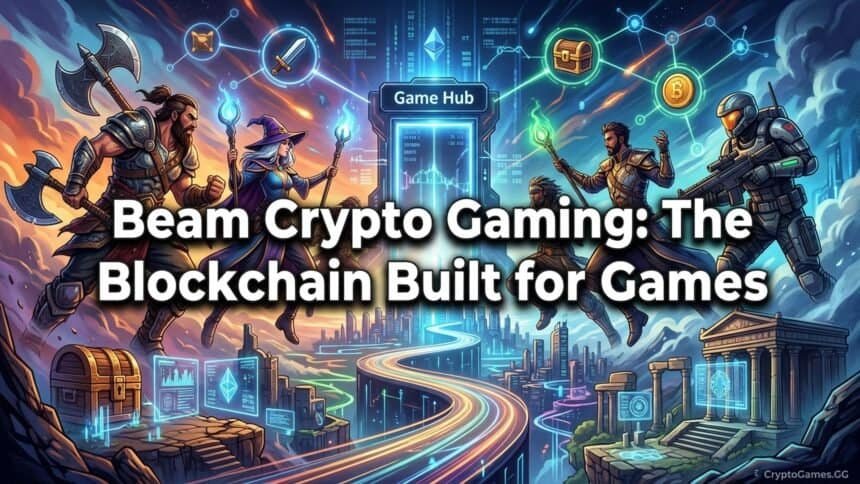
Beam crypto gaming refers to the Beam Network, a gaming-focused blockchain built by Merit Circle, the blockchain gaming DAO and guild. Beam launched in 2023 as a dedicated infrastructure layer for web3 gaming, offering game developers a blockchain with low transaction costs, gaming-specific tools, and built-in marketplace infrastructure. The BEAM token governs the network and is used for transactions within the ecosystem. This guide explains what Beam is, how it works, and which games are building on it.
Quick Answer: Beam is a gaming-focused blockchain built and governed by Merit Circle. It runs on Avalanche’s Subnet technology, providing fast and cheap transactions optimized for gaming workloads. The BEAM token governs the network and enables in-game transactions. Beam includes a built-in NFT marketplace called Sphere and a developer SDK called Beam SDK that simplifies web3 game development. In 2025 and 2026, multiple games have launched on Beam.
What Beam Is and Where It Came From
Beam was developed by Merit Circle, a blockchain gaming DAO that started as a scholarship guild during the Axie Infinity era and evolved into a diversified gaming investment and infrastructure organization. After the 2022 crypto market crash forced a strategic reconsideration across the industry, Merit Circle decided that owning their own blockchain infrastructure was more sustainable than operating purely as a game investor and scholarship operator.

Beam launched in 2023 on Avalanche’s Subnet framework, which allowed Merit Circle to create a dedicated blockchain without building consensus infrastructure from scratch. The Avalanche Subnet model lets teams create application-specific blockchains that benefit from Avalanche’s validator network security while customizing transaction parameters, fees, and governance for their specific use case.
The rebranding from Merit Circle DAO governance token to BEAM token coincided with the blockchain launch, renaming the governance token to reflect the new infrastructure focus rather than purely the gaming guild operations.
The BEAM Token: Governance and Utility
BEAM is the native token of the Beam Network. It serves two primary functions: governance voting rights for Beam ecosystem decisions, and gas payment for transactions on the Beam chain.
BEAM holders vote on key protocol parameters including fee structures, validator incentives, treasury allocations, and which new game projects to support with ecosystem grants. The governance process has been active with multiple proposals passing through Merit Circle’s community voting system.
As the gas token for the Beam chain, BEAM is required for any on-chain transaction: NFT mints, marketplace trades, token transfers, and in-game on-chain actions. Transaction fees on Beam are very low, making even high-frequency gaming activity economically viable for players.
BEAM can be staked through the Merit Circle ecosystem to earn yield and governance weight. Staking creates demand for BEAM beyond pure speculation and provides passive income for long-term holders who want to participate in ecosystem governance.
Beam’s Technical Architecture
Beam is built as an Avalanche Subnet, specifically using the Avalanche L1 architecture. This means it has its own set of validators who specifically secure the Beam chain rather than sharing the general Avalanche validator set. This dedicated validator model gives Beam consistent performance independent of congestion on the main Avalanche network.
The chain processes transactions significantly faster than Ethereum mainnet and at a fraction of the cost. For gaming applications that require many small transactions per player session, this cost and speed profile is essential. A game where each player action costs $0.50 in gas fees is economically unplayable for most users. Beam’s architecture makes per-transaction costs negligible.
EVM compatibility means Ethereum-familiar smart contract development languages and tools work on Beam without modification. Solidity smart contracts deployed on Ethereum can be adapted to Beam with minimal changes, reducing migration costs for game developers who have existing Ethereum-based game logic.
Sphere: Beam’s NFT Marketplace
Sphere is the built-in NFT marketplace for the Beam ecosystem, serving as the primary trading venue for all NFTs from games running on Beam. The marketplace handles buying, selling, and collection display for all Beam-native NFTs.
Game developers on Beam can integrate their in-game items with Sphere automatically, giving players a familiar marketplace interface without building custom marketplace infrastructure. Players who hold Beam game NFTs can list them on Sphere and reach other Beam ecosystem participants.
Sphere charges marketplace fees on each trade. A portion of these fees goes to BEAM token stakers, creating a direct economic connection between marketplace activity and BEAM staking returns. Growing marketplace volume benefits stakers financially, aligning their interests with ecosystem health.
Beam SDK: Developer Tools
The Beam SDK is Merit Circle’s developer toolkit for building web3 game features on the Beam chain. It provides pre-built components for common web3 gaming functions: wallet creation, NFT minting, marketplace listings, token transfers, and transaction management.
The SDK supports Unity and JavaScript environments, covering the two most common development platforms for web3 game projects. Pre-built wallet components allow developers to add embedded wallet functionality to their games without building custom wallet logic from scratch.
Documentation and technical support for Beam SDK has been a point of emphasis for Merit Circle. Game developers choosing a blockchain for their project increasingly cite developer experience quality as a primary factor alongside transaction costs and ecosystem size.
Games Running on Beam in 2026
Beam has attracted a portfolio of games across multiple genres. The most notable in 2025 and 2026 include:
Beamable is a Unity-based development framework being used by multiple game studios on Beam to add blockchain features to existing or new games with minimal code changes. Several games built using Beamable have launched on Beam.
Mighty Action Heroes is a battle royale game built on Beam that has attracted meaningful player counts. The game uses blockchain item ownership for weapons and cosmetics, with active secondary market trading on Sphere.
Merit Circle-invested games often launch on Beam as their chain of choice, giving the ecosystem a pipeline of projects from the DAO’s investment portfolio. This structured deal flow gives Beam a game launch advantage compared to chains that depend entirely on organic developer outreach.
According to DappRadar’s blockchain gaming chain comparison data, Beam has established itself as one of the growing mid-tier gaming chains in 2025 and 2026, with ecosystem activity significantly ahead of most newly launched gaming chains.
BEAM vs Other Gaming Chains
| Chain | Key Games | Daily Active Wallets (Q3 2025) | NFT Fee Model |
|---|---|---|---|
| Ronin | Axie Infinity, RavenQuest, Pixels | Leading | Near-zero |
| Immutable X | Gods Unchained, Illuvium | Top tier | Gas-free for users |
| opBNB | World of Dypians | Leading | Very low |
| Beam | Mighty Action Heroes + portfolio | Growing mid-tier | Very low (BEAM gas) |
| Solana | Star Atlas | Top tier | Very low |
Frequently Asked Questions
What is Beam crypto gaming?
Beam is a gaming-focused blockchain built by Merit Circle on Avalanche’s Subnet framework. It provides fast, low-cost transactions for web3 games along with built-in marketplace infrastructure (Sphere), developer tools (Beam SDK), and the BEAM token for governance and gas payments. Multiple games have launched on Beam in 2025 and 2026.
What is the BEAM token?
BEAM is the native token of the Beam Network used for governance voting and gas payments for on-chain transactions. It was previously the governance token for Merit Circle DAO before the blockchain rebrand. BEAM can be staked to earn fees from the Sphere marketplace and governance weight in ecosystem decisions.
How is Beam different from other gaming blockchains?
Beam’s key differentiator is its origin from Merit Circle, a gaming DAO with existing game investments and scholarship operations. This gives Beam a built-in pipeline of games from Merit Circle’s investment portfolio alongside its open developer ecosystem. Most competing gaming chains depend entirely on external developer adoption without this captive game pipeline.
Is Beam a good investment for crypto gaming?
BEAM as an investment thesis depends on believing Beam ecosystem game activity will grow substantially, driving transaction volume and marketplace fees. The Merit Circle relationship provides a structural advantage in game pipeline. The Avalanche Subnet architecture gives Beam technical credibility. As with all gaming chain tokens, BEAM is volatile and should only represent a position sized appropriately for high-risk speculative assets.
Beam crypto gaming represents the newer generation of gaming blockchain thinking: vertically integrated infrastructure owned by an organization with existing game relationships and investment capital. Whether Beam ultimately reaches the daily active wallet counts of Ronin or Immutable X depends on how many high-quality games launch successfully on the chain over the next two to three years. The foundation is solid. The execution over time will determine the outcome.