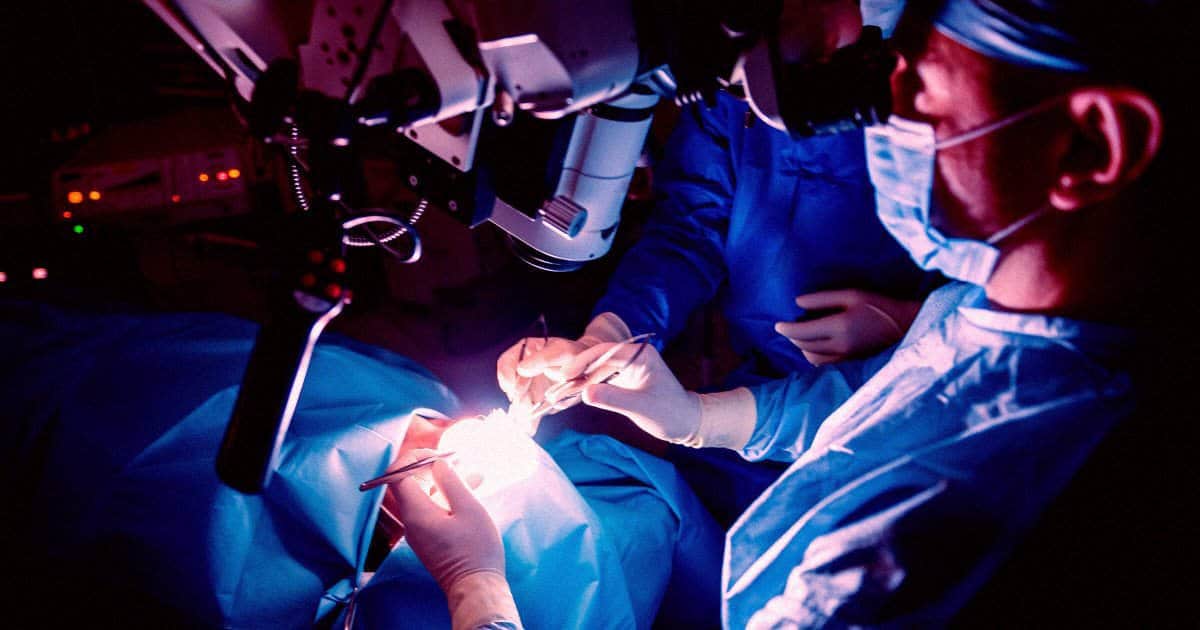

There are no road signs inside your skull. That’s the problem a team of neurosurgeons in London handed to an AI tool in May, and it’s the line the patient himself used afterward.
The operation happened at the National Hospital for Neurology and Neurosurgery. Details stayed under wraps until now. Rhys Hibbert, 48, went in with a large tumor on his pituitary gland and came out with his eyesight intact.
“When I came round… I could see everything in the room clearly,” Hibbert said. Before the surgery, he couldn’t walk on his own without glasses or walking sticks.
What the software was actually doing
The tool analyzed live footage of the operation and flagged key brain structures like nerves and blood vessels as the surgeons removed the growth. In plain terms, it kept them from poking around where they shouldn’t be.
A camera went in through the nose and sat at the base of the skull. From that feed, the system tracked the surgical instruments in real time, identified where hidden vessels and nerves were most likely to be, and highlighted safe areas to extract the tumor. Think facial recognition, pointed at anatomy nobody can see.
The humans stayed in control of the entire procedure. But the tool played a critical role in guiding their work, and that distinction is doing a lot of work in every write-up of this case.
Why the pituitary is the hard one
It sits right next to the arteries feeding blood to the brain and the optic nerves that control vision. “Going a millimeter wrong can make a critical difference,” health officials said. The failure modes are blindness, stroke and death.
Hibbert’s tumor was benign, which changes the stakes but not the geometry. It was at the base of the brain, hidden from view. The surgeons had to cut a precise path to reach it without damaging anything on the way.
The training data is the whole story
The system was trained on hundreds of surgical videos of pituitary tumor removals. Researchers manually drew around the vessels and nerves in each video so the model could get an accurate idea of where they are. Tedious, human, unglamorous work.
That labeling effort is what makes the claim credible. The AI system “has been exposed to a breadth of surgical examples that would take a surgeon many years to encounter,” said Sophia Bano, an associate professor in robotics and AI at University College London and the technical lead for the tool.
The part nobody has answered yet
What happens when it’s wrong? That question doesn’t have a published answer here, and it should bother you a little.
AI in medicine is already a touchy subject as more doctors lean on these tools to take clinical notes and look up symptoms. Surgery is a steeper drop. For a pituitary tumor removal, a surgeon typically studies brain scans until they intimately know each patient’s unique anatomy before going in.
Experts worry that doctors may become too dependent on the software, especially as a new generation of med students is being raised on it. A tool that shortcuts years of pattern recognition also shortcuts the years that build it.
Hibbert isn’t conflicted
“From a patient safety perspective, I can see absolutely the benefit. There are no road signs inside our head,” he said.
And on the surgery itself: “It’s given me my life back.” He walked in needing sticks and glasses. That’s the measurement that counts, even if it’s a sample size of one.