
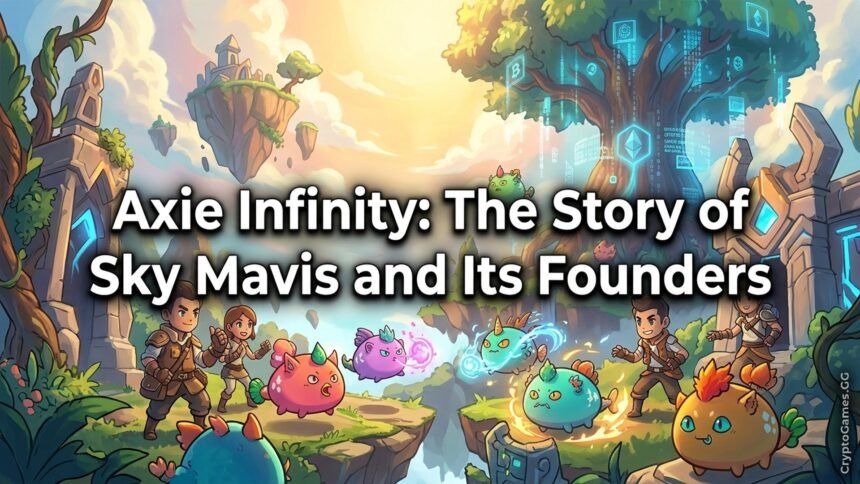
Axie Infinity: The Story of Sky Mavis and Its Founders
The story of Axie Infinity’s founders is one of the most remarkable origin stories in blockchain gaming. A small Vietnamese team with a Pokémon-inspired idea, launched in 2018 when blockchain gaming barely existed as a concept, built the product that brought play-to-earn to global consciousness — and then navigated a catastrophic hack and market collapse to rebuild something more structurally sound than what had come before.
Table of Contents
- Who Founded Axie Infinity
- The Origin: Why Pokémon Meets Blockchain
- The Early Years: Building Before Anyone Was Watching
- The 2021 Peak: When the World Noticed
- The 2022 Crisis: Surviving the Hack and Market Collapse
- Rebuilding: What Sky Mavis Did After the Crash
- The Current Chapter: A Multi-Game Ecosystem
- Frequently Asked Questions
Who Founded Axie Infinity
Sky Mavis was co-founded in 2018 by Trung Nguyen (CEO), Aleksander Leonard Larsen (COO), Andy Ho (CTO), Tu Doan (Art Director), and Jeffrey Zirlin (Growth Lead). The company is headquartered in Ho Chi Minh City, Vietnam, reflecting its founders’ roots and Vietnam’s growing technology talent pool.
Trung Nguyen is the most publicly visible of the founders. A computer science graduate, he conceptualized Axie Infinity as a blockchain-based creature collection game inspired by the games he played growing up. His vision from the start was that blockchain ownership could change the relationship between players and games — giving players genuine ownership of the assets they earned and spent time acquiring.

Aleksander Larsen, a Norwegian co-founder and the company’s COO, brought international perspective and business development focus. He became the primary spokesperson for Axie Infinity in English-language media during the game’s 2021 peak, appearing in interviews globally to explain the play-to-earn model to audiences encountering it for the first time.
The Origin: Why Pokémon Meets Blockchain
The core concept behind Axie Infinity was straightforward: apply blockchain ownership to the creature collection and battle genre that Pokémon had popularized. The founders observed that players spent significant time and money in games like Pokémon without ever actually owning the creatures they loved. If those creatures existed as NFTs on a blockchain, ownership would be genuine, trading would be legal, and the economic value of time spent playing would belong to the players rather than the developer.
The DeFi primitives that enabled this vision were still early in 2018. Non-fungible tokens existed but were largely unknown outside the crypto community following CryptoKitties’ November 2017 launch. The play-to-earn model had not been proven at any meaningful scale. Sky Mavis was building toward a concept the market had not yet validated.
The Early Years: Building Before Anyone Was Watching
Sky Mavis operated quietly from 2018 to 2020, growing a small but dedicated player community while iterating on the game mechanics. These years were critical for establishing the technical foundation: the Axie breeding system, the battle mechanics, the marketplace infrastructure, and the early version of what would become the Ronin Network.
The decision to build a dedicated gaming blockchain rather than operate on Ethereum mainnet was made from necessity. Ethereum’s transaction fees in 2020 made the frequent small interactions of a blockchain game prohibitively expensive for most players. Sky Mavis began developing Ronin — an Ethereum sidechain specifically designed for gaming workloads — as a prerequisite for making the game economically accessible.
Early funding included a $1.5 million seed round in 2019. The team was small, the player base was modest, and mainstream recognition was essentially zero. The founders built primarily from conviction about the future of player-owned economies rather than from existing market validation.
The 2021 Peak: When the World Noticed
The COVID-19 pandemic accelerated what might have been a gradual growth curve into a rapid explosion. Players in the Philippines, Vietnam, Indonesia, and Venezuela discovered that Axie battles generated SLP tokens with real market value. The discovery spread through local communities, social media, and eventually international media outlets that ran stories about players earning full incomes from a video game.
Sky Mavis raised $152 million in a Series B round in October 2021 led by Andreessen Horowitz, with participation from Paradigm, Mark Cuban, and other prominent investors. The company’s valuation reached $3 billion. Trung Nguyen and the founding team had built a multibillion-dollar company in three years from a seed investment and an unproven concept.
At peak, Axie Infinity had 2.7 million daily active users and generated $364 million in monthly revenue — comparable to major traditional gaming companies in revenue terms, achieved by a team that had been completely unknown to the mainstream gaming industry just two years earlier.
The 2022 Crisis: Surviving the Hack and Market Collapse
March 29, 2022 was the worst day in Sky Mavis’s history. The company discovered that the Ronin bridge — the infrastructure connecting Ronin to Ethereum mainnet — had been exploited through a validator key compromise. Approximately $625 million in ETH and USDC had been stolen over the preceding days before the breach was discovered.
The attacker was later identified by the US Treasury as Lazarus Group, a North Korean state-sponsored hacking organization. The exploit used compromised validator private keys to approve fraudulent withdrawals. Because the Ronin bridge had concentrated validator control among a small number of validators (including Sky Mavis itself holding several keys), the attacker needed fewer compromised keys to gain approval for large withdrawals than a more decentralized validator set would have required.
Trung Nguyen’s public response was transparent and accountable. Sky Mavis committed to covering all lost funds — a commitment that required emergency fundraising of $150 million from investors including Binance. The team immediately began redesigning the bridge security architecture and expanding the validator set to distribute control more broadly.
The May 2022 collapse of the Terra/Luna ecosystem crashed crypto markets broadly. SLP fell to under $0.001. Daily active users dropped 95% from peak. The combination of the hack’s damage to trust and the market crash’s damage to token economics created existential pressure on the company.
Rebuilding: What Sky Mavis Did After the Crash
Sky Mavis’s post-crisis response demonstrated organizational resilience that few companies — in crypto or otherwise — have matched after similar-scale disasters.
They covered all hack losses through the emergency fundraising, establishing that they stood behind their users even when the failure was catastrophic. They redesigned the Ronin bridge with expanded validator sets, multi-signature requirements for large transactions, and a withdrawal limit system that prevents similar single-event theft at scale. They launched Axie Origins, a complete mechanical redesign of the core battle game with improved gameplay depth.
Most strategically, they opened the Ronin Network to other game developers. This decision transformed Ronin from a single-game chain into a gaming ecosystem platform. By 2023 and 2024, other teams were building successful games on Ronin — RavenQuest, Pixels, Lumiterra — diversifying the chain’s economic base beyond dependence on Axie Infinity alone.
The Current Chapter: A Multi-Game Ecosystem
In 2025 and 2026, Sky Mavis operates primarily as a blockchain gaming ecosystem company rather than purely as the developer of a single game. The Ronin Network hosts multiple successful games alongside Axie Infinity. AXS governance token captures value from the entire ecosystem through staking distributions of Ronin protocol fees.
Trung Nguyen and the founding team continue leading Sky Mavis with the same core conviction they started with: that players should own the value they create through gameplay, and that blockchain provides the technical foundation for that ownership to be genuine rather than nominal.
The company’s journey — from Vietnamese startup to global peak to catastrophic crisis to rebuilt ecosystem — has become one of the defining corporate stories in blockchain gaming’s young history. Whatever happens to Axie Infinity as a game, Sky Mavis has proven that a team can survive what appeared to be a fatal combination of external hack and market collapse through transparent leadership, user-first commitments, and strategic adaptation.
Frequently Asked Questions
Who is the CEO of Axie Infinity?
Trung Nguyen is the CEO and co-founder of Sky Mavis, the company that created Axie Infinity. He is a Vietnamese computer science graduate who conceptualized Axie Infinity in 2018 and has led the company through its peak, its crisis, and its rebuilding phase.
Where is Sky Mavis headquartered?
Sky Mavis is headquartered in Ho Chi Minh City, Vietnam. The company maintains a primarily Vietnam-based engineering team alongside international team members in business development, marketing, and partnerships roles.
How much did the Axie Infinity hack cost?
The March 2022 Ronin bridge hack resulted in approximately $625 million being stolen — one of the largest cryptocurrency thefts in history. Sky Mavis covered the losses through emergency fundraising of $150 million from investors including Binance and committed to making all affected users whole.
Is Sky Mavis still operating in 2026?
Yes. Sky Mavis continues operating in 2026, maintaining Axie Infinity across its Origins, Homeland, and Classic game modes while also operating the Ronin Network as a multi-game gaming blockchain ecosystem. The company has continued rebuilding its player base and diversifying the Ronin ecosystem beyond its original single-game focus.
The founders of Axie Infinity built something that changed blockchain gaming permanently. Whatever the company’s future trajectory, the proof of concept they established — that players in developing economies could earn meaningful income through blockchain gaming, that a team could build a blockchain game infrastructure worth billions from a seed investment, and that a crypto gaming company could survive a catastrophic breach through accountability and adaptation — has permanently changed what others believe is possible in this industry.