

Black holes aren’t supposed to destroy information. Quantum mechanics says it can’t happen. But Stephen Hawking’s own theory of black hole evaporation says it does. That contradiction has haunted physics since the 1970s, and nobody’s been able to cleanly resolve it.
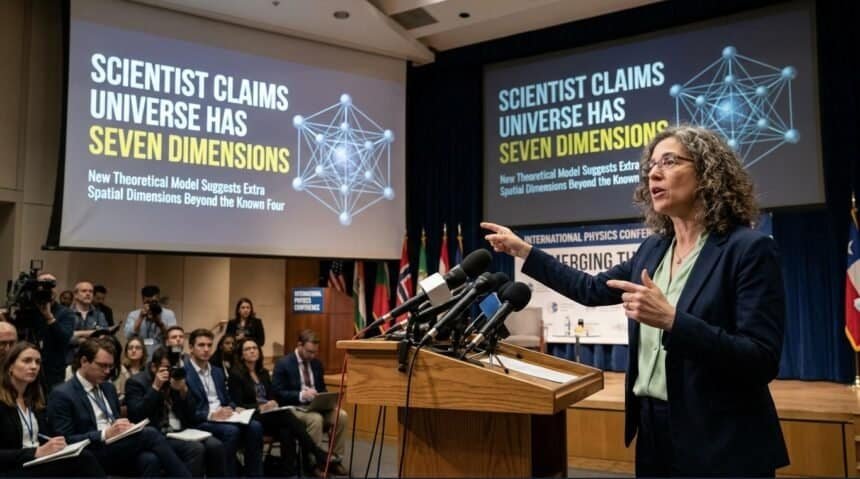
A new paper from Richard Pinčák at the Slovak Academy of Sciences proposes a way out. The catch: the universe needs to have seven dimensions, not four.
3 dimensions you can’t see

We perceive three dimensions of space and one of time. Pinčák’s model, published March 19 in the journal General Relativity and Gravitation, adds three more that are compactified, or curled up so tightly at subatomic scales that we can’t detect them directly.
“Our model proposes that the universe actually has seven dimensions: the four we know, plus three tiny extra dimensions curled up so tightly that we cannot directly perceive them,” Pinčák said.
These hidden dimensions are arranged in a structure called G₂ geometry, a mathematical framework connected to M-theory, one branch of string theory. The shape of those folded dimensions matters. As Pinčák put it to Live Science: “Think of it like origami. The way you fold the paper determines what the final shape can do.”
Why Hawking’s paradox is such a problem
Hawking showed decades ago that black holes emit radiation and slowly shrink. If they evaporate completely, everything they swallowed disappears with them. That violates a bedrock rule of quantum mechanics: information can be scrambled, but never destroyed.
“Imagine you throw a book into a fire,” Pinčák said. “The book is destroyed, but in principle you could reconstruct every word from the smoke, ash, and heat — the information is scrambled, not lost.”
Complete black hole evaporation breaks that principle. The new model says it doesn’t have to happen.
A twist in spacetime stops the collapse
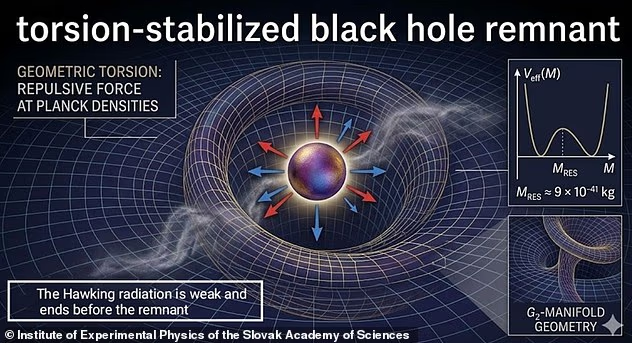
The G₂ geometry generates something called torsion, a twisting effect in spacetime. At extremely small scales, near the end of a black hole’s life, this torsion creates a repulsive force that kicks in and halts the evaporation before the black hole vanishes entirely.
“This repulsive force acts as a brake, halting the evaporation before the black hole vanishes completely,” Pinčák said.
What’s left behind is a stable remnant with a mass of roughly 9 × 10⁻⁴¹ kilograms, about 10 billion times smaller than an electron. That remnant preserves the information in subtle oscillations called quasinormal modes. Quantum mechanics stays intact.
The dark matter connection
The model goes further. Those microscopic remnants, accumulated over the age of the universe, could account for dark matter, the roughly 27% of the universe’s mass that we can detect gravitationally but have never directly observed.
The same torsion field also produces a potential energy pattern identical to the one behind the Higgs mechanism, the process that gives mass to particles like the W and Z bosons. That’s an unexpected link between black hole physics and the electroweak scale.
“The same torsion field… generates a potential energy landscape that is identical in form to the one responsible for giving mass to the W and Z bosons — the carriers of the weak nuclear force,” Pinčák said.
Don’t hold your breath for proof
Pinčák is upfront about the limits. The energy scales involved are far beyond anything current particle accelerators can reach. The model predicts that hypothetical Kaluza-Klein particles tied to the extra dimensions should have masses around 10¹⁶ gigaelectronvolts, roughly 14 orders of magnitude heavier than the top quark.
No existing instrument comes close to probing that range. But the theory does make falsifiable predictions. If lighter versions of those particles turn up at future colliders, the model is wrong. Future gravitational wave detectors or gamma-ray telescopes observing the final stages of primordial black hole evaporation could also provide indirect evidence.
“The important point is that the predictions are concrete — the model can be wrong, which is what makes it scientific,” Pinčák said.
That’s a healthy attitude for a theory proposing three invisible dimensions we can’t measure yet. The math is published, the predictions are specific and the paradox, at least on paper, has a new escape route.


![27 Games Hit Xbox Next Week, and 3 of Them Are Worth Your Attention [April 20-24]](https://cryptogames.gg/wp-content/uploads/2026/04/nwox-hero-183901881c24bba113ff-1024x576-1-150x150.jpg "27 Games Hit Xbox Next Week, and 3 of Them Are Worth Your Attention [April 20-24]")