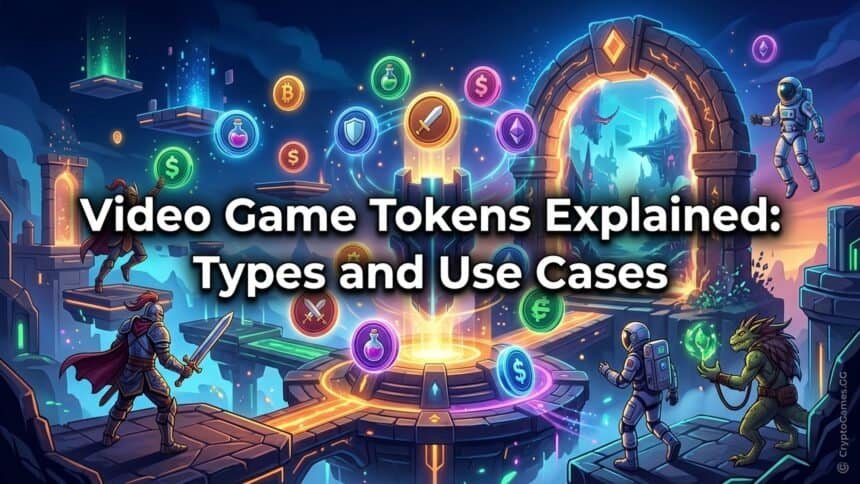
Blockchain video game tokens are a distinct category from the casino and arcade tokens that share the same name. Where physical gaming tokens are used for one specific location and have no value outside it, blockchain video game tokens are cryptocurrency assets that exist on public ledgers, trade on exchanges, and can represent both governance rights and in-game purchasing power. This guide explains the types of tokens that power blockchain video games, how they work, and what separates good token design from problematic design.
Quick Answer: Blockchain video game tokens fall into four categories: governance tokens that give holders voting rights over game economics (AXS, GODS, ILV), utility tokens earned through gameplay and spent in-game (SLP, QUEST, BIGTIME), NFTs representing unique in-game assets (character NFTs, card NFTs, land NFTs), and platform tokens that govern blockchain infrastructure multiple games run on (IMX, RON). Each type serves a different economic role and carries different investment characteristics.
How Blockchain Game Tokens Differ from Traditional In-Game Currency
Traditional in-game currencies like World of Warcraft Gold, Fortnite V-Bucks, or FIFA Coins share one property: they exist only inside the game company’s database. The company creates them, controls their supply, and can change their value or remove them at any time. Players cannot convert them to real money through official channels, and selling them for cash typically violates terms of service.

Blockchain video game tokens are fundamentally different in three ways. First, they exist on a public blockchain that no single company controls. Supply rules are encoded in smart contracts that are publicly readable and tamper-resistant. Second, they can be freely traded on cryptocurrency exchanges or decentralized trading platforms at real market prices. Third, the rules governing their creation and usage are transparent and visible to any player or investor who wants to verify them.
These differences mean blockchain video game tokens create genuine economic value for players who earn them through gameplay. They also create genuine risk — token prices can fall as well as rise, and a game with poor tokenomics can see its tokens lose all value even while the game continues running.
Type 1: Governance Tokens
Governance tokens give holders voting rights over significant decisions affecting the game or platform. They are typically fixed in supply or have tightly controlled issuance, making them relatively scarce compared to utility tokens earned through gameplay.
What governance tokens do: Holders vote on token emission rate changes, fee structure modifications, treasury spending proposals, and major game design decisions. In well-designed systems, vote outcomes directly affect the game’s economic parameters. In poorly designed systems, governance is theater with no real effect on the game’s development.
Economic benefits: Many governance tokens distribute protocol revenue to stakers. Marketplace trading fees, game transaction fees, and treasury earnings distribute to token holders who lock their tokens in staking contracts. This creates yield from real economic activity rather than from minting new tokens.
Examples: AXS for the Axie Infinity and Ronin ecosystem. GODS for Gods Unchained. ILV for Illuvium. GALA for Gala Games. Each has a fixed or controlled total supply and provides some form of protocol fee distribution to stakers.
Type 2: Utility Tokens
Utility tokens are the everyday currency of a game’s economy. Players earn them through gameplay and spend them on in-game actions. They are designed to circulate, not to be hoarded.
How they are created: When a player completes a qualifying game action — winning a battle, completing a quest, crafting an item — the game’s smart contracts automatically distribute utility tokens to that player’s wallet. The distribution amount is set by the game’s emission schedule.
How they are spent: Utility tokens are spent on token sink activities: crafting, upgrading, breeding, tournament entry, and in-game purchases. The balance between earning rate (emissions) and spending rate (sinks) determines whether the utility token maintains price stability or inflates over time.
Examples: SLP in Axie Infinity, earned through battles and spent on Axie breeding. QUEST in RavenQuest, earned through quests and crafting, spent on guild formation and higher-tier crafting. BIGTIME in Big Time, earned through dungeon runs and spent on upgrades.
Investment consideration: Utility tokens are less suitable for long-term investment than governance tokens because they are designed for circulation. An actively used utility token will constantly have selling pressure from players who earn and sell. The right relationship with utility tokens is to earn and spend them within the game, or to hold very short term positions on market momentum rather than as long-term holdings.
Type 3: NFT Assets
NFTs, or non-fungible tokens, represent unique in-game items. Unlike fungible utility tokens where every token is identical, each NFT has a unique identifier and properties that distinguish it from all others. A specific Axie character is an NFT. A specific Gods Unchained card is an NFT. A specific Sandbox LAND parcel is an NFT.
Character NFTs represent playable characters with specific attributes, abilities, and visual appearances. They are earned through gameplay, purchased in game marketplaces, or created through breeding mechanics. Character NFT value depends on the character’s usefulness in the current game meta and collector demand for specific visual traits.
Card NFTs in card games like Gods Unchained and Parallel TCG represent specific cards from the game’s card pool. Each card has unique game mechanics associated with it. Card values depend on the card’s competitive utility, its rarity, and collector demand for visually appealing or historically significant cards.
Land NFTs in metaverse games like The Sandbox and Decentraland represent virtual real estate parcels. Land NFTs derive value from their location within the virtual world (proximity to high-traffic areas), development potential, and the broader popularity of the platform.
Equipment NFTs in RPGs like Illuvium and Big Time represent weapons, armor, and gear that affect character performance. These combine collector value with functional gaming utility, creating demand from both players who want the performance advantage and collectors who value rarity.
Type 4: Platform Tokens
Platform tokens govern blockchain infrastructure that multiple games run on, rather than a single specific game. They capture value from the entire ecosystem of games on their platform rather than from one game alone.
IMX — Immutable X is the platform token for the Immutable gaming blockchain. Every transaction on Immutable X requires IMX for fee payments. As Gods Unchained, Illuvium, and dozens of other games generate transaction volume, IMX demand grows proportionally. Platform tokens create diversified gaming exposure that single-game tokens cannot.
RON — Ronin Network serves as the gas token for the Ronin gaming blockchain. Axie Infinity, RavenQuest, Pixels, and all other Ronin games generate transaction volume that drives RON demand. Ronin’s position as one of the leading gaming blockchains by daily active wallets makes RON one of the most utility-grounded gaming tokens available.
BEAM — Beam Network serves the Beam gaming blockchain built by Merit Circle. As more games launch on Beam and player activity grows, BEAM transaction demand grows. Platform tokens like BEAM represent bets on the platform’s ability to attract quality games and grow its player ecosystem.
Real Examples from Major Games
| Game | Governance Token | Utility Token | Chain |
|---|---|---|---|
| Axie Infinity | AXS | SLP | Ronin |
| Gods Unchained | GODS | GODS (earned via ranked) | Immutable X |
| Illuvium | ILV | sILV2 (in-game) | Immutable X |
| RavenQuest | — (AXS for Ronin) | QUEST | Ronin |
| Big Time | — | BIGTIME | Immutable X |
| The Sandbox | SAND | SAND | Ethereum/Polygon |
| Star Atlas | POLIS | ATLAS | Solana |
| Parallel TCG | PRIME | PRIME | Ethereum/Base |
How Game Tokens Are Created
Blockchain video game tokens are created through smart contracts deployed on their respective blockchains. The creation process varies by token type.
Governance tokens are typically created in a single initial issuance event. The smart contract mints the total supply at deployment and then distributes it over time according to a vesting schedule. No new governance tokens should be mintable after the initial supply is set — this is the scarcity guarantee that governance token holders depend on.
Utility tokens are created continuously through gameplay rewards. When a player completes a qualifying action, the reward distribution smart contract mints new utility tokens and transfers them to the player’s wallet. The minting rate is governed by the emission schedule written into the smart contract — typically a fixed amount per game action type, sometimes modified by player level, item quality, or seasonal parameters.
NFTs are minted when a new unique asset is created — when a player opens a card pack, breeds a new character, or creates a new item. Each minting creates one new unique NFT with a unique token ID. The total number of NFTs of any specific type is determined by how many items can be created through gameplay mechanics.
Frequently Asked Questions
What are video game tokens in crypto?
Blockchain-based cryptocurrency tokens used within video games to represent in-game currency, governance rights, or unique asset ownership. Unlike traditional in-game currency controlled by game companies, blockchain video game tokens exist on public ledgers, can trade at real market prices on exchanges, and are governed by publicly readable smart contracts rather than private company databases.
Can you earn real money from video game tokens?
Yes. Players earn utility tokens through gameplay that can be sold on exchanges for other cryptocurrencies or converted to fiat currency. Amounts vary significantly by game, token price, time invested, and player skill level. Most players earn supplementary amounts rather than full incomes. Token prices fluctuate, so dollar-equivalent earnings vary even when token earnings remain constant.
How are blockchain game tokens different from V-Bucks or Robux?
V-Bucks and Robux are traditional in-game currencies stored in the game company’s database. They cannot be sold or traded outside the game’s own store, they can only be purchased (not earned), and they disappear if the game shuts down or your account is banned. Blockchain game tokens are owned by players as cryptocurrency, can be traded freely on external exchanges, are governed by smart contracts rather than company policy, and persist on the blockchain regardless of what happens to the game.
Blockchain video game tokens represent a genuinely new category of asset that did not exist before cryptocurrency. Understanding which type of token you are interacting with — governance, utility, NFT, or platform — is the foundation for making good decisions about how to engage with them, whether as a player earning tokens through gameplay, a collector building an NFT portfolio, or an investor evaluating governance token positions.