

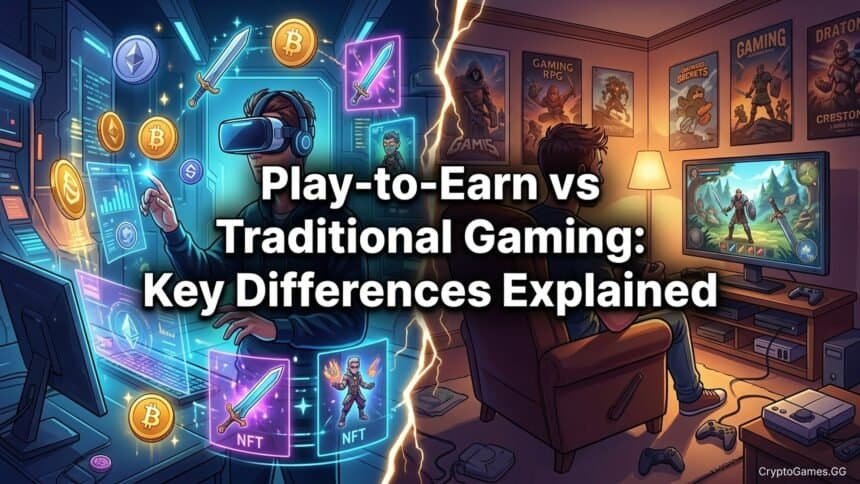
The question of play-to-earn versus traditional gaming comes up constantly in 2026. Both have passionate advocates and vocal critics. The honest answer is that neither model is universally superior. Each serves different player priorities, and the best choice depends on what you actually value in gaming. This comparison covers every meaningful difference between the two models without the promotional spin that dominates most coverage of the space.
Quick Answer: Play-to-earn gaming gives players true ownership of in-game assets, the ability to earn real cryptocurrency, and governance rights. Traditional gaming offers higher production quality, simpler onboarding, and more polished gameplay. P2E games carry financial risks and complexity that traditional games do not. Traditional games offer no earning potential for average players. The right choice depends on whether ownership and earning matter more than game quality and accessibility to you.
Asset Ownership: The Fundamental Difference
In traditional gaming, you pay for access to items that the developer owns. Your Counter-Strike skins, your Fortnite outfits, your FIFA Ultimate Team cards all live in the developer’s private database. They can be altered, removed, or made inaccessible by a terms of service violation, a game shutdown, or a company decision. You have no legal ownership and no external recourse.

In play-to-earn gaming, in-game items of value are NFTs recorded on a public blockchain under your wallet address. No developer can remove or alter the ownership record. You can sell, transfer, or hold them without asking anyone’s permission. When RavenQuest or Gods Unchained shuts down someday, your NFTs will remain in your wallet permanently.
This difference has direct financial implications. The secondary market for traditional game items, where it exists, is unofficial and technically against terms of service. The secondary market for blockchain game items is official, encouraged, and legally straightforward. A rare weapon in an NFT game can be sold on an open marketplace for its market price. A rare weapon in a traditional game cannot be legally sold at all.
Earning Potential: Who Can Make Money
In traditional gaming, earning real money is reserved for professional esports players, streamers with large audiences, and content creators with existing platforms. The typical player who invests thousands of hours in World of Warcraft or Fortnite earns exactly nothing from that investment in real currency terms.
In play-to-earn gaming, earning mechanisms are open to all players regardless of skill level. Completing daily quests, crafting items, participating in guild activities, and selling earned NFTs on open markets all generate real income opportunities. The skill ceiling matters because better players earn more, but earnings are not gated behind professional-level performance.
The honest caveat: earnings in P2E games are not stable or guaranteed. Token prices fluctuate. Game economies can inflate. The same session that earned you $10 last month might earn you $2 today if the token price fell. You are earning in volatile cryptocurrency, not in stable income. According to DappRadar’s 2025 gaming analysis, play-to-earn holds approximately 42% revenue share of the blockchain gaming market, confirming real earnings activity, but the distribution of those earnings is highly unequal toward the most skilled and strategic players.
Game Quality and Depth Compared
Traditional gaming wins decisively on production quality for most titles. The largest traditional game studios spend hundreds of millions of dollars on single titles. The visual fidelity, gameplay depth, sound design, and narrative quality of top traditional games have no equivalent in blockchain gaming today.
Elden Ring, Red Dead Redemption 2, and God of War have no direct blockchain gaming competitors in terms of production quality. This is simply the current reality.
Play-to-earn gaming is closing the gap but has not closed it. Illuvium demonstrates that blockchain games can have AAA visual quality. RavenQuest shows that MMORPG mechanics can be genuinely engaging alongside earning mechanics. Gods Unchained proves that a blockchain card game can be genuinely competitive. But these are exceptions rather than the standard across the P2E space.
The play-to-earn games that compete effectively with traditional gaming in quality are also, not coincidentally, the ones with the strongest and most sustainable economies. Game quality and economic sustainability tend to correlate because building a good game requires the same organizational discipline that designing a sustainable economy does.
Cost to Play: What Each Model Actually Charges
Traditional gaming costs are straightforward. Buy the game, pay for DLC, subscribe for online access. The costs are explicit and predictable. A $60 game gives you a complete experience with defined costs.
Play-to-earn costs are more complex. Many games have free-to-play entry options, but meaningful earning often requires owning specific NFT assets. Entry costs for games with NFT requirements vary from a few dollars for basic Axie Infinity starters to hundreds or thousands for the best earning assets in more competitive configurations. Transaction fees on Ethereum mainnet can be significant during network congestion, though gaming-specific chains like Ronin and Immutable X have near-zero fees.
The key difference is that P2E spending is investment-like rather than consumption-like. When you buy a $60 traditional game, you have spent $60 for entertainment. When you buy a $200 Axie team, you have invested $200 in an asset that may appreciate, depreciate, or lose all value depending on game popularity and token market conditions. The potential upside is real. So is the potential for total loss.
Time Investment: What Each Model Rewards
Traditional gaming rewards time investment with in-game progress: higher levels, better gear, unlocked content, skill improvement. These rewards exist entirely within the game’s ecosystem and cannot be extracted into real-world value. Your 2,000 hours in Destiny 2 built a powerful character that has zero external financial value.
Play-to-earn gaming rewards time investment with both in-game progress and externally valuable tokens and NFTs. Your 2,000 hours in RavenQuest built a powerful character and generated QUEST token earnings you could have sold throughout that period. This does not make P2E unambiguously better. The financial component adds complexity, tax obligations, and a relationship to your time that traditional games do not have.
Some players find the financial layer adds meaningful motivation. Others find that tying financial outcomes to game sessions changes the psychological relationship with gaming in ways they dislike. Playing becomes work-adjacent rather than purely recreational. This is a personal reaction that varies significantly between individuals and is worth considering before committing to P2E gaming as your primary entertainment.
Risk Profile: What Can Go Wrong
In traditional gaming, the main risks are platform discontinuation, account bans, and wasted entertainment spending. When EA shut down older game servers, players lost access to games they paid for. When Blizzard banned accounts, players lost progress. These are real but limited risks. The financial downside is bounded by what you originally spent.
In play-to-earn gaming, the risk profile is categorically different because real financial assets are involved. Token prices can collapse 90% or more. NFT values can drop to zero if a game loses its player base. Smart contract exploits can result in total loss of assets. The 2022 Ronin bridge hack cost players collectively $625 million. These are not theoretical risks.
The upside potential is also categorically different. Some players earned thousands of dollars during favorable P2E periods. Traditional gaming offers no comparable upside. The higher risk and higher potential reward are two sides of the same coin. Choosing P2E means accepting both.
Onboarding: How Hard Is It to Start
Traditional gaming onboarding is nearly frictionless. Download a client, create an account with email and password, buy with a credit card, play. The entire process takes minutes and uses familiar technology that billions of people already understand.
Play-to-earn onboarding is more complex. Setting up a crypto wallet, securing a seed phrase, acquiring cryptocurrency through an exchange, transferring to the gaming wallet, potentially bridging between chains, and managing gas fees all precede actual gameplay. For non-technical players, this complexity is a genuine barrier that puts many off before they ever experience the game.
Embedded wallets in newer P2E games are reducing this friction significantly. Games like those launching on Immutable’s platform now allow players to sign up with Google accounts and have wallet creation happen invisibly in the background. This reduces but does not eliminate the onboarding complexity gap relative to traditional gaming.
Community and Social Dynamics
Traditional gaming communities form around shared love of a game’s content. The toxicity in competitive communities is about competitive outcomes. The social dynamics are primarily about gaming skill and engagement.
Play-to-earn communities have an additional economic dimension. Financial outcomes create different social dynamics. When token prices fall, community frustration is financial rather than purely recreational. When the game economy is strong, community enthusiasm has an investment-enthusiasm quality that differs from pure gaming excitement. Guild structures create organizational hierarchies with real economic stakes that traditional game guilds typically lack.
This is not inherently better or worse. It is different. Some players find the economic engagement layer enriching. Others find it creates a mercenary atmosphere that conflicts with their reasons for gaming in the first place.
Complete Side-by-Side Comparison Table
| Factor | Play-to-Earn | Traditional Gaming |
|---|---|---|
| Asset ownership | Player owns as NFT on blockchain | Developer owns all items |
| Earning real money | Available to all players | Esports and streaming only |
| Game quality (avg) | Improving but still lags | Higher production quality overall |
| Onboarding | More complex, improving | Very simple |
| Cost structure | Investment-like, variable | Purchase-based, predictable |
| Financial risk | Real loss potential | Bounded by purchase price |
| If game shuts down | NFTs remain in wallet | Items disappear |
| Game economy | Player-influenced, volatile | Developer-controlled, stable |
| Time investment value | Generates financial returns | In-game progress only |
| Regulatory complexity | Tax obligations on earnings | No tax implications |
| Security risks | Wallet security critical | Account security only |
| Governance rights | Token holder voting | Developer decides everything |
Which Should You Choose
Choose play-to-earn if: you want genuine ownership of what you earn and buy in games, you are interested in the earning potential and comfortable with the financial risk, you want a say in how your games develop through governance, and you are willing to invest the time to understand the technology and economics properly.
Choose traditional gaming if: you want the best production quality and most polished gameplay experiences available, you prefer simple onboarding with no cryptocurrency involved, you want predictable entertainment costs without financial risk exposure, and the earnings opportunity does not matter to you relative to the gaming experience itself.
Many players engage with both simultaneously. Traditional games for their entertainment value and production quality. Play-to-earn games for the economic layer that traditional gaming does not provide. The two models are not mutually exclusive, and the fastest-growing category in both is hybrid games that offer traditional-quality gameplay with optional blockchain ownership layers for players who want them.
Frequently Asked Questions
Is play-to-earn gaming worth it compared to traditional gaming?
It depends on what you value. If ownership and earning potential matter more to you than current game quality, play-to-earn is worth it. If production quality and simplicity matter more, traditional gaming wins. Many players find value in both simultaneously rather than treating it as an either/or decision.
Can you make a living playing play-to-earn games?
A very small number of skilled, strategic players do earn meaningful income from play-to-earn games. Most players earn supplementary income rather than a primary living. Treating it as a full-time income source without substantial gaming expertise and economic sophistication is high risk. The realistic framing is a side income with real upside and real downside.
Why is traditional gaming still more popular than play-to-earn?
Traditional gaming has higher production quality, much simpler onboarding, no financial complexity or risk, and decades of established player communities around beloved franchises. Play-to-earn is a newer model with legitimate advantages but also genuine disadvantages in quality and accessibility that will take time to fully close. Market share will evolve as quality improves and onboarding simplifies.
Are play-to-earn games really games or just financial products?
Both exist in the P2E space. Some blockchain games are genuine games with optional earning mechanics. Others are primarily financial products with game-like interfaces. The distinction matters for sustainability: genuine games retain players through market downturns because they enjoy playing. Financial products lose players when token prices fall. Evaluate each project individually rather than making blanket judgments about the category.
The play-to-earn versus traditional gaming debate misses the more interesting question: what happens when the best elements of both are combined? The games emerging in 2026 that blend AAA production quality with optional blockchain ownership and earning mechanics represent where the most compelling gaming experiences are being built. That convergence is worth watching, regardless of which camp you currently belong to.