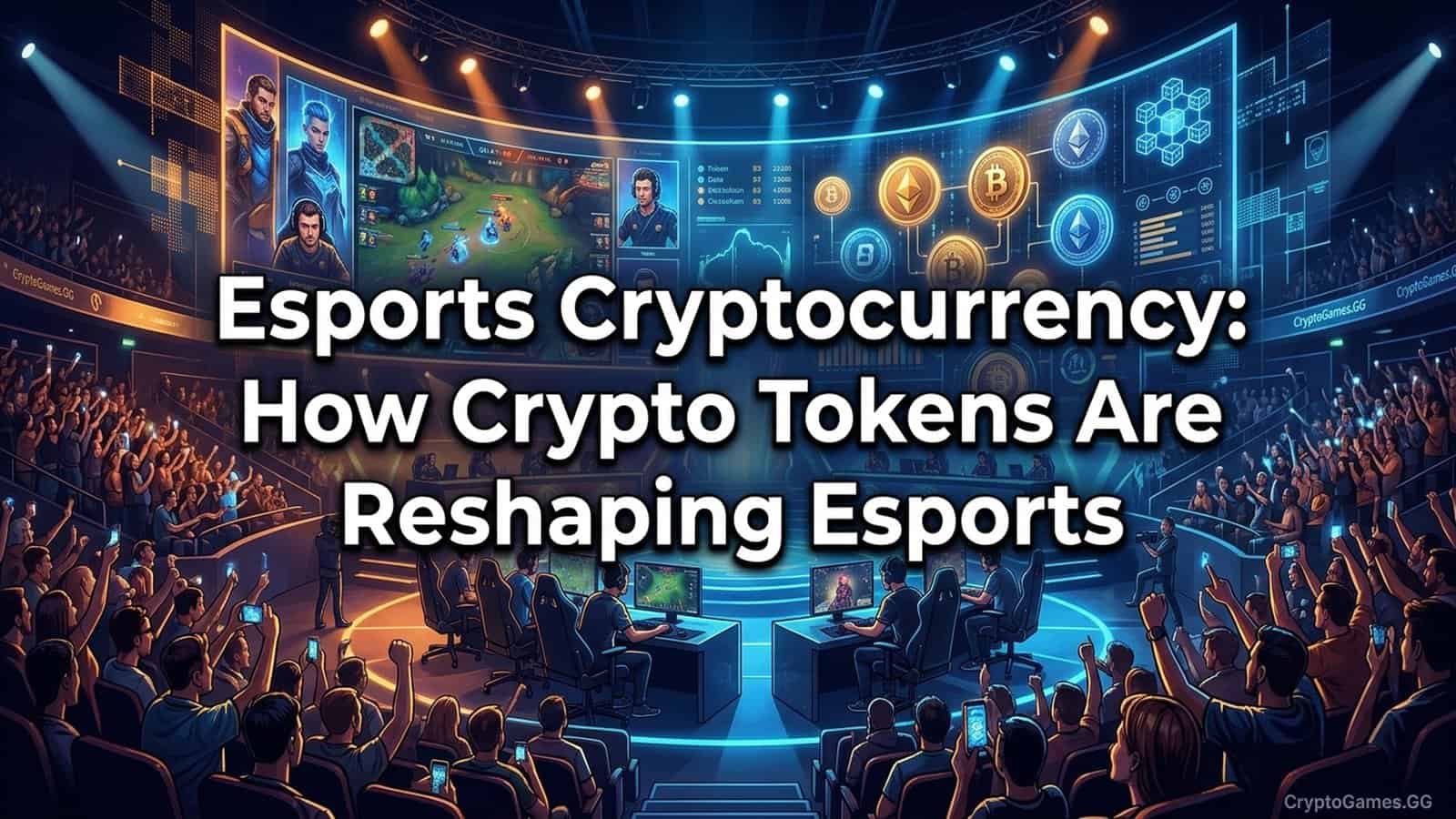


Esports cryptocurrency encompasses a range of blockchain-based tokens that connect competitive gaming to crypto economics. Fan tokens give supporters voting rights and exclusive access. Player tokens represent economic stakes in individual professional players. Blockchain prize pools automate tournament payouts through smart contracts. The intersection has produced some genuine innovations and some significant marketing noise. This guide separates them honestly.
Quick Answer: Esports cryptocurrency operates across three distinct segments: fan tokens issued by esports organizations through platforms like Chiliz and Socios.com, giving fans voting rights on minor decisions and exclusive access; prize pool tokens where tournament winnings are distributed as cryptocurrency; and blockchain-native esports games where competitive assets are NFTs. Fan tokens are the most developed segment. Player revenue-sharing tokens remain legally complex in most jurisdictions.
The Three Segments of Esports Cryptocurrency
Esports cryptocurrency does not describe a single unified phenomenon. Three distinct segments exist, each with different mechanics, risk profiles, and levels of adoption.
Fan tokens are the most established segment. Esports organizations issue tokens on blockchain platforms that give holders fan engagement benefits: voting on minor team decisions, accessing exclusive content, and priority ticket purchasing. Chiliz’s Socios.com platform leads this market.
Player and team economic tokens represent a more speculative development where tokens give holders financial stakes in player earnings or team performance. This segment is less developed and more legally complex than fan tokens, particularly regarding securities law questions in jurisdictions such as the United States.
Blockchain-native esports refers to competitive gaming within blockchain games where the assets players compete with are NFTs and tournament prizes are distributed as cryptocurrency through smart contracts. Gods Unchained, Parallel TCG, and RavenQuest all have developed competitive structures within this model.
Fan Tokens: The Established Model
Fan tokens are the most mainstream form of esports cryptocurrency. They give token holders limited but real participation rights in their supported team or organization: votes on minor decisions, exclusive merchandise access, enhanced viewing experiences, and priority event access.
The economic model for fan tokens is participation-based rather than profit-sharing. Holding a fan token does not entitle you to a share of team prize winnings, sponsorship revenue, or broadcast fees. What it entitles you to is enhanced fan engagement mechanics and the status of being a token holder within the team’s community.
Fan token prices fluctuate with team performance, major tournament schedules, and broader cryptocurrency market conditions. Tokens for teams during or approaching major tournament runs typically see price increases as demand from excited fans competes with existing supply. Post-tournament, prices typically normalize.
How Chiliz and Socios.com Work
Chiliz is the blockchain platform underlying Socios.com, the primary fan token marketplace for sports and esports organizations. The CHZ token is the base currency used across the Socios ecosystem for purchasing fan tokens and participating in fan engagement activities.
Organizations that want to issue fan tokens work with Socios to create a token supply. Initial token offerings (ITOs) sell the first batch of tokens to fans, generating revenue for the organization. Tokens then trade on secondary markets where any holder can buy or sell at market prices.
Chiliz Fan Token Rewards is a separate program that issues reward tokens to fans who participate in voting events and app interactions, creating engagement incentives beyond simple token holding. The gamification of fan engagement is a significant part of Socios’s appeal for both organizations and supporters.
The Chiliz blockchain processes fan token transactions at scale with low fees, making it practical for fans to vote, trade small amounts, and participate in engagement events without prohibitive transaction costs.
Esports Fan Token Examples and Performance
Multiple esports organizations have issued fan tokens through Socios and other platforms.
Team Liquid has been among the more active esports organizations in the Socios ecosystem. Their fan token (LQID) has seen the volatility pattern common to fan tokens: price spikes around major tournament participation and normalized prices during off-seasons.
Faze Clan issued fan tokens during their peak period of mainstream cultural influence. Faze Clan’s engagement with NFTs and cryptocurrency through multiple channels, including Socios fan tokens and direct NFT drops, represented one of the more comprehensive esports crypto strategies in the industry.
NAVI (Natus Vincere) the European esports organization famous for their Counter-Strike dominance, issued a fan token that attracted support from their substantial global fanbase. NAVI’s competitive success in major tournaments created natural demand events for the token during tournament periods.
The pattern across most esports fan tokens is consistent: price movements are more correlated with team competitive performance and cryptocurrency market cycles than with intrinsic value creation. Fans who buy tokens because they believe their team will win and want to share in the excitement are the primary demand driver, not investors seeking returns from business fundamentals.
Player Tokens and Revenue Sharing
Player tokens represent a more ambitious and legally complex segment of esports cryptocurrency. The concept: a professional player issues a fixed supply of tokens representing some economic stake in their future earnings. Holders receive a percentage of tournament winnings, streaming revenue, and sponsorship deals in exchange for their token holdings.
Several platforms have attempted this model, including Starly, Rally, and various sports-specific player token platforms. The model faces significant regulatory challenges in the United States and Europe, where tokens representing profit-sharing arrangements may qualify as securities requiring registration with financial regulators.
In practice, most player token implementations have been modified to avoid explicit revenue sharing, instead offering exclusive access, merchandise, and engagement benefits — effectively converging with the fan token model while avoiding securities law issues. Genuine player revenue-sharing tokens remain legally ambiguous in most major jurisdictions as of 2026.
Blockchain Prize Pools
Tournament organizers using blockchain for prize distribution offer two practical advantages over traditional methods: transparency and automation. Funds deposited into a smart contract prize pool are publicly verifiable before the tournament begins. Participants can confirm the prize pool exists rather than trusting the organizer’s word. Payouts execute automatically when tournament results are recorded, without depending on organizer timeliness or good faith.
Several blockchain gaming tournaments have used this model successfully. Gods Unchained’s ranked season rewards distribute automatically to top-ranked players based on on-chain leaderboard data. No human needs to approve payment — the smart contract reads the leaderboard and distributes rewards to qualifying wallet addresses.
For blockchain-native games, this integration is straightforward because game results are already on-chain. For traditional esports games, implementing blockchain prize distribution requires creating a trust oracle that can verify traditional game results and trigger smart contract payouts — a more complex integration that most traditional esports tournaments have not undertaken.
Blockchain-Native Esports Games
The clearest current intersection of blockchain and genuine competitive esports exists in games built on blockchain from the ground up.
Gods Unchained has the most developed competitive scene among blockchain-native games. Ranked seasons create structured competition with NFT card pack rewards distributed to high-performing players. The game’s competitive community shares strategic discussion, deck analysis, and meta commentary that mirrors traditional card game competitive communities.
Parallel TCG runs regular competitive tournaments with PRIME token prizes and NFT rewards. Their competitive infrastructure includes online qualifiers, regular prize pools, and a growing community of dedicated competitive players who engage with the game for its strategic depth independently of the NFT component.
According to Chainlink’s esports and blockchain analysis, the most durable intersections of blockchain and competitive gaming focus on asset ownership and prize distribution mechanics rather than speculative player token schemes. The utility is clearer and the regulatory path is less complicated.
What Esports Cryptocurrency Delivers vs What Is Hype
| Claim | Reality in 2026 |
|---|---|
| Fan tokens give fans a real voice | Partial. Voting rights are real but limited to non-strategic decisions. Teams do not put meaningful business decisions to token vote. |
| Player tokens let fans share in star earnings | Mostly unrealized. Legal complexity has limited most implementations to fan engagement benefits rather than genuine revenue sharing. |
| Blockchain eliminates prize payment delays | True for blockchain-native games. Very limited adoption in traditional esports where off-chain result verification adds complexity. |
| Fan tokens are investments in team success | Partially. Price correlates with team performance but does not entitle holders to financial participation in team revenue. |
| Blockchain esports is the future of competitive gaming | Blockchain-native competitive gaming is growing but traditional esports games show no signs of blockchain integration in core competitive mechanics. |
Frequently Asked Questions
What is an esports fan token?
A blockchain-based token issued by an esports organization that gives holders fan engagement benefits: voting rights on minor team decisions, exclusive content access, enhanced viewing experiences, and priority merchandise purchasing. Traded on secondary markets through platforms like Chiliz’s Socios.com. Price fluctuates with team performance cycles and broader cryptocurrency markets.
Can you earn cryptocurrency by playing esports competitively?
Yes, in blockchain-native competitive games like Gods Unchained and Parallel TCG. Ranked competition distributes NFT and token rewards to top performers. In traditional esports games like Counter-Strike or League of Legends, prize pools are typically paid in fiat currency unless a specific tournament organization chooses cryptocurrency distribution. A small number of blockchain-native esports tournaments offer cryptocurrency prizes directly.
Are esports fan tokens a good investment?
Fan tokens are primarily fan engagement products rather than financial investments. Price appreciation is correlated with team competitive success and crypto market cycles rather than with business fundamentals. Holders who buy to support their team and participate in fan experiences may find the engagement value worthwhile. Holders primarily seeking financial returns should understand that fan tokens are not claims on team revenue and are highly volatile.
What esports organizations have cryptocurrency tokens?
Multiple major esports organizations have issued fan tokens through Socios.com including Team Liquid, Faze Clan, Natus Vincere, and others. The specific active tokens and organizations change as the market evolves. Check Socios.com’s current partner list for the most up-to-date roster of esports organizations with active fan tokens.
How are blockchain gaming tournaments different from traditional esports?
In blockchain gaming tournaments, competitive assets (cards, characters, items) are NFTs the players own rather than licensed content from the developer. Prize pools can be distributed automatically through smart contracts when on-chain results are recorded. Players who earn valuable NFTs through tournament performance own those assets permanently and can sell them on open markets. In traditional esports, all assets are developer-owned and prize distribution depends on organizer processes.
Esports cryptocurrency is at its most valuable where it solves real problems: automating prize distribution that traditionally required organizer trust, giving fans meaningful engagement mechanics beyond passive viewership, and creating player-owned competitive assets in blockchain-native games. Where it has been used primarily as a fundraising mechanism or speculative vehicle without genuine fan utility, the outcomes have been poor for holders and damaging to the organizations that issued the tokens. Follow the utility, not the hype.