
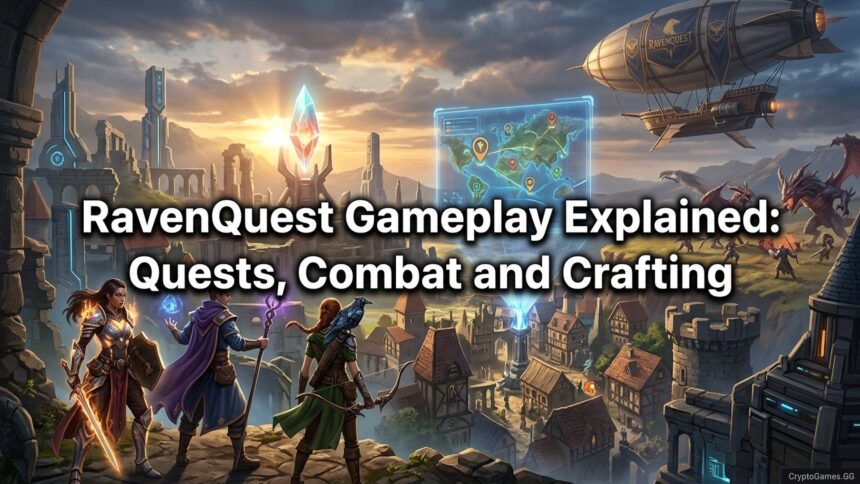
RavenQuest has more depth than it shows you in the first hour. The pixel art style reads casual. The reality is a strategic MMORPG with interlocking systems around RavenQuest progression that took eight years to build. This guide breaks down every gameplay system that matters: how quests work, how the combat model functions across different Archetype builds, how the crafting economy creates real earning opportunities, and how to build efficient progression habits that compound into consistent $QUEST earnings. Whether you want to focus on PvP, economics, or pure exploration, the systems here support all three paths.
The Quest System and How Progression Works
RavenQuest uses a multi-layered quest system that generates experience, crafting materials, and $QUEST earning simultaneously. Understanding the layers helps you prioritize efficiently rather than following every quest notification without understanding what each contributes.
Main story quests advance the game’s lore narrative and unlock new world regions. They provide the highest XP per hour in early and mid-game stages and naturally guide you through the world’s geography. Complete the main story quest line as your primary direction when you first start. It unlocks the systems you need for economic play.

Daily quests reset each day and provide consistent FAME contributions. They ask you to perform specific activities: defeat a number of certain enemy types, gather specific resources, or complete a particular crafting task. Daily quests are the most time-efficient FAME source for players with limited daily play time. Even completing three or four daily quests per session builds meaningful FAME over a week.
Weekly challenges offer larger FAME rewards for completing significant activities like defeating world bosses, running high-value Trade Pack routes, or reaching specific Profession milestones. These contribute disproportionately to weekly FAME totals for players who complete them.
Hidden Expeditions are special quests found through exploration rather than through the quest notification system. They mark player discoveries in the game world with unique rewards including $QUEST allocations. Players who deliberately explore off-route find these regularly. Players who follow only the main quest path miss them entirely.
Combat Mechanics Deep Dive
RavenQuest’s combat runs in real time with action-oriented movement. You position your character, aim abilities directionally in some cases, and manage cooldown rotations for your three Archetype spell pools simultaneously. The tactical layer comes from managing 54 potential abilities (18 per Archetype across three equipped Archetypes) down to an active hotbar of 8 to 12 slots you can reach during combat.
Cooldown management is the core mechanical skill. Each Archetype ability has an independent cooldown. Building rotations that minimize windows where you have no ability available keeps your DPS consistent and your survival tools available when needed. Beginners often burn all their cooldowns in the first 10 seconds of a tough fight and then stand there waiting for them to reset. Space your abilities deliberately rather than front-loading all your damage.
Positioning matters more in RavenQuest PvP than in PvE. Ranged builds want distance. Melee builds want to close gap and stick to targets. Many abilities have directional components or positional triggers that deal bonus damage from specific angles. Learn your active build’s positioning requirements before entering contested PvP zones.
The Archetype synergy system rewards cross-archetype combinations. Warfare abilities that reduce enemy defenses synergize with Archery abilities that deal raw damage to unarmored targets. Holy abilities that apply healing buffs to allies synergize with Protection abilities that hold enemy attention. Understanding which mechanics in your three Archetypes feed into each other turns a collection of individual abilities into a coherent combat system.
Death in PvP zones carries an item loss risk. Equip your best gear only when you have a clear plan for the session and understand the risk level of your route. Carrying backup gear sets in your bank for PvP sessions and equipping them only when needed reduces the cost of being caught off-guard.
Pro Tip: The Expeditions roguelike dungeon system added in the Treasures Below expansion is the best place to learn combat mechanics at your own pace. Expeditions scale in difficulty and let you test ability rotations against challenging enemies without the PvP risk of open world zone content. Run Expeditions specifically to learn your Archetype abilities before taking your build into PvP zones where death has real consequences.
The Crafting System Explained
Crafting in RavenQuest produces the goods that fuel Trade Packs, the items that improve character performance, and the raw materials that feed other players’ crafting operations. Every player benefits from understanding crafting even if they don’t intend to specialize in it.
Crafting occurs at specific stations in safe-zone cities. Each station produces different item categories. Blacksmithing stations produce weapons and armor. Alchemy stations produce consumables and buffs. Woodworking stations produce tools and certain structural components. Cooking stations produce food items that apply temporary stat buffs during combat sessions.
Material inputs for crafting come from resource nodes in the open world. Wood, ore, herbs, and other raw materials gather from nodes that spawn in specific regions. Higher-tier regions contain higher-tier materials that produce higher-quality crafted items. The resource gathering loop connects to the combat loop: reaching high-tier resource regions often requires fighting through enemy populations or navigating contested PvP zones.
Crafting produces items at quality levels based on your Profession skill and the tier of materials used. Higher Profession skill in a crafting category allows you to use higher-tier materials and produce better quality outputs. Investing skill progression into a primary crafting profession creates a compounding advantage: better materials access means better outputs, which sell for higher prices in the player auction system or convert into more valuable Trade Packs.
Professions and Skill Progression
Professions are skill trees that improve your character’s capabilities in specific activity domains: combat, gathering, crafting, or trading. Investing Profession points into a single tree creates depth of specialization. Spreading points across all professions creates a generalist who does everything adequately but nothing exceptionally.
Combat professions improve damage output, survivability, and ability effectiveness for specific Archetype types. Investing in the Warfare combat profession improves the effectiveness of your Warfare Archetype abilities specifically rather than providing generic stat increases.
Gathering professions improve resource yield and access to special resource node types. Investing here creates a character who generates more crafting materials per hour in the open world. This directly increases the volume of Trade Packs you can run per session.
Trading professions improve Trade Pack delivery values and reduce the time cost of certain economic activities. High-level Trading profession characters earn more $QUEST per delivered Trade Pack than low-level characters running identical routes. For players focused on economic play over combat, Trading professions are the highest-priority investment.
Dungeon Expeditions: The Roguelike System
The Treasures Below expansion introduced Expeditions, a scaling roguelike dungeon system that provides the most challenging PvE content in RavenQuest. Expeditions generate scaling loot quality, unique Expedition-specific items, and FAME contributions without PvP risk.
Each Expedition run generates a procedurally varied dungeon with random enemy compositions and encounter types. Difficulty scales based on the Expedition tier you enter. Higher-tier Expeditions require stronger builds and better coordination but yield proportionally better rewards. The roguelike design means each run is unique, maintaining long-term interest beyond what static dungeon content provides.
Running Expeditions with guildmates multiplies both challenge and reward potential. Group Expeditions allow higher-tier entries than most solo players can reach, and the reward multiplier for group completions makes them the most time-efficient FAME source for organized players.
Arena PvP and Ranked Mode
The Ranked Arena added in the Treasures Below expansion brings structured competitive PvP to RavenQuest with a matchmaking system and MMR-based ranking. Arena matches are instanced one-on-one or two-on-two formats where players fight without the resource loss risk of open world PvP zones.
Arena rank earns FAME at rates that scale with your rank tier. Higher rank means more FAME per Arena session, creating a meaningful progression incentive for PvP-focused players who want to maximize their weekly $QUEST allocation through structured competition rather than open world risk.
The Arena also provides a testing ground for Archetype builds. You can experiment with combination changes against real opponents without risking gear in open world zones. Top Arena players consistently report using Arena matches to refine their builds before committing those builds to high-stakes PvP trade routes.
How to Farm Efficiently
Efficient farming in RavenQuest means maximizing FAME generated per hour of actual play time rather than simply spending the most hours online.
Identify your two or three highest FAME-per-hour activities and prioritize them each session. For most players, this combination includes daily quest completion (consistent baseline FAME), one or two Trade Pack runs on a reliable route (high FAME if the route is optimized), and one Expedition run for loot and FAME variety.
Route optimization for Trade Packs reduces dead travel time. Plan your crafting, gathering, and delivery locations so each trip generates forward progress rather than backtracking. Players who map their routes in advance and pre-craft their Trade Packs before loading up for delivery run significantly more packs per session than players who plan each step reactively.
Use the Silver economy to supplement $QUEST earnings. Silver is the in-game non-blockchain currency that powers most basic commerce. Selling crafted items and gathered materials for Silver, then using Silver to buy $QUEST-denominated items for resale, creates additional earning pathways beyond pure $QUEST farming.
The Player Economy: Silver, Trade, and $QUEST
RavenQuest runs a dual-currency economy. Silver is the in-game fiat currency earned from everything, spendable on basic commerce, and exchangeable for $QUEST through specific mechanisms. $QUEST is the on-chain token with real-world value that connects the in-game economy to blockchain trading platforms.
The exchange rate between Silver and $QUEST fluctuates with supply and demand from active players. When game activity is high and many players convert Silver to $QUEST, $QUEST supply increases and the price tends to soften. When a major expansion launches and new players flood into the game, increased activity boosts both Silver generation and $QUEST demand simultaneously.
The auction house in safe-zone cities allows player-to-player trading for both currencies. Identifying market gaps, where supply of a crafted item is low relative to buyer demand, and filling those gaps through targeted crafting creates consistent Silver income that converts to $QUEST earnings beyond the FAME allocation.
Common Beginner Mistakes
Entering PvP zones too early is the most expensive mistake. Your first few hours in RavenQuest should build Profession levels, character Archetype efficiency, and understanding of the map layout before you risk gear in contested zones. Deaths in PvP zones early in your career can cost gear that takes hours to replace.
Neglecting daily quests because they feel small. Daily quests each individually are modest FAME contributors. Over a full week, consistently completing three to five dailies per day accumulates to a meaningful FAME total that anchors your weekly $QUEST allocation. Miss them consistently and your weekly earnings lag peers with identical active play time.
Spreading Profession investment too thin. A character with 5 points in every Profession tree is mediocre at everything. A character with 25 points in Trading and 15 in Gathering is exceptional at economic play. Decide your primary path early and invest accordingly rather than sampling everything shallowly.
Frequently Asked Questions
What is the fastest way to earn $QUEST in RavenQuest?
Consistent Trade Pack runs on optimized routes combined with full daily quest completion generates the most reliable weekly FAME and $QUEST allocation. PvP zone routes pay significantly more per pack than safe-zone routes. Players with high Renown multipliers from long-term investment earn more $QUEST for the same FAME activities than new players.
How does RavenQuest handle PvP griefing?
The zone system requires deliberate entry into PvP territories. You cannot be attacked in safe zones. A karma system penalizes players who repeatedly kill low-level characters in PvP zones, creating social deterrents against organized griefing campaigns.
Can I play solo effectively in RavenQuest?
Yes. Most content including questing, crafting, solo Expeditions, and safe-zone resource gathering is fully solo-viable. High-tier group Expeditions and large-scale territory control PvP require coordinated groups. Solo players miss those modes but access everything else without social dependency.
Conclusion
RavenQuest rewards players who understand its systems before trying to earn from them. Learn the Archetype combinations that suit your playstyle, optimize one Trade Pack route before expanding to others, complete daily quests without exception, and invest Profession points into a coherent specialization rather than spreading them. The FAME system compounds over time. Players who establish strong habits in the first two weeks earn significantly more by week eight than players who learn reactively as problems arise.