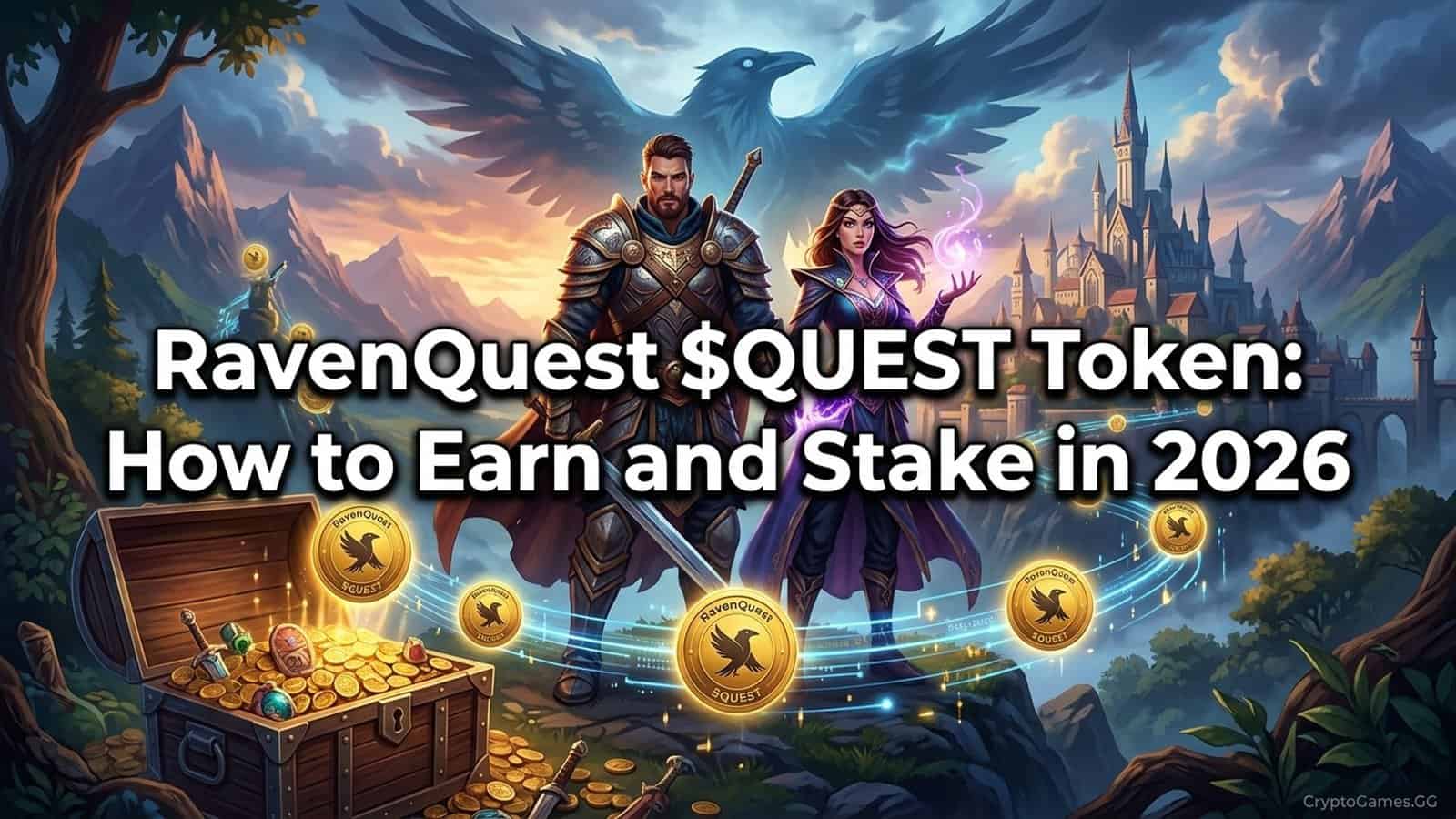


The RavenQuest Quest token connects eight years of MMORPG development to a real blockchain economy. Unlike most gaming tokens that launched before the game existed, $QUEST launched into a live game with 200,000+ monthly active players already. That sequence matters: the utility was real before the token arrived, rather than the reverse. This guide explains exactly how $QUEST works, how to earn it through gameplay, how staking functions, and what the token’s supply and distribution mechanics mean for anyone considering holding it beyond spending it in-game.
$QUEST is RavenQuest’s on-chain currency on Immutable zkEVM with a 1 billion maximum supply. Players earn it weekly through the FAME system based on gameplay activity. It spends in-game on premium features, crafting, and cosmetics. It also trades on QuickSwap V3 on Immutable zkEVM. As of early 2026, circulating supply is approximately 260 million tokens with a market cap near $1.1 million.
What $QUEST Does Inside RavenQuest
$QUEST serves as the premium in-game currency layer for all optional high-value purchases and access features in RavenQuest. Its in-game utility creates sustained organic buy pressure from active players who earn it through gameplay but also spend it regularly on features they want.
Premium membership is the highest-value $QUEST expenditure for dedicated players. A $QUEST-denominated membership subscription provides FAME multipliers, additional bank storage, and cosmetic benefits that compound over time. Active players who prioritize FAME earning often find the membership pays for itself through the FAME acceleration it provides to weekly $QUEST allocations.
Ability enhancements through RavenCards require $QUEST to open card packs. RavenCards modify specific spell performance across your Archetype builds. Rare cards with significant gameplay impact trade on secondary markets at meaningful prices, creating a consistent $QUEST sink through both primary pack purchases and secondary market activity using the token.
Cosmetic purchases including exclusive pets, mounts, and character appearance items price in $QUEST. The cosmetic economy creates demand from players who don’t need the gameplay enhancements but want visual distinction in the shared world. Social economies in successful MMORPGs consistently generate meaningful economic activity at the cosmetic layer.
Land maintenance fees for land NFT owners denominate in $QUEST. Landowners need regular $QUEST to keep their plots producing at maximum efficiency. This creates predictable recurring demand from the landowner player segment regardless of new player activity levels.
How the FAME-to-$QUEST Earning System Works
The FAME system distributes $QUEST weekly to active players based on proportional contribution to the total FAME pool. Every Tuesday, the game calculates each connected wallet’s FAME earned during the prior week and distributes $QUEST from the weekly allocation proportionally.
FAME sources and approximate relative contribution rates (based on community data from early 2026):
Trade Pack completions through PvP zones generate the highest FAME per active hour. A well-optimized Trade Pack run on a contested route can generate 3x to 5x the FAME of equivalent safe-zone questing time. The risk premium justifies the earnings premium, but the $QUEST return depends on whether you survive the route.
Daily quest completion provides consistent FAME across all activity types. Three to five daily quests completed per session generates predictable weekly FAME regardless of what else you’re doing. This makes daily quests the most reliable component of a $QUEST earning strategy since they don’t depend on market conditions or PvP zone competition.
World boss (Aether Echo) kills generate significant FAME per kill but require organized groups and competition from other players for the same boss. Coordinating guild boss runs consistently is more reliable than solo boss hunting.
Crafting and resource gathering contribute FAME at lower rates than combat and Trade Pack activities but provide FAME accumulation during sessions where active combat isn’t your focus. They serve as a FAME baseline rather than a primary earning mechanism.
Minimum activity thresholds prevent trivial accounts from claiming weekly allocations. Connect your wallet, complete a minimum level of activity measured by FAME accumulation, and confirm your claim each Tuesday through the web dashboard available at ravenquest.io.
Pro Tip: The weekly $QUEST distribution pool size is not fixed. Tavernlight can adjust the weekly allocation amount based on game health metrics and token economics goals. Following official RavenQuest social channels and the weekly patch notes gives advance notice of distribution pool changes that affect your expected weekly earnings before they happen rather than after.
The Renown Multiplier: Long-Term Earning Advantage
Renown is the permanent progression metric that multiplies your FAME earnings over time. Unlike weekly-resetting FAME, Renown accumulates permanently and creates a compounding advantage for players who invest in it early.
The Renown Multiplier means that two players performing identical activities in the same week earn different amounts of FAME. The player with higher Renown earns more FAME per action. After Tuesday calculations, the higher-Renown player receives a larger share of the weekly $QUEST pool despite playing the same amount.
How to increase Renown: reaching character level milestones, completing achievement collections, unlocking rare cosmetic items, and owning RavenQuest Munk NFTs each contribute Renown points. The fastest Renown growth comes from consistent milestone completion rather than any single large action.
The compounding math works in your favor if you invest in Renown early. A player who builds Renown aggressively in their first month earns more $QUEST per hour of gameplay for the rest of their time in RavenQuest compared to a player who delays Renown investment. Every Renown point added early benefits every future session rather than only current ones.
The Munk NFTs deserve specific attention. Owning and connecting Munk NFTs to your account provides the highest single-source Renown contribution available. Munk NFT prices vary in secondary markets. Calculating whether the additional Renown-driven $QUEST earnings over time exceed the Munk purchase cost tells you whether buying one represents a return-positive investment for your playing intensity.
$QUEST Staking: What Tavernlight Has Announced
As of early 2026, Tavernlight has announced potential token staking and buyback mechanisms but has not launched a formal staking program equivalent to ILV or AXS staking. The game’s CMO and founder have discussed ecosystem mechanisms for reducing circulating supply and rewarding long-term token holders in livestreams and community communications.
The October 2025 $20,000 Land NFT buyback demonstrated Tavernlight’s willingness to use treasury funds for supply management. A formal staking mechanism would represent the next step in that economic management approach, providing structured passive yield to $QUEST holders alongside the FAME-based earning system for active players.
Check the official RavenQuest documentation and Discord announcements for the most current staking status. The token economy is actively evolving and staking features may launch after this article’s publication. Never assume staking details based on older articles about this specific game.
$QUEST Tokenomics: Supply, Distribution, and Vesting
Total $QUEST supply: 1 billion tokens hard cap. Circulating supply as of early 2026: approximately 260 million tokens. The fully diluted valuation at current prices runs near $4.5 million, with a circulating market cap near $1.1 million.
The token distribution model allocates a portion to weekly player rewards through the FAME system. Additional allocation goes to the team and development fund with vesting schedules. Early supporters from the three pre-launch playtest phases received a small airdrop allocation. The land sale participants received $QUEST as part of landowner benefit pools.
The gap between circulating supply (260 million) and max supply (1 billion) means approximately 740 million $QUEST remains to enter circulation through future emissions, team vesting, and ecosystem programs. Unlike ILV which has nearly all its supply in circulation, $QUEST has significant future inflation potential. This is standard for a recently launched token, but holders should factor the emissions schedule into any longer-term position sizing.
The $QUEST token on CoinGecko shows real-time market cap, volume, and price data updated continuously from trading activity on Immutable zkEVM.
How to Withdraw and Trade $QUEST
$QUEST earned through FAME distributions arrives in your connected Immutable wallet on Tuesdays. The token lives natively on Immutable zkEVM. Trading it requires using QuickSwap V3 on Immutable zkEVM, which is the primary DEX for the Immutable ecosystem.
To access QuickSwap V3 on Immutable zkEVM: connect your Immutable Passport or MetaMask wallet configured for the Immutable zkEVM network. Navigate to the QuickSwap interface. Select the QUEST/USDC pair for the most liquid trading pair. Confirm the swap transaction. Gas fees on Immutable zkEVM are minimal compared to Ethereum mainnet.
Transferring $QUEST from Immutable zkEVM to Ethereum mainnet for trading on centralized exchanges requires using the official Immutable bridge. The bridge process has a withdrawal waiting period and incurs mainnet gas costs on the final settlement. For most players accumulating modest weekly $QUEST amounts, trading directly on QuickSwap within the Immutable ecosystem is more practical than bridging to mainnet for exchange trading.
Spending $QUEST in-game is the simplest path for most players. Premium membership purchases, RavenCard pack openings, and cosmetic purchases all denominate in $QUEST at rates visible in the in-game shop. Comparing these prices against the current market rate of $QUEST tells you whether you’re getting better value spending in-game versus selling and reinvesting elsewhere.
Token Buybacks and Supply Management
Tavernlight conducted a $20,000 Land NFT buyback in October 2025, removing circulating land NFT supply to stabilize asset values. The same mechanism applies to $QUEST: when the development team identifies market conditions where a buyback benefits the ecosystem, they use treasury funds to purchase tokens from the open market, effectively reducing circulating supply temporarily.
The $QUEST 2.0 token economy update released alongside the Treasures Below expansion reshaped the distribution mechanics to reward active engagement through new leaderboards and earning mechanisms. This type of iterative tokenomics management is more common in games with experienced development teams who monitor economic data and respond to emerging imbalances before they compound into structural problems.
Monitoring official announcements about supply management activities helps $QUEST holders time their own buying or selling activity relative to these events. Buyback announcements typically create short-term positive price pressure as the market anticipates reduced supply. Post-buyback, prices often settle to a new equilibrium. Neither effect is guaranteed or precisely predictable, but the pattern is common enough to be worth tracking.
Honest Risk Assessment for $QUEST Holders
$QUEST is a small-cap gaming token in a category with significant historical failure rates. Most gaming tokens launched in 2021 to 2024 declined 90% or more from their peaks. $QUEST’s low market cap relative to its all-time high reflects this category reality rather than any game-specific failure.
The risks specific to $QUEST: remaining supply inflation from the 740 million tokens yet to enter circulation, Tavernlight’s reliance on sustained player engagement to maintain FAME pool demand, and the competitive landscape of blockchain MMORPGs where well-funded competitors can erode RavenQuest’s player base over time.
The advantages relative to comparable gaming tokens: a fully launched game with proven player retention, a token that entered a live economy rather than a speculative product, and active supply management through buybacks and token economy updates. These distinguish RavenQuest from gaming projects that raised capital through token sales before shipping a product.
The realistic framing: $QUEST is best evaluated as a game-earned currency that you might accumulate to spend on premium features, convert to other assets, or hold speculatively in small amounts proportional to your gaming investment. It is not a blue-chip cryptocurrency investment. Sizing expectations accordingly leads to better outcomes than treating it as a high-conviction long-term hold.
Frequently Asked Questions
How much $QUEST can I earn per week?
Weekly earnings depend on your FAME contribution as a percentage of the total player pool and the weekly distribution pool size. Active players completing daily quests and Trade Pack routes typically earn between $2 and $20 weekly in $QUEST at current market rates, based on community reports. Highly dedicated players with strong Renown multipliers can earn more.
Do I need to hold $QUEST to play RavenQuest?
No. The entire game is free to play without touching $QUEST. Blockchain features are optional. You only need $QUEST if you want premium membership, RavenCards, specific cosmetics, or participation in the token economy layer.
What is the $QUEST token contract address?
The $QUEST token lives on Immutable zkEVM. Verify the official contract address through the official RavenQuest website or their verified CoinGecko listing to avoid interacting with impersonation tokens. Never use contract addresses from unofficial sources.
When does Tavernlight plan to launch formal staking?
As of early 2026, formal staking has been discussed but not launched. Monitor official RavenQuest Discord and patch notes for updates. Token economy features evolve rapidly in live games and announcements typically provide advance notice before implementation.
Conclusion
$QUEST is a gaming token that launched the right way: into a working game with an established player base. The FAME system’s proportional earning model creates fair distribution without guaranteeing returns, which is the honest structure for a sustainable token economy. Earn it through gameplay, spend it on features that genuinely benefit your progression, and evaluate any holding position against the realistic risk profile of a small-cap gaming token in a competitive category. The game justifies your time investment. The token rewards your engagement honestly.