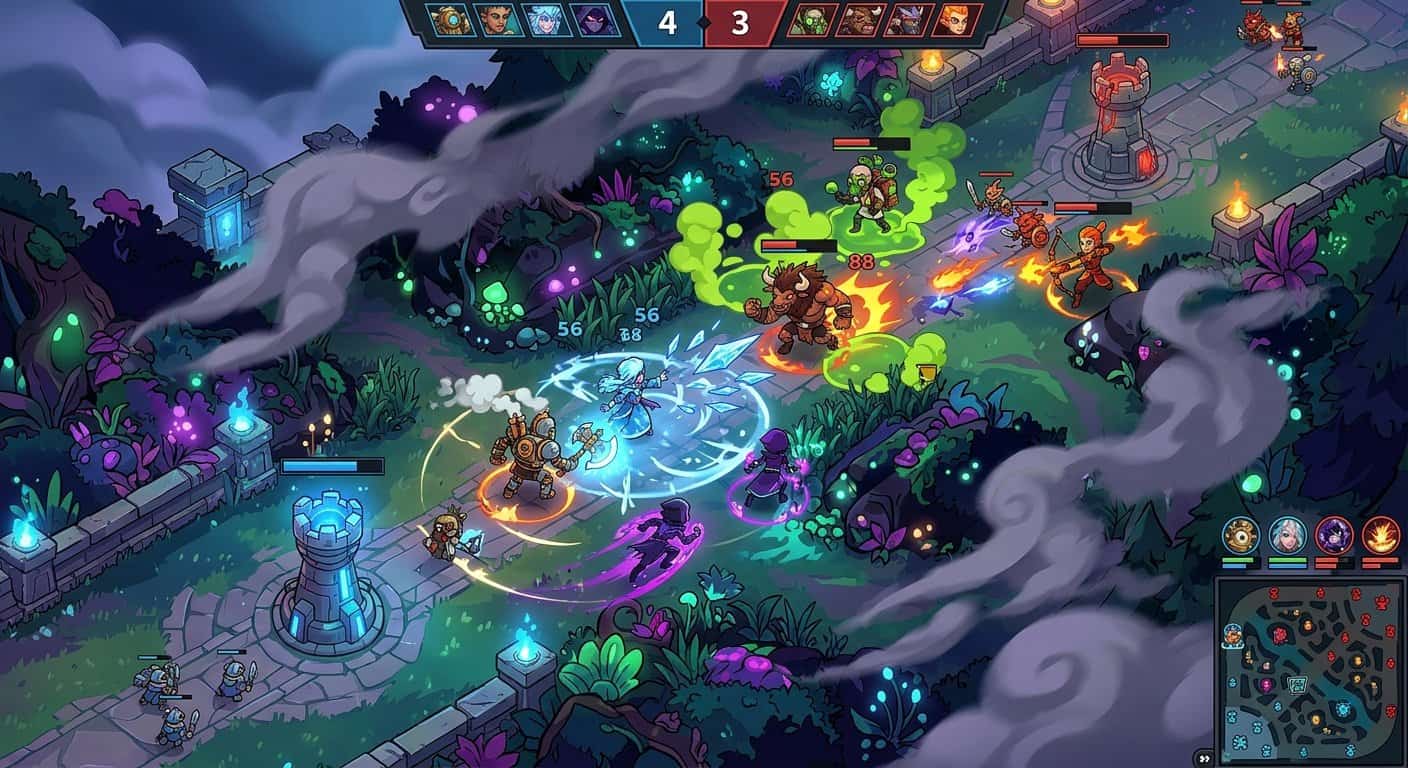

A developer named Om Patel pointed Claude Opus 4.8 at the MOBA genre and walked away with a fully playable, multiplayer League of Legends clone running in a browser. The game is called LMAO, short for League of Mediocre Arena Outcasts, and it’s live at right now. No download, no account, no install.
It has 18 original champions, a two-lane map called Ruckus Ravine with a contested jungle, fog of war, ward placement, summoner spells, a full item shop with build paths, jungle camps, epic objectives and room-based multiplayer using four-letter lobby codes. It also has bots with three difficulty settings that the tweet describes as “chill,” “normal,” and “sweaty.”
The entire thing was built in under a day by one person with zero game dev experience and zero art skills.
Every pixel is AI-generated
The art didn’t come from a designer or an asset store. Patel had Claude generate every character, animation and background as SVG code, then converted them to procedural canvas rendering for smooth in-game animation. Dedicated sub-agents handled each champion individually.
The champion names Claude originally suggested tell their own story. “Teehee” instead of Teemo. “CtrlAltDefeat” as a champion name. Patel had to manually clean them all up to avoid infringing on Riot Games’ IP. The final roster includes characters like Bramblewick, Frostele, Cogsworth, Professor Fumes, Vesh and Nana Cinder, each assigned a class (fighter, marksman, mage, tank, assassin, support).
The item shop follows the same pattern: original names that sound like they came from a parallel universe where League had a much smaller budget. Cleaver of Regret. Catastrophe Cap. Spiteful Bulwark. All with component build paths.
The tech stack and workflow
The game runs on TypeScript, React and Canvas for the frontend, with PartyKit handling the server-authoritative multiplayer backend. The map uses a tilted perspective camera rendered live in the browser. Controls mirror League’s conventions: right-click to move, A for attack-move, QWER for abilities.
Patel’s workflow treated Claude like a development team. He used /goal commands to kick off the entire project and queue up lists of bug fixes, and ultracode workflows for large optimization tasks. Claude built the bot AI on its own, complete with last-hitting, ganking and, according to the website, pinging you when you’re missing.
The token bill
The project consumed 2.7 billion total tokens, though the majority were cache reads. Actual output came to 15.5 million tokens. At Anthropic’s list API pricing, that would have cost roughly $6,600. Patel covered it using his Pro Max subscriptions instead.
What this signals
The LMAO project is joining a growing list of AI-built games that people are using as informal benchmarks for model capability. The question has shifted from “can AI write code” to “how complex of an application can it build end-to-end with a single operator.”
A multiplayer MOBA with 18 characters, networked play, bot AI, fog of war, an item economy and jungle objectives is a specific answer to that question. It’s not a polished commercial product. The website’s disclaimer makes that clear: “Not affiliated with, endorsed by, or even dimly aware of any other game that may sound similar. Any resemblance to a more expensive product is purely a triumph of the human spirit.”
But it works. You can play it right now with friends or against bots that, according to the fake review section on the site, “try far too hard.”