


There’s no single switch that turns off Instagram’s data collection. I went looking for one, and what I found instead was seven separate places you have to check, spread across the app, your phone’s system settings and a web page you can’t reach from your phone.
That’s the honest starting point. Meta can still learn from what you search for, watch, like, follow, post and click inside Instagram no matter what you toggle. It also receives device and network information, location-related signals, data from businesses and information shared across connected accounts. Meta AI can use Facebook and Instagram activity to tailor its recommendations, too.
So the job isn’t shutting it off. The job is going source by source and closing the ones you can.
The setting that explains the telepathic ads
You know the feeling. You browse a product on some other site, and an ad for the same thing shows up in your feed minutes later.
Meta says it doesn’t use your phone’s microphone to listen in on your conversations to serve those ads. The more mundane explanation: a retailer, app or other business sent it information about your visit, purchase or another interaction.
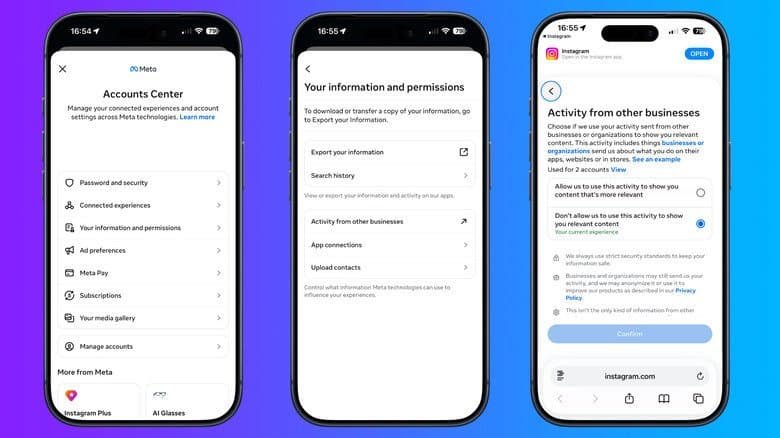
Meta began rolling out a broader Activity from other businesses control in July 2026. It replaces Your activity off Meta technologies and expands an older ad setting called Activity information from ad partners. The new control decides whether businesses can use the information they already send to personalize ads, Feed content and AI responses.
To find it, open Instagram, go to your profile, tap the three-line menu and open Accounts Center. Look for Activity from other businesses. Meta is introducing the setting by country, so some accounts will still show Ad preferences > Ad settings > Activity information from ad partners instead. Pick the option that stops Meta from using this activity for personalization.
Now the part nobody puts in the announcement. This doesn’t stop businesses from sending the data, and it doesn’t touch activity generated inside Instagram. Your ads can still reflect the accounts you follow, posts or Reels you engage with, searches, ad clicks, profile details or customer lists uploaded by advertisers. You’re telling Meta that your activity off its platforms shouldn’t inform your ad experience. You’re not turning off ad personalization.
Europe gets a second lever, and it’s weaker than it sounds
In the European Region, Accounts Center offers personalized or less-personalized ads under Ad preferences > Ad settings > Ad experience.
Less-personalized uses fewer signals. But Meta says it can still use details such as age, location, device information, ad interactions and content on screen during the current session. Content on screen during the current session is doing a lot of work in that sentence.
Your phone’s own controls do something different
On an iPhone, open Settings > Privacy & Security > Tracking and turn off Instagram’s permission. Apple’s Ask App Not to Track blocks tracking across other companies’ apps and websites for advertising or sharing information with data brokers. It doesn’t stop Instagram from recording what you do inside Instagram.
On Android, the path is usually Settings > Apps > Instagram > Permissions. Go through location, contacts, photos and videos, camera and microphone, and deny anything you don’t need.
Turning off location removes one direct source. It doesn’t make you invisible. Meta may still estimate where you are from an IP address, network information, device signals and account activity.
Contact syncing is its own separate problem
This one’s buried, and it’s the setting I’d check first if you’ve had the app for years.
Go to Accounts Center > Your information and permissions > Upload contacts, select the Instagram account and turn off Connect contacts on every device. Every device is the operative phrase. It’s per-device, so switching it off on your phone leaves an old tablet happily syncing.
That stops future syncing. It does not delete contacts already uploaded. For those, you need Manage contacts in Accounts Center on Instagram.com, and Meta says deletion can take up to 90 days.
Linked accounts feed each other
Meta uses information across accounts added to the same Accounts Center to personalize ads and suggest accounts to follow.
Removing an account under Accounts Center > Accounts pulls it out of that Accounts Center. It may also disable shared logins and other connected features, which is a real cost if you rely on them. And it does not delete the account or the information already attached to it.
Talking to Meta AI counts as activity now
On December 16, 2025, Meta began using interactions with its AI features as signals for content and ad personalization in most regions. Mention hiking in a chat, and that could contribute to later recommendations for hiking posts or products.
There’s no setting for this. Meta did not introduce a separate control that lets you keep chatting with Meta AI while excluding those conversations from this use. You chat, or you don’t.
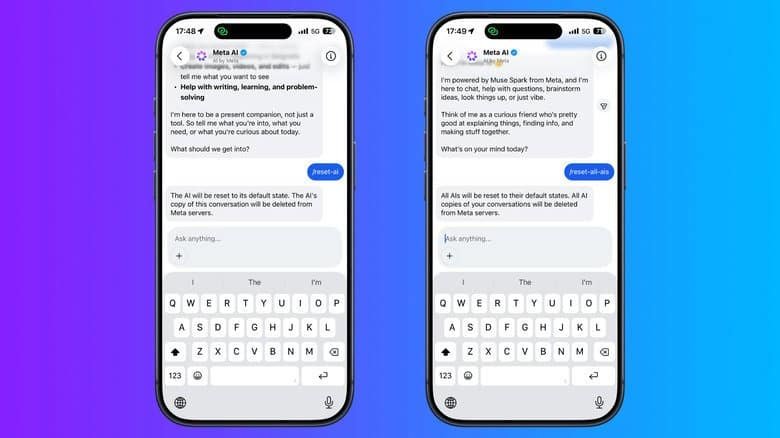
What you do get is two cleanup commands in Instagram AI chats. Type /reset-ai to delete that AI’s copy of the conversation and the details it saved, or /reset-all-ais to reset every AI chat in the app. Your visible chat sticks around until you delete it yourself.
Be clear about what these commands are. They clear saved context. They aren’t opt-outs from advertising, ordinary data collection, or model training.
Model training is a different fight entirely
Personalization and training are separate systems, and the settings above don’t govern the second one.
Meta uses public posts and comments from adult accounts, along with interactions with its AI features, to improve generative AI models in regions where it relies on legitimate interests. Users in the EU and UK can object through Meta’s Privacy Center. That’s a regional right, not a universal Instagram setting.
Which leaves the one rule that works everywhere, on every account, regardless of which version of the settings menu Meta has rolled out to you: don’t put names, addresses, financial details, medical information or anything else you wouldn’t post publicly into a Meta AI chat. Run the reset commands after a conversation you’d rather the AI forget, and file the objection form if you’re somewhere it exists.



[…] lawsuit accuses Meta of designing Instagram and Facebook in ways that encouraged children to use the platforms compulsively while failing to address […]