Mangoes are better than plums. I know this. I chose plums anyway.
That was the first real decision Petit Planet asked of me, and it tells you most of what you need to know about the game. The new life sim from miHoYo, published by HoYoverse for a planned winter 2026 release, hands you two starter worlds: Hexia, a mildly temperate place where plums grow with abundance, or Taffeh, a savanna world drenched in red sunset and home to forests of mango trees. Your fruit becomes the basis of your cooking, trading, gifting and eating at the start of the game. It’s been a hot summer. I went with Hexia.
Yes, it’s Animal Crossing. No, that’s not a knock.
There’s no pretending otherwise. Both games are twee crafting sims about managing small villages. Both feature a wide cast of anthropomorphic animals. Both run on a feedback loop of meditative bliss.
And yet Petit Planet impresses despite its commitment to well-established form. I played an hour of it at Gamescom 2026 and got pulled into the vibes faster than I expected, even as I kept circling back to a question about how long any of it holds.

You’re the human in a world of talking animals
The first person Petit Planet introduces you to is yourself. The place is stuffed with anthropomorphic animals, but you play as a person, hired by a company called Loomi Co. to help revitalize uninhabited planets in a solar cluster called the Starsea.
Character creation lets you pick a title from options including Hustling, Grass-Gathering, Stargazing, Laid-Back, Popular and Essay-Writing. Guess which one I took. You name yourself, too. I went with Ari1, a choice I stand by and will not be defending.

The planet select wheel implied there’d be more than two worlds in the final version. For the demo, it was Hexia or Taffeh.
An hour of shaking trees and dodging bugs
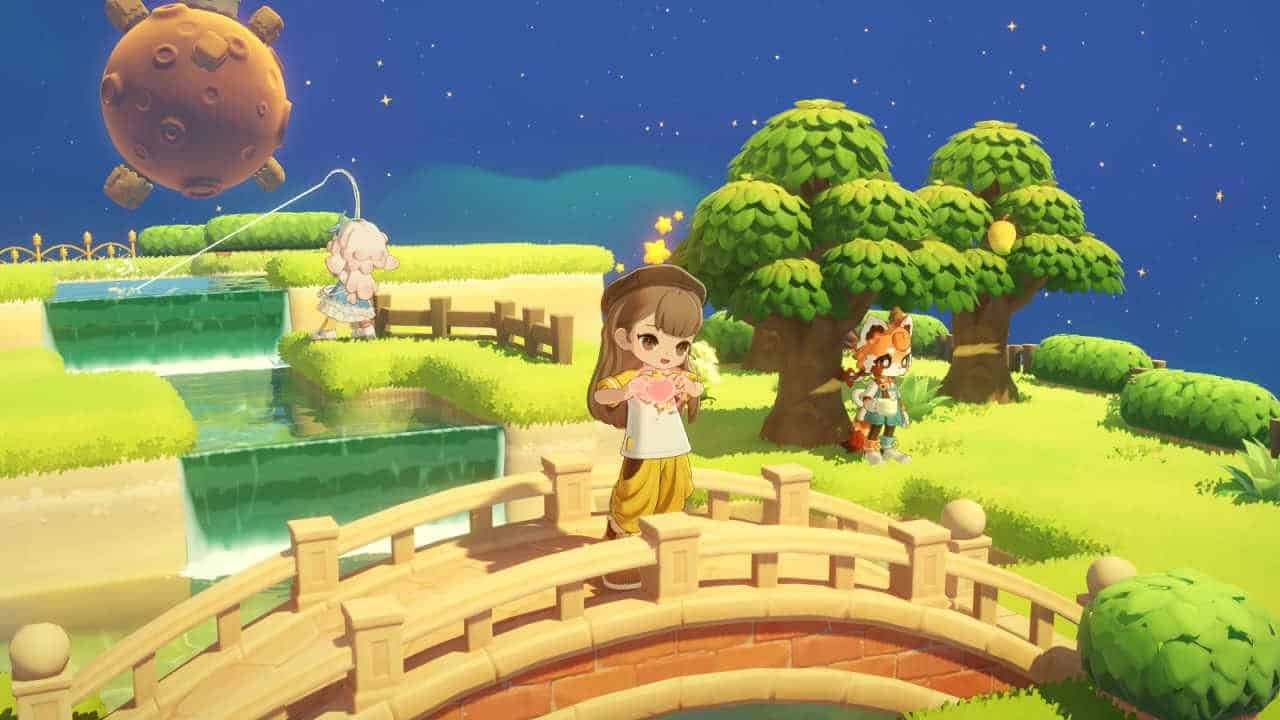
My planet felt roughly Mario Galaxy-sized, which is to say small enough to circle and big enough to keep finding things. I shook plum trees. I gathered plums. I met a bear named Mobai and learned to make his special tea, whose key ingredient is, of course, plums.
Mobai also taught me to fish and catch bugs and handed over a rod and a net. Other residents turned up, including a bunny with pink fur named Elsasani.
The minigames aren’t stressful. You point your tool at the bug or fish you want, then click a fleeting icon when it appears. Simple, but it’s how you clear those early-game missions of the “catch five different types of bugs” variety, and it gives the game a layer of interactivity past gathering and building.
I pulled in a Black Carp, Mosquitofish and Black Tilapia. Snagged a Pearl Oyster and Moon Crab from shallow water. Caught a bunch of bugs whose names I tapped through as fast as the game would let me, because I’m scared of bugs. Yes, even the cutesily rendered ones.
The actual goal, sort of
Hand your creatures to Mobai and your planet’s ecology grows. That appears to be the primary mission, though the game doesn’t push you to stay on task.
A healthier planet pulls in more animal neighbors, each with a unique name and personality. You get a kit early on that lets you build a house, then more kits for building houses for your citizens. Before long you’ve got a neighborhood.
The animals talk. That’s the twist, and the complication.
In one notable break from its inspiration, the animals in Petit Planet speak with fully voiced dialogue instead of Animal Crossing‘s cutesy gibberish.
Which lands differently given that back in May, HoYoverse caught some flak for reportedly planning to invest $14.6 billion in AI tools over the next three years, including for “AI-powered NPCs” in Petit Planet. A 2025 early beta of the game appeared to use AI-generated text for character speech bubbles.
Asked whether the Gamescom demo included AI voices, a representative for HoYoverse sent this statement: “All voice performances in the playable demo were delivered by real human voice actors. No AI-generated voices were used. We remain committed to working with talented voice acting professionals to bring our characters to life.”
The hub, and the thing lurking in it
My demo wrapped after a trip to Galactic Bazaar, the de facto hub area. There I unlocked chat with other human players and earned a signpost that let me name my world. I called it Planet1. Consistency is a virtue.
The Bazaar also has a rhythm minigame, item trading and social spaces to sit around in: cafes, fire pits, public squares.
There will be a gacha element of some sort. I didn’t run into it during the demo, but I spent the back half of my hour imagining every way a premium currency could scrape against the idyllic vibes the rest of the game works so hard to build.
That’s the existential question here. A good cozy game promises limitless creativity. Capitalism has very tangible bounds. One of them gives.
Petit Planet hits Windows PC in winter 2026, with a limited beta running in late September. I’ll be there, on Hexia, eating plums I didn’t want.