

In Brief:
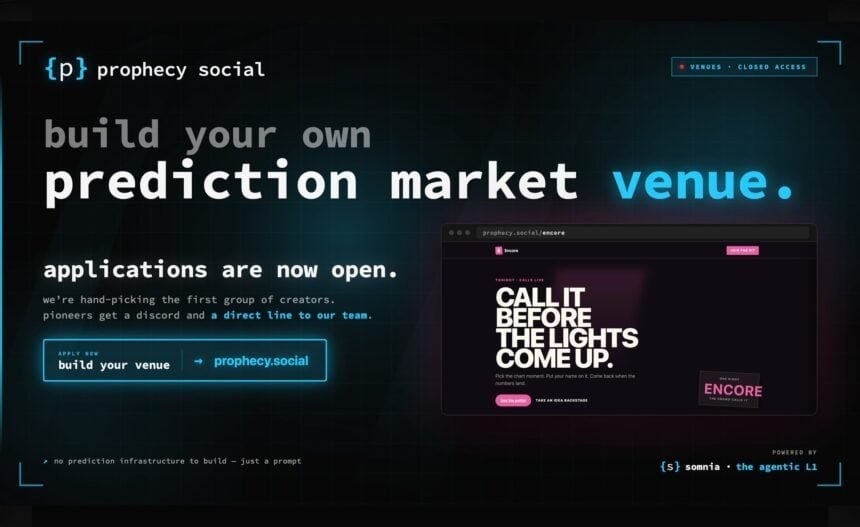
- Prophecy Social announced Prophecy Social Venues, letting creators and communities deploy their own branded prediction market venues on the same infrastructure that runs its main app.
- Operators control branding, categories and curation while Prophecy handles resolution, settlement and liquidity, and every market shares liquidity across the protocol no matter which venue created it.
- Somnia published a breakdown of the underlying architecture days after the announcement, pointing to AI agents that resolve markets inside the execution environment rather than through an external oracle.
Prophecy Social opened its prediction market stack to outside operators this week, announcing Prophecy Social Venues.
Creators and communities can deploy their own venue with their own branding, markets and categories, running on the same infrastructure behind Prophecy Social itself. Somnia said projects and communities can create a custom venue using an agent, with market creation and resolution handled agentically. The rollout is going out through a closed beta.

Earlier this week, @ProphecySocial_ announced Prophecy Social Venues, giving creators and communities the ability to build their own prediction market experiences on top of the same infrastructure powering their platform.
This article breaks down how that infrastructure works@SomniaView on X ↗
What operators get
Prophecy handles resolution, settlement and liquidity. The venue owner keeps control of curation.
Liquidity doesn’t fragment across venues. Every market shares liquidity across the entire protocol regardless of which venue created it, making venues branded front ends and curation layers rather than separate pools.
Points work the same way. Prophecy Points span every Prophecy Social venue, and trader counts are measured as distinct wallets holding points across all venues. The daily PST bonus is one claim per day across every venue in the Somnia ecosystem.
How resolution works
There’s no human moderator and no dispute committee. When a trading window closes, multiple independent AI agents pull evidence from news APIs, price oracles and public data feeds, each evaluating it against the market’s resolution criteria and producing a vote with its reasoning attached.
The consensus threshold is visible on every market before a user takes a position. Once agents reach it, the outcome is recorded on Somnia and winners can claim immediately.
After a market closes, users can inspect the full resolution trail: which sources the agents consulted, what they found and how each one voted.
The edge case is spelled out in the docs. If agents can’t reach consensus or find insufficient evidence, the market settles at the last known price position, and each trader’s PST payout reflects the value of their shares at the point resolution was attempted, not a return of the original stake.
Somnia’s architectural argument is that the agent runs inside the execution environment with the same consensus guarantees as any other onchain transaction. Execution runs across validator nodes, so the outcome is verified by the network rather than a single service. Most systems that rely on AI for resolution bolt it on externally, according to Somnia, which is where they slow down and where trust gaps appear.
Every market also carries a quality score called the Caliber, assigned at creation, rating source reliability and question precision. Higher-rated markets pulled meaningful participation in week one. Lower-rated ones didn’t.
The token is play money
PST is soulbound. It can’t be transferred, traded or cashed out. Users get a one-time grant at sign-up that carries across venues, a daily top-up every 24 hours, and more through correct predictions and market creation.
The platform is free to play, with the trading fee sponsored by Prophecy Social and Somnia. Sign-up runs through FaceID, email, Google or X, and a Somnia wallet is created automatically with no gas to manage. SOMI rewards go out at the end of each season based on the leaderboard.
Week one numbers
More than 5,000 users joined in less than a week after launch and over 2,000 markets went live, each created and resolved without manual intervention. Week one generated 3.6 million points counting toward SOMI rewards.
Creation is prompt-based. A user types a prompt, and Somnia agents structure the market, define resolution criteria and publish it onchain, with no human in the loop from prompt to validation to creation to resolution.
Prophecy Social has been widening what users can build. “We’re starting off the week with some good news: public market creation is back! You can now make your own crypto and football markets. The points are awarded when a market closes, not when they’re created (so metrics like volume can be counted too). More categories coming via verified partner status. Keep an eye out!” the project said in a post on X. Stocks markets followed, letting users build questions on whether a ticker closes above or below a target price.
Background
Somnia’s mainnet launched in September 2025 and has processed more than 2 billion transactions. The chain started as a high-throughput network aimed at metaverse and consumer applications before repositioning as an Agentic L1 built for AI agents, on the thesis that the next phase of the internet will be shaped by agents operating onchain. Its stack includes MultiStream consensus and the IceDB state database.
A March 2026 leadership change brought in Peter Lipka, co-founder and former chief operating officer of Improbable, as chief executive officer, alongside Harry Lang as chief marketing officer and Kevin Zia as chief operating officer. Founder Paul Thomas remains involved, with his focus shifted toward long-range direction. Thomas described the prediction protocol’s design this way: “This concept gives us the market of markets.”
Lipka laid out the infrastructure case in a keynote titled “Prediction Markets in the Age of AI Agents” at Prediction Conference 2026, held April 22 to 24 at MEET in downtown Las Vegas, where Somnia was a platinum sponsor. “Prediction markets are where AI and crypto converge in a way that actually works… The next phase isn’t about better interfaces. It’s about better infrastructure,” Lipka said.