

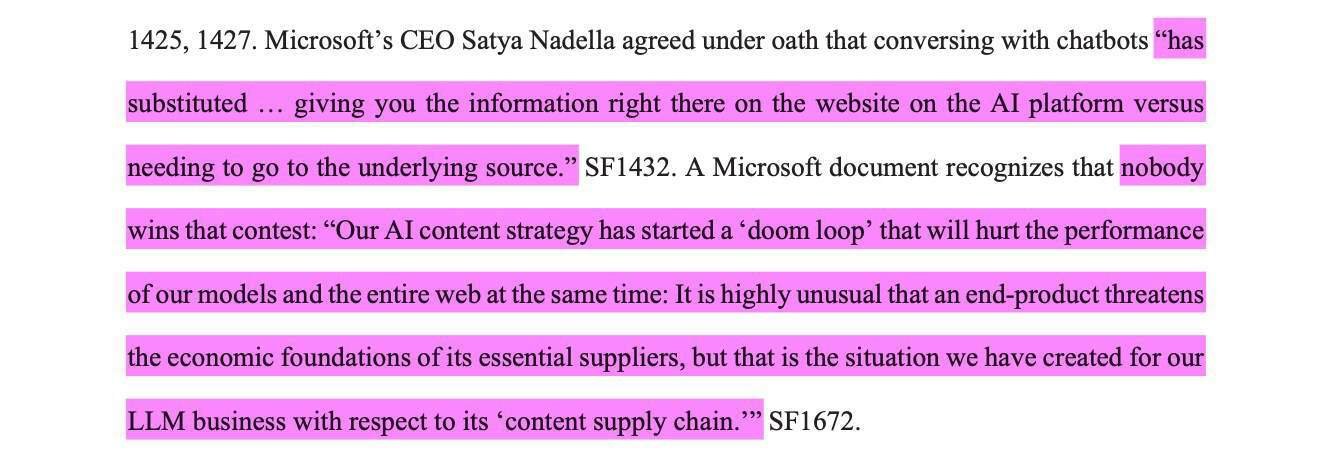
Unsealed court filings in the New York Times’ case against OpenAI and Microsoft contain a sentence no company wants read aloud in a courtroom. An internal Microsoft document describes the company’s own approach as having “started a ‘doom loop’ that will hurt the performance of our models and the entire web at the same time.”
That’s not a critic’s framing. That’s the supplier writing its own autopsy while the patient is still breathing.

The 92-page filing is full of this stuff. And the through line is uncomfortable for both companies: the people building these products understood what they were doing to the web that feeds them, wrote it down, and kept going.
The quote Microsoft is trying to disown
A large share of the sharpest language comes from Brent Hecht, Microsoft’s director of applied science. He called ChatGPT and Copilot‘s data harvesting the “largest theft of labor in human history” and said Microsoft’s defense makes a “complete mockery of the idea of ‘fair use.'”
![This case is about, as Microsoft’s Director of Applied Science [Brent Hecht] put it, “an astonishing theft of unprecedented proportions”; SF1437, perhaps the “largest theft of labor in human history.”SF1652. Defendants repeatedly copied millions of Plaintiffs’ copyrighted articles in their entiretywithout permission to produce substitutive commercial AI products. OpenAI’s Head of ChatGPTwrote that “[p]ublishers” face an “existential threat” from those products, SF1466, which, he said,“are largely substitutive, period” and “will get more and more substitutive as they get better.”SF1473-74. Such admissions eviscerate Defendants’ “fair use” defense because substitution is“copyright’s bête noire.” Andy Warhol Foundation for the Visual Arts, Inc. v. Goldsmith, 598 U.S.508, 528 (2023). For Defendants to prevail on this defense “would,” the same Microsoft executiverecognized, arguably “make a complete mockery of the idea of ‘fair use.’” SF1450.](https://cryptogames.gg/wp-content/uploads/2026/09/microsoft-and-openai-knew-theyd-started-a-web-doom-loop-2.jpg "Microsoft and OpenAI knew they'd started a web 'doom loop'")
Microsoft’s response is to put distance between itself and its own director of applied science. “These comments reflect one employee’s individual perspective, are not a legal analysis, and do not represent the company’s views,” Microsoft spokesperson Alex Haurek said.
In a separate filing, Jordan Usdan, GM for data strategy and ops at Microsoft AI, went further and cast Hecht as a kind of in-house contrarian. Hecht “holds divergent, academic, and forward-looking views about how data ecosystems for AI should operate and is employed at Microsoft to bring asymmetrical, futuristic, and academic points of view … nor is he someone who speaks for Microsoft specifically as to his theoretical views on AI’s potential effect on content creators,” Usdan said.
Read that twice. The defense isn’t that Hecht was wrong. It’s that he was hired to be the guy who says things like that.
Google Zero stopped being a theory
Here’s the part that makes the “theoretical views” line hard to swallow: it happened. Google Zero is real. AI is eating the web, and you can watch it happen in your own analytics.
Satya Nadella admits in the filing that chatbots have basically replaced search and removed the need to go straight to the source for information. The Microsoft document is blunter about what that means structurally: “It is highly unusual that an end-product threatens the economic foundations of its essential suppliers, but that is the situation we have created for our LLM business with respect to its ‘content supply chain.'”
Elsewhere, Microsoft is quoted admitting that “LLMs are a product that destroys its own supply chain,” because the model substitutes for the very training data that made it possible.
The referral numbers behind it
OpenAI’s own media and economic experts tied the drop in referral traffic at sites like the Times directly to AI summaries, including Google’s AI Overviews. They’ve speculated search referrals may be down as much as 60 percent.
OpenAI’s Nick Turley put the mechanism in one line: once you get an answer from the chatbot, there is “no good reason to click” through to the source. Internal documents called ChatGPT “the modern newsstand.” A newsstand that doesn’t pay the printers.
“Insanely good at regurgitation”
OpenAI also knew its model reproduced copyrighted material verbatim. Employees acknowledged that “prevention of memorization” mattered to “minimize copyright violations,” then noted that GPT-4 “memorized a ton of data and therefore will be insanely good at regurgitation.”
The filing follows that with receipts, citing examples of ChatGPT spitting out long strings of copy lifted straight from articles in the Times, Mercury News, The Denver Post, LifeHacker and Eurogamer.
This is the gap that matters in the case. Not whether training on public text is fair use in the abstract, but whether a system that can recite the article on demand is a substitute for reading it.
The paywall answer is the worst one
Nadella is quoted saying “anything that is paywalled should be licensed.” Reasonable position. Then an OpenAI representative admitted being “unaware” of any effort to detect or remove paywalled content from training data.
One of those statements is a principle. The other is an operations answer, and it’s the operations answer that describes what actually shipped.
About the altruism
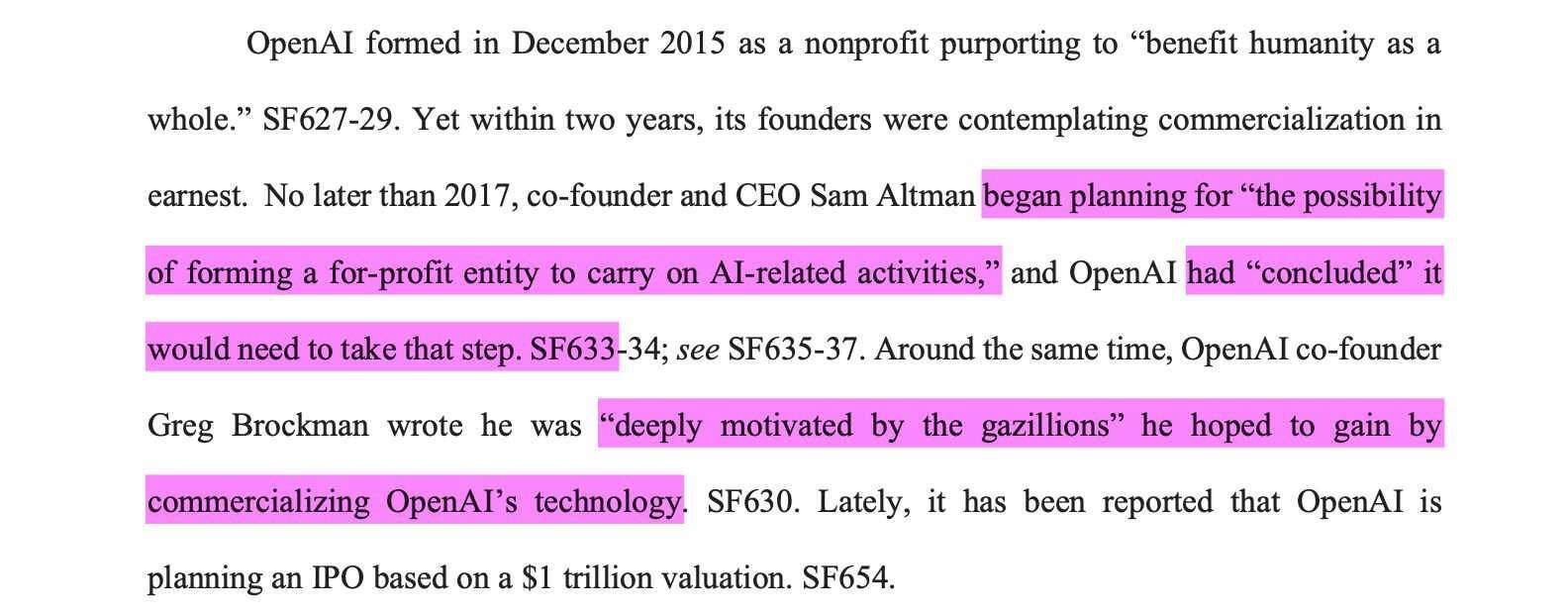
Both companies have spent years framing this work as a public good. The filing offers a different vocabulary. OpenAI cofounder Greg Brockman is more interested in the “gazillions” of dollars he could potentially make through commercial AI.
Microsoft, meanwhile, knew exactly how the scraping would land with the people being scraped, admitting that “almost no one intended for they [sic] content they created to be used in this fashion, nor are they compensated for its use.”
OpenAI policy director Jack Clark saw further than most, warning the company was “creating systems that substitute for the labor of the people that define the ‘culture’ of society.”
The defense, and what it leaves out
Haurek cautioned that “Satya’s testimony and Microsoft’s position in this case are perfectly consistent. He spoke to broad principles and changes underway in how people find and consume information. Those observations should not be confused with conclusions about copyright questions before the Court, which Microsoft addresses in its filings.”
Fine. Legal conclusions belong to the court. But the filing isn’t primarily about legal conclusions. It’s about knowledge, and on that question the documents are not ambiguous. Both companies understood they were going to do lasting damage to the publishing industry and the “millions of people” it employs, and that the damage would eventually degrade their own models, and they went ahead anyway.
If you run a site that depends on search traffic, the useful takeaway isn’t outrage. It’s that the entity best positioned to model your traffic collapse already did the math, wrote “doom loop” in a document, and shipped. Plan your next two years on the assumption that nobody is coming to fix the referral numbers, because the people who broke them counted the cost and decided the gazillions were worth it.