In Brief:
- Myria is discontinuing its Layer 2 node infrastructure as part of a full migration to Ethereum L1, announcing the change through a tweet and an email with no bridging instructions provided.
- Remaining node emission tokens will be distributed to all node owners’ registered L1 wallets within three to five business days.
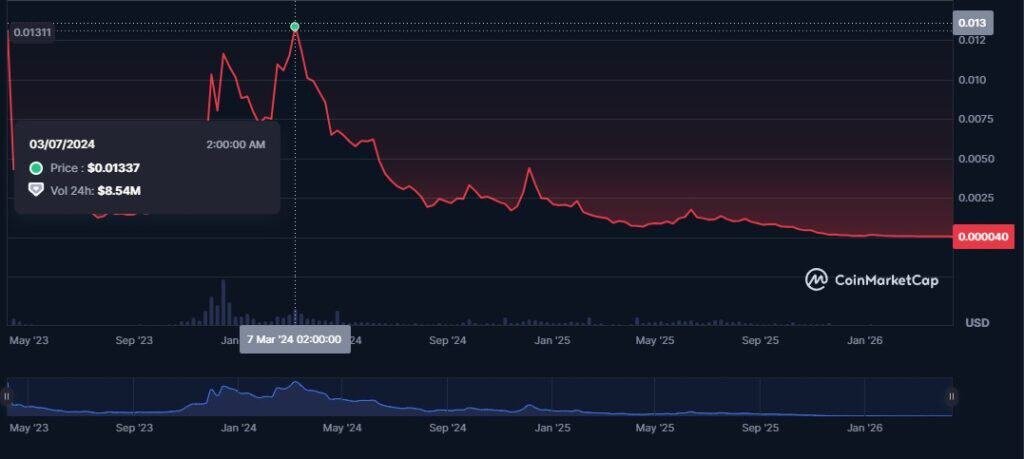
- Node operators must manually bridge all L2 tokens and assets to Ethereum L1 before April 27, 2026, or risk losing access to them. MYRIA has fallen 99.69% since July 2024.
Myria is pulling the plug on its Layer 2 node network. The gaming-focused infrastructure provider announced it is migrating fully to Ethereum L1, rendering its existing L2 node operations unnecessary.
The shutdown means node operators need to act. Anyone holding tokens or assets in a Myria L2 wallet, including all earnings from node operations to date, must bridge those assets to Ethereum L1 before April 27, 2026. Myria said it can’t perform the bridging on behalf of users for security reasons.

The remaining token allocation earmarked for node emissions under Myria’s tokenomics will be distributed to all node owners at their registered L1 wallet addresses. The team said that distribution should arrive within three to five business days.
An announcement with no instructions
The entire communication consisted of a tweet and an email. No step-by-step bridging guide. No FAQ. No video walkthrough. No support documentation linked. For a decision that requires every node operator to manually move assets off a chain that is about to be discontinued, the absence of any instructions is striking.
Operators who purchased nodes and ran infrastructure for this project are now expected to figure out the bridging process on their own within a two-week window, or lose their assets. That’s a significant ask delivered with minimal effort.
The numbers tell the story
A Myria node currently earns 1,108 MYRIA tokens per day. At the token’s current price, that’s worth roughly $0.045 per day. That doesn’t cover the cost of running a VPS to host the node, let alone recoup the original purchase price.
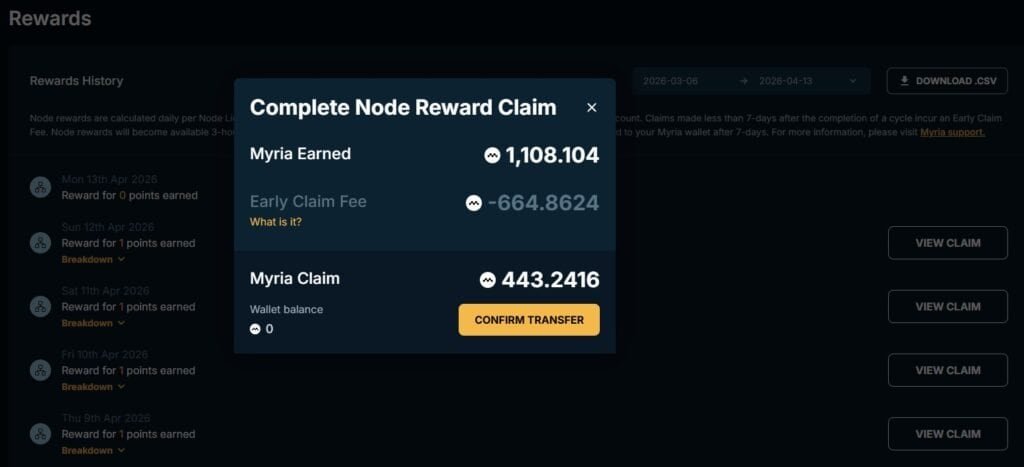
And about that purchase price: a Myria node still costs $6,400. The team has not closed node sales. As of today, users can still buy a node license for a product that the company has just announced it is discontinuing. That fact alone raises questions about how this wind-down is being handled.
The MYRIA token tells the rest of the story. On July 3, 2024, it traded at $0.01337. It now sits at $0.00004025, a 99.69% decline.
A project gone quiet
The announcement arrives after a prolonged period of near-silence from the Myria team. Visible development updates have been scarce over the past year. Public-facing activity has slowed to a crawl, and the community has grown increasingly skeptical about whether the project is being actively maintained at all.
For many node operators who invested thousands of dollars in licenses and months of server costs, the trajectory has been difficult to watch. The token has lost virtually all of its value. Daily earnings don’t cover hosting fees. And now the infrastructure they were running is being shut down with a tweet, an email, and a two-week deadline.
Why the migration
Myria framed the move as a strategic shift toward a streamlined, L1-native infrastructure. The company said it continues building tools for game developers to launch and scale on Ethereum, and the migration positions it to better serve that developer community without the overhead of maintaining a separate L2 network.
What node operators lose
Node operations are being permanently discontinued. There’s no replacement program or alternative staking mechanism mentioned in the announcement. Myria thanked operators for their contribution to running the network but offered no details on future roles for that community segment.
The April 27 deadline leaves operators roughly two weeks to complete the bridge. Anyone who misses it risks stranded assets on infrastructure that will no longer be supported. How they’re supposed to complete that bridge, the team didn’t say.







![27 Games Hit Xbox Next Week, and 3 of Them Are Worth Your Attention [April 20-24]](https://cryptogames.gg/wp-content/uploads/2026/04/nwox-hero-183901881c24bba113ff-1024x576-1-150x150.jpg "27 Games Hit Xbox Next Week, and 3 of Them Are Worth Your Attention [April 20-24]")