
NVIDIA’s CEO isn’t worried about AI replacing workers. He’s worried about workers who refuse to use it.
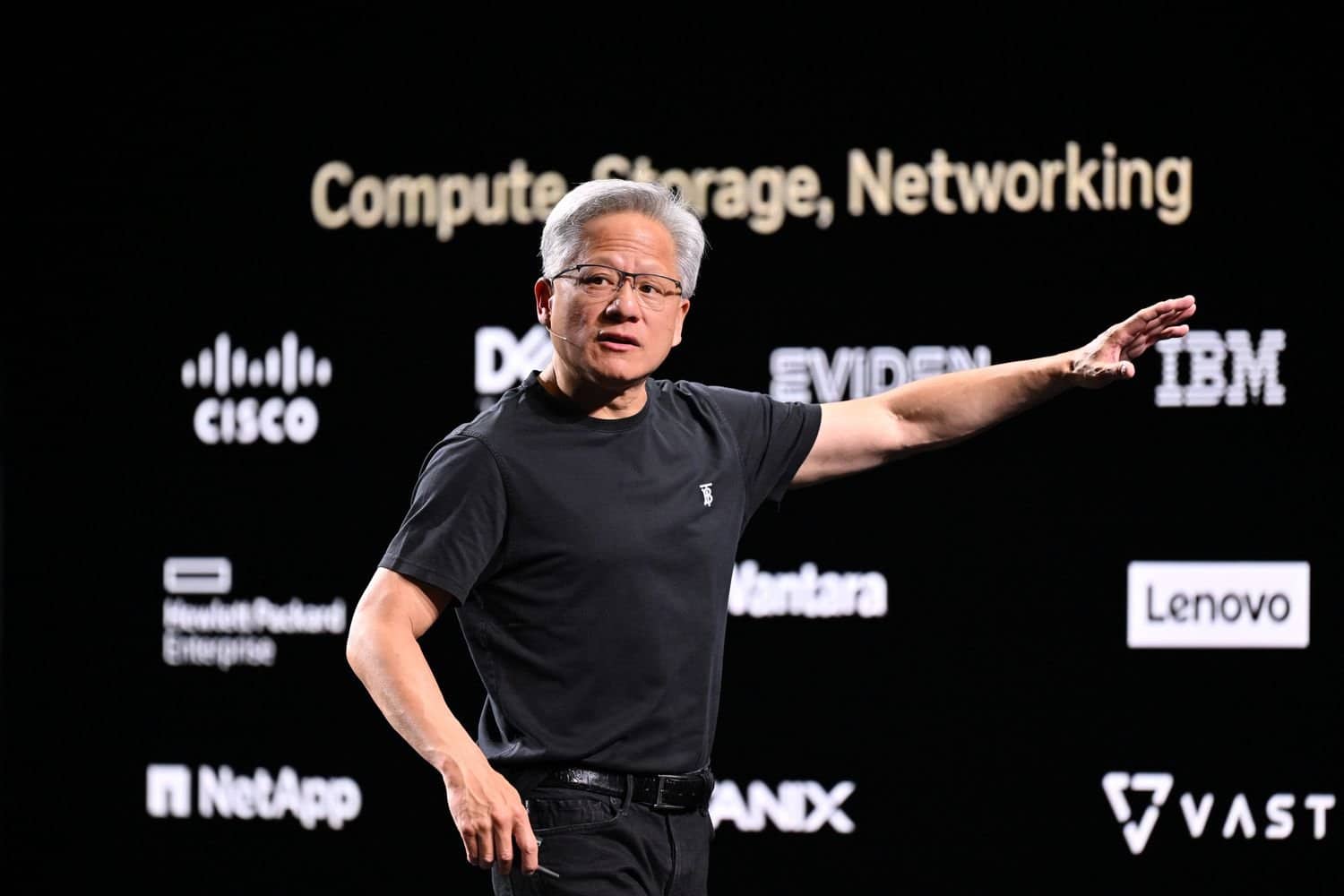
Speaking at the Stanford Graduate School of Business, Jensen Huang framed the current AI wave as a modern Industrial Revolution and pushed back on the idea that the technology will leave most people unemployed. His core argument: AI is a job platform, not a job killer. But only if you learn to use it.
“It is unlikely most people will lose a job to AI,” Huang said. “It is more likely that someone will lose a job to someone who uses AI. And so we have to make sure everybody uses AI.”
The carpenter who became an architect
Huang pointed to a specific example to illustrate how AI changes the shape of work rather than eliminating it. A carpenter, he said, can now use AI tools to produce architectural designs and interior layouts that were previously out of reach. The craft doesn’t disappear. It expands.
“They elevate their craft, elevate their service, and elevate their business to a level to offer more,” Huang said. “AI is not this incredible technology that no one knows how to use but AI is an incredible technology that everyone should know how to use. It’s the reason why it’s the fastest adopted technology in the history because it’s so easy to use.”
The thesis is simple: adaptability has always been the differentiator. Those who integrate AI into their work gain leverage. Those who don’t get outpaced by those who do.
More jobs at the end than at the beginning
Huang made a broader prediction about employment over the long arc of the AI era.
“My belief is, we’re going to create more jobs in the end,” he said. “There’ll be more people working at the end of this industrial revolution than at the beginning of it. Just like at the end of the last one, the beginning of this one.”
He pointed to the physical infrastructure behind AI as proof that the job creation is already underway. New factories are being built to meet chip and hardware demand, and those facilities require thousands of workers. The supply chain feeding the AI industry is generating employment on its own, separate from the software layer.
Not everyone’s buying it
Huang’s optimism runs directly against what other tech leaders are saying. Anthropic CEO Dario Amodei has warned that AI could eliminate half of all entry-level white-collar jobs within one to five years. Shopify’s CEO told managers to exhaust AI tools before requesting additional headcount. The gap between Huang’s message and the actions other companies are taking is wide.
And even within Nvidia’s own product line, the tension is visible. The company’s DLSS 5 announcement drew backlash from artists who argued the AI upscaling technology could override a creator’s original art direction. Nvidia responded by saying the tech “fully honors the intent of the original creator,” but the pushback showed that enthusiasm for AI isn’t universal, even when it comes wrapped in better frame rates.
The sales pitch underneath the philosophy
Nvidia’s entire business runs on companies and governments buying more AI infrastructure. Every new factory, every agentic AI deployment, every enterprise scaling up its compute needs feeds directly into Nvidia’s revenue. Huang’s message that AI creates more jobs than it destroys is also a message that the world should keep building, keep buying and keep investing in the technology his company supplies.
That doesn’t make his argument wrong. The radiology example he’s cited elsewhere, where AI tools increased demand for doctors rather than replacing them, is a real data point. The new construction jobs tied to chip fabrication are real. But when the CEO of a company worth over $4 trillion tells you not to worry about AI, it helps to remember what’s on the other side of that reassurance.