
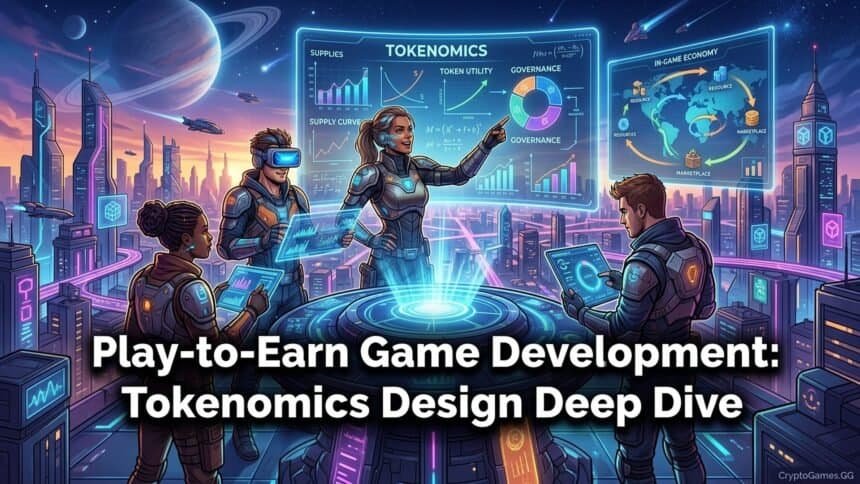
Most play-to-earn game development guides focus on the technical stack. This guide focuses on the decision that determines whether your game survives: tokenomics design. Every P2E game that collapsed in 2022 had technically functional smart contracts. What they lacked was economic architecture that could sustain player income as market conditions changed and player counts grew. The lessons from those failures are directly applicable to building games that last.
Quick Answer: Play-to-earn game development requires designing token economics before writing any code. Core decisions include: whether to use a single or dual token model, how to set emission rates that scale with player growth, which sink mechanisms create genuine demand for earned tokens, how to structure vesting for team and investor allocations, and what governance rights governance token holders receive. Getting these decisions wrong is irreversible without community-disrupting contract migrations.
Why Tokenomics Kills More Games Than Bad Code
Consider the statistics. In 2022, hundreds of play-to-earn games went from active player bases to effectively zero active players in months. Their smart contracts still worked. Their games still ran. But their token economies collapsed because they were designed to work during growth and had no mechanism for stability at scale or during contraction.

The most common failure pattern: a game mints tokens to reward players, player count grows rapidly, token supply grows faster than demand, token prices fall, earning value drops, players leave, token prices fall further, remaining players leave. This Ponzi dynamic is not caused by malicious intent in most cases. It is caused by designers who did not model their economy under different growth scenarios before launch.
Smart contract bugs cause specific incidents. Bad tokenomics cause game-ending death spirals. Both are serious. Tokenomics is harder to fix because changing it after launch requires deploying new contracts and migrating user holdings, which damages community trust even when technically executed well.
Single Token vs Dual Token: The Core Decision
The single most important tokenomics architecture decision is whether to use one token or two.
Single token model. One token serves all purposes: governance, utility, and speculation. Axie Infinity’s original AXS-only model in 2018 was single token. The problem: when a token serves as both governance (where holders want scarcity) and utility (where players need to earn freely), the inflation required for gameplay rewards destroys the governance value. Players who held AXS for governance suffered as play earnings diluted their holdings.
Dual token model. A scarce governance token and a freely-earned utility token. Axie Infinity’s introduction of SLP as the utility token alongside AXS was the first major dual-token implementation. AXS retained governance value because its supply was controlled. SLP served as the gameplay currency. The model solved the inflation-destroys-governance problem but introduced a new one: utility token price still collapsed when emissions outpaced demand.
The dual token model is the current industry standard. Every major successful P2E game in 2025 and 2026 uses it. The remaining design challenge is making the utility token economy sustainable, not the governance/utility separation which is now considered mandatory.
Design rule: If anyone on your team says “we don’t need two tokens,” show them the post-mortem analysis of any single-token P2E game from 2022. The counterargument does not exist in practice.
Emission Rate Design
Emission rate is how fast new utility tokens enter circulation through player rewards. Setting it correctly is the second most important tokenomics decision.
The key principle: emissions must scale slower than player count, not proportionally. If daily emissions double every time players double, supply growth outpaces demand growth whenever player-generated demand grows slower than player count — which it always does eventually.
Fixed daily emission. A fixed daily token budget distributed among all players. As player count grows, each player earns less per session. This creates natural inflation control but can frustrate players who joined expecting specific earnings. RavenQuest uses elements of this approach.
Activity-weighted emission. Total daily emissions are fixed but distributed based on relative activity. Top players earn more; casual players earn less. This rewards engagement quality over quantity and creates a more sustainable earning distribution.
Season-based emission schedules. Emission rates change between seasons, allowing the team to adjust supply based on market conditions and player feedback. This flexibility is valuable but requires governance clarity about who controls emission rate changes and through what process.
Model your emission rate at 1x, 5x, 10x, and 50x your launch player count. At each scale, what is the daily token supply entering circulation? What price must the token maintain to make a given player’s earnings equivalent to their target income? If the required price at 50x players is implausibly high, your emission rate is too generous at 1x.
Token Sink Design: The Most Important Mechanic
Token sinks are mechanisms that remove tokens from circulation. They are the counterpart to emissions. Without sinks, emissions inflate supply indefinitely. With well-designed sinks, supply and demand reach equilibrium.
Properties of good token sinks: They must be desirable. Players should want to spend tokens on what the sink offers, not feel forced to in order to access content they have already paid for. They must be scaled — as player count grows, sink capacity should grow proportionally. They should create value within the game rather than just destroying tokens for its own sake.
Crafting and upgrading costs. Spending utility tokens to craft items or upgrade equipment is the most natural sink in RPG-style games. Players have intrinsic motivation to make their characters stronger, and the token cost feels like a fair trade for progression. RavenQuest uses crafting costs extensively as its primary utility token sink.
Breeding and creation costs. Axie Infinity’s breeding fees, paid in SLP, were its core sink mechanism. Each breeding action burned tokens. The problem: breeding created more supply (new Axies) that could generate more earnings, creating a recursive loop. Design creation mechanics that sink tokens without proportionally increasing the game’s earning capacity.
Entry fees for high-reward content. Tournament entry fees, ranked season deposits, or access fees for premium content zones all sink tokens in exchange for high-value gameplay opportunities. This is economically clean: players who want higher earnings invest more tokens to access higher-earning opportunities.
Governance staking locks. Requiring utility token staking (not just governance token staking) for governance participation removes utility tokens from circulation while giving players a reason to hold rather than immediately sell. The locked tokens are not burned but are temporarily removed from active supply.
The golden rule of sinks: design them so that a player at the average earnings level wants to spend approximately 60–80% of their earned tokens on sinks and keeps 20–40% as net income. If sinks absorb less than this, surplus selling pressure depresses token price. If they absorb more, players feel coerced and leave.
Vesting Schedules That Don’t Destroy Your Launch
Team and investor token allocations need vesting schedules that prevent the dump-on-launch pattern that has destroyed multiple P2E games at their most vulnerable moment.
Standard best practice in 2026: 12-month cliff, 36-month linear vesting for team allocations. 6-month cliff, 24-month linear vesting for private sale investors. 0-3 month cliff, 12-month linear vesting for public sale participants.
The cliff period is the time before any tokens unlock. A 12-month cliff means team members cannot sell any tokens for the first year, regardless of market conditions. This demonstrates commitment and prevents immediate post-launch dumping.
Publish your vesting schedule publicly before token launch. Show the community exactly when team and investor tokens unlock. Transparency on this point is mandatory for serious community trust. Projects that hide or obscure vesting schedules are a red flag that community members have learned to recognize.
Model the selling pressure from each unlock event before setting the schedule. If your total team and investor allocation is 30% of supply and it all unlocks in month 12, that is a massive one-time selling event. Spread unlocks across 24 to 48 months in monthly tranches to smooth the market impact of each release.
Governance Token Design
Governance tokens should have genuine utility beyond speculation. The most credible governance token designs in 2026 combine real voting rights over meaningful protocol decisions with economic benefit from ecosystem performance.
Meaningful governance scope: Token holders should vote on decisions that actually matter. Emission rate changes, treasury allocation, new feature priorities, fee structure adjustments. Voting on cosmetic choices or marketing taglines is theater, not governance. Players recognize the difference.
Economic benefit from ecosystem: Governance token stakers should earn a share of marketplace fees, protocol revenue, or treasury distributions. This creates demand for governance tokens from people who want yield, not just from people who want voting rights. It also aligns long-term holder interests with ecosystem health.
Supply control: Governance token total supply should be fixed or near-fixed from launch. Inflation of the governance token destroys its value for existing holders and undermines the scarcity that creates its long-term value proposition.
Modeling Your Economy Before Launch
Build an economic model spreadsheet before writing any smart contracts. The model should capture daily token emissions at multiple player count scenarios, daily token sink absorption at each scenario, resulting net token supply change, implied token price required for specific earning targets, and projected market cap at each price level.
Run these scenarios: launch day (100 players), 1 month post-launch (1,000 players), 6 months post-launch (10,000 players), token price at 50% of launch price, token price at 10% of launch price. For each scenario, does the game still have viable player economics? Do sinks still absorb meaningful supply?
If your model shows the game only works when token price is above a specific floor, design additional sinks that kick in below that floor. Price-triggered sink mechanisms can help stabilize token economics during market downturns.
Common P2E Tokenomics Failures
Unlimited minting without governance control. The team retains unconstrained ability to mint new tokens after launch. Players cannot verify supply is controlled. This is a critical red flag that experienced players identify immediately.
Sinks designed only for launch conditions. The game has strong sinks that absorb 80% of emissions at launch player count. At 10x players, emissions multiply by 10 but sink capacity only multiplies by 3 because the sink activities have natural limits. Supply overwhelms demand at scale.
Launch allocation too concentrated. Team and early investors hold 60% of token supply with only 6-month vesting. The market cap at launch prices the entire supply. When vesting unlocks, massive sells overwhelm buy pressure regardless of game health.
No mechanism for economic recovery. When token prices fall significantly, there is no automatic mechanism that reduces emissions or increases sink attractiveness. The game lacks stabilizers that activate when economic conditions deteriorate.
Frequently Asked Questions
What is tokenomics in P2E game development?
Tokenomics is the economic design system governing how tokens are created, distributed, used, and removed from circulation within a play-to-earn game. It includes emission rate design, sink mechanism design, supply allocation, vesting schedules, and governance structures. Tokenomics design determines whether a game’s economy is sustainable long-term.
How do you design a sustainable P2E economy?
Design sinks before setting emissions. Model the economy at multiple player count and price scenarios before writing contracts. Use a dual token model separating governance and utility. Set conservative emission rates that can be increased if needed rather than aggressive rates that must be cut. Ensure vesting schedules spread team token unlocks over years, not months. Audit all contracts before handling real player assets.
How long does it take to build a P2E game?
A minimum viable P2E game with working tokenomics, smart contracts, and basic gameplay takes 6 to 12 months for a competent small team. A quality game that competes for players in 2026 takes 12 to 36 months. The 2021 generation of 3-month launches produced the games that failed in 2022. The development time difference between a 6-month and 24-month build shows clearly in the quality outcomes.
The play-to-earn games that define blockchain gaming in 2026 were built by teams who spent more time designing their economies than writing their contracts. That priority order is not intuitive for developers who prefer shipping code to modeling spreadsheets. But it reflects the actual failure patterns of the industry. Build the economics first. Then build the game around them.