
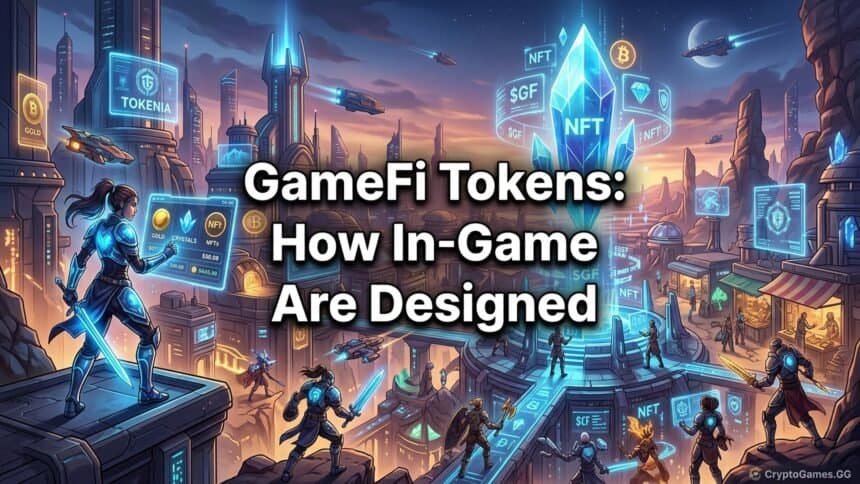
A GameFi token is a cryptocurrency that powers the economic layer of a blockchain game. These tokens serve as governance tools, in-game currencies, access mechanisms, and speculative assets — sometimes all simultaneously. The design of how these roles are structured determines whether a game’s economy sustains player income over time or collapses under the weight of its own inflation. This guide explains how GameFi tokens are designed, what separates sustainable designs from failing ones, and how to evaluate a token before committing any investment.
Quick Answer: GameFi tokens fall into two categories: governance tokens with fixed or controlled supply that give holders voting rights and economic benefits from the protocol, and utility tokens freely earned through gameplay and spent on in-game actions. Sustainable GameFi economies use both, with strong sink mechanisms that absorb utility token emissions at a rate that maintains price stability even as player counts grow. The most common failure is utility tokens with too-high emissions and too-weak sinks.
The Two Types of GameFi Tokens
Every GameFi ecosystem operates with two fundamentally different types of tokens, even if not always two separate contracts.

Governance tokens represent ownership and control in the game’s ecosystem. Supply is typically fixed or very tightly controlled. Holders vote on game economic parameters, treasury allocations, and major protocol decisions. Governance tokens often distribute a share of protocol fees to stakers, creating economic benefit alongside voting rights.
Utility tokens are the everyday currency of the game’s economy. They are earned freely through gameplay and spent on in-game actions. Supply grows as players earn and potentially shrinks through sink mechanisms. Utility tokens are designed for circulation, not for holding as store of value.
The distinction matters enormously for investors. Buying a governance token is like buying a stake in the game’s economic infrastructure. Buying a utility token is like holding the game’s currency — useful for transactions but subject to inflation from ongoing player earnings.
How Governance Tokens Work
Governance tokens give holders a direct voice in how the game develops. In a well-designed system, meaningful decisions go to token holders for votes: emission rate changes, fee structure modifications, new feature priorities, and treasury spending proposals.
The economic benefit of governance tokens comes from protocol fee distributions. When players trade NFTs on the game’s marketplace, a fee is collected. A portion routes to the platform treasury and a portion distributes to governance token stakers. As trading volume grows, staking yield grows proportionally. This creates genuine economic alignment between governance token holders and game success.
AXS for Axie Infinity, GODS for Gods Unchained, and ILV for Illuvium all serve this governance role. Each has staking mechanisms that distribute protocol revenue to long-term holders, creating demand beyond speculation.
A governance token with no actual governance power is a red flag. If token holders cannot vote on meaningful decisions, the token is purely speculative. Look for active DAO proposals, voting participation rates, and evidence that vote outcomes actually affect the game’s parameters.
How Utility Tokens Work
Utility tokens are the money players earn by playing. Complete a dungeon, earn BIGTIME. Craft items in RavenQuest, spend and earn QUEST. Win a ranked season in Gods Unchained, receive GODS tokens distributed from the prize pool.
Utility tokens circulate continuously. New tokens enter supply as player rewards. Existing tokens leave supply through spending on sinks. The price of the utility token at any moment reflects the balance between these forces.
The key property of a healthy utility token economy: players spend tokens on things they want to buy, not because they are forced to. When spending is genuinely desirable — upgrade your character, craft a rare item, enter a tournament — it feels like a natural part of playing. When spending feels coerced or arbitrary, players accumulate tokens instead of spending them, supply grows, and price falls.
The Dual Token Model in Practice
The dual token model became the industry standard after Axie Infinity proved its value and then its limitations. AXS as governance and SLP as utility worked conceptually. The AXS/SLP ratio reflected the different economic roles.
What the original Axie dual token model did not solve: SLP emissions grew proportionally with player count, but SLP sinks were primarily breeding fees that created new supply rather than absorbing existing supply. The net result was continuous SLP inflation that eventually overwhelmed any price support.
Successful dual token implementations in 2025 and 2026 address this by designing utility token sinks that absorb an increasing proportion of emissions as player count grows. RavenQuest’s QUEST token economy has multiple layered sinks — crafting costs, guild formation fees, tournament entry — that collectively absorb substantial daily emissions without any single sink becoming a bottleneck.
Token Sinks: The Hidden Engine
Token sinks are the mechanisms that remove utility tokens from circulation. They are the counterpart to emissions and the primary lever for price stability. Most players never think about sinks explicitly, but sink quality determines whether a GameFi token retains value over months and years.
Effective sink types by category:
Progression sinks let players spend tokens to advance their character, unlock content, or upgrade equipment. Players have intrinsic motivation to progress, so these sinks feel natural. The design challenge is ensuring progression does not create diminishing returns that cause advanced players to stop spending.
Creation sinks require token spending to create new in-game assets: breeding a new character, crafting a rare item, minting a seasonal collectible. These are particularly effective because they feel productive — spending creates something valuable, not just removes tokens. The risk is that creation increases the game’s earning asset count, potentially increasing future emissions.
Competition sinks require token entry fees for high-reward competitive modes. Players pay to access better earning opportunities. This sink scales well because competitive motivation grows with player count — more players means more competition, meaning more entry fee burning.
Governance sinks require utility token staking for governance participation alongside or instead of purely governance token staking. This removes utility tokens from liquid supply without burning them, creating a temporary supply lock-up effect.
How to Evaluate a GameFi Token
Before putting capital into any GameFi token, work through this evaluation sequence.
Step 1: Identify the token type. Is this a governance token or a utility token? Governance tokens are investment-adjacent. Utility tokens are currency-adjacent. The same holding strategy does not apply to both.
Step 2: Find the emission schedule. How many tokens enter circulation per day at current player count? What happens to emissions as player count doubles? Is there a mechanism that controls emissions during rapid growth?
Step 3: Map the sink mechanisms. What mechanisms remove tokens from circulation? Are they voluntary (players choose to spend) or mandatory (players must spend to access content)? Do sink volumes scale with player count?
Step 4: Check daily active wallet trends. Use DappRadar to find the 90-day wallet trend for the game. Growing player base creates increasing sink demand. Declining player base signals economic problems before token price reflects them.
Step 5: Verify team and investor vesting. Find the tokenomics documentation and identify when team and investor tokens unlock. A major unlock event upcoming is a potential selling pressure event worth noting.
According to CoinGecko’s gaming token category data, the top gaming tokens by market cap in 2026 include AXS, ILV, GODS, IMX, SAND, and GALA. These tokens have maintained market presence through multiple cycles, which is itself a meaningful signal of durability versus the hundreds of gaming tokens from 2021 that no longer appear in market rankings.
Top GameFi Tokens in 2026
AXS (Axie Infinity) — Governance token for the Axie Infinity ecosystem and Ronin Network. Staking generates yield from Ronin protocol fees. Supply is fixed at 270 million tokens. Significant historical volatility but maintained market presence through multiple cycles.
ILV (Illuvium) — Governance token for Illuvium on Immutable X. Staking distributes revenue from in-game purchases and NFT marketplace fees. AAA game quality provides genuine demand foundation beyond speculation.
GODS (Gods Unchained) — Governance token for Gods Unchained. Staking rewards come from card pack sales and marketplace fees. One of the most consistently active NFT gaming tokens by trading volume and player activity.
IMX (Immutable X) — Governance token for the Immutable X platform. Fee payments within the ecosystem require IMX. As more games launch on Immutable X and transaction volume grows, IMX demand grows from transaction fee requirements.
SAND (The Sandbox) — Governance and utility token for The Sandbox metaverse. Used for LAND purchases, asset trading, and in-world transactions. Highly correlated with broader metaverse market sentiment.
Red Flags in GameFi Token Design
No published tokenomics documentation. Any game asking for real investment without documented token economics is asking you to trust them blindly with your capital. Legitimate projects publish complete tokenomics before public sales.
Single token for governance and utility. When one token must serve both governance (scarce, appreciating) and utility (freely earned, circulating) roles simultaneously, one of these functions will fail. Almost always the governance value fails as utility emissions inflate supply.
Emission rates that cannot be reduced without team discretion. Governance communities should control emission rates, not developers unilaterally. A team that can increase or decrease emissions without governance votes can manipulate the economy against community interests.
Sinks described vaguely in documentation. “Players can spend tokens on exclusive items” is not a sink design. A real sink document specifies exactly what each spending action costs, what it provides, and how sink volumes scale with player activity levels.
Launch price implies implausible future market cap. If a token at launch price with 20% of supply circulating already implies a total market cap exceeding comparable established games, the token is overpriced at launch regardless of how good the game is.
Frequently Asked Questions
What is a GameFi token?
A cryptocurrency that powers the economic layer of a blockchain game. GameFi tokens serve governance functions (voting on game decisions, staking for protocol fees), utility functions (in-game currency earned through gameplay and spent on in-game actions), or both through a dual-token model where separate tokens handle each role.
Are GameFi tokens a good investment?
Governance tokens for games with growing player bases, strong sink mechanisms, and durable gameplay are more defensible investments than pure utility tokens, which are subject to inflationary pressures from ongoing player emissions. All GameFi tokens carry high volatility and should represent a small portion of any portfolio. Research the specific token’s emission schedule, sink mechanisms, and game health metrics before investing.
How do GameFi tokens earn yield?
Governance tokens earn yield through staking programs that distribute protocol fees — a percentage of marketplace trading fees, game transaction fees, or treasury earnings. Utility tokens do not typically earn yield; they are spent and earned through gameplay. Some platforms offer utility token liquidity pool yield farming on DEXes, though this carries additional smart contract risk.
GameFi tokens are simultaneously more interesting and more complex than most cryptocurrency categories. They combine game mechanics, economic design, and market dynamics into a system where all three dimensions interact continuously. Understanding how each dimension works — and how they interact — is what separates informed GameFi participation from speculative gambling on token prices.