

There’s no ammo bar. Anywhere. In a Total War game built almost entirely around guns, Creative Assembly just quietly deleted the one mechanic every other squad tactics game leans on, and honestly, thank the Emperor.
I got about an hour with an early build of Total War: Warhammer 40k at a recent event, split into three slices: a tutorial, a taste of the campaign (customization included) and one big battle. All of it seen through Space Marine helmets. All of it involving a lot of dead Orks and a lot of little dudes shouting “For the Emperor!”
The wait has been long. Creative Assembly put out the first Total War: Warhammer in 2016, and the part of the community that cares more about the 41st Millennium than the fantasy stuff has been asking for this ever since. It took longer than anyone wanted. It’s finally on the horizon.
Trebuchets are out, tanks are in
Total War has always had ranged units, but the series has fundamentally been about two armies closing distance and stabbing each other with swords. This one flips that. It’s the first entry built on WarCore, Creative Assembly’s new engine, and the first ranged-focused Total War since 2009’s Total War: EMPIRE.
Walking mechs replace siege weapons. The jump forward in time meant the gameplay had to move with it.
The tutorial dropped my squad at a crash site to secure it, which doubled as a crash course in movement, cover and dropping missiles on greenskins. It also introduced the mechanics you’ll need to learn: strafe-firing, suppressing enemies, calling down drop pods from orbit with fresh forces.
The chainswords still sing
Guns haven’t killed close combat. Far from it.
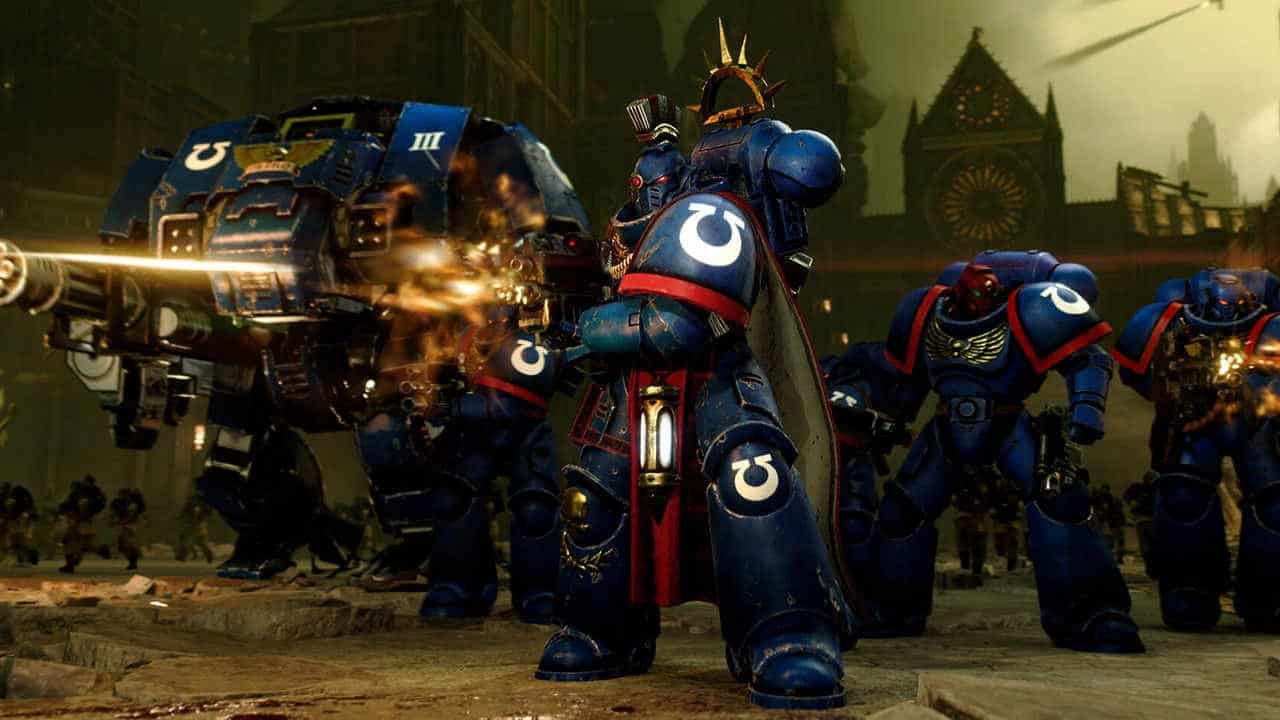
The clearest look at what WarCore can do came when I paused the action and zoomed into a marine-on-ork bloodbath. Units caked in blood. Bodies mid-vault over cover. Space Marine chainswords with their motorized teeth throwing sparks off Ork axes while bullets flew overhead.
And underneath the new coat of paint, this is still a Total War game with the same tactically rich strategic playground the series built its name on. Even in the intro scenario, the number of bodies on the field and the number of fronts I had to manage kept me honest. Positioning still matters. Countering still matters. There look to be more ways than ever to bend a battlefield to your needs.
Being a bit out of practice, I got a reminder of those lessons the hard way during the campaign mission.
The Thetha-Citadel goes badly, then well
My objective: retake the nearby Thetha-Citadel Astropathic Relay Station and clear out the xeno threat. Orks again, and their space force was already in position, wrecking the planet from the ground and from orbit both.
Before dropping in, I looked around the system. Planets orbiting a menacing blood red star, with what looked like an equally imposing Chaos Gate looming nearby. I couldn’t interact with either during the demo. They’re teases of mechanics still to come.
Zoom back to the planet and you get a more familiar Total War screen: zones, cities, armies to command. Rotating the view across large swaths of the planet is smooth, and the sight of space behind the curved world does a lot of work selling the scale here.
I trained new troops, made my way to the station, and sent my Immortals of Demos (the custom chapter I’d set up and colored beforehand) to deal with Snaz Braggerz.
Aggressor marines, Intercessors, Dreadnoughts, Repulsor Executioner tanks. I grouped them and sent them out. Then I made some bad calls. Note to self: don’t spread yourself thin, and turn the game speed back down when things get hairy.
The Orks marched on my last group of marines and tanks, dug in on the high ground of a landing pad from earlier in the match. A few tense minutes of gunfire and orbital ordnance later, we routed them and destroyed their Stompa super-heavy walker. Watching that yellow monstrosity tip over and explode was nearly as satisfying as pulling it off on the actual tabletop.
The Imperium of Man had won again. That ego boost carried me directly into the “Very hard” big battle Creative Assembly had left for us to try, and let’s just say things went differently.
About that grey pile of shame
Customization is a huge part of 40k and miniature games generally, so I was glad the campaign slice opened with an early look at it.
If you’ve never touched tabletop miniatures: the armies you bring to the table usually have to be built first, and they arrive unpainted. “Grey pile of shame” is the hobbyist term we use, lovingly, for the backlog of models we haven’t gotten to yet.
What’s in the build right now is thin. You can adjust a base, accents and detail colors across the whole armor, plus your chapter’s name and emblem. That’s it.
The color selection, though, is something else. Creative Assembly is using the actual paint colors Games Workshop sells. Scrolling through, I spotted Caledor Sky and Screamer Pink before landing on Mournfang Brown for the base of my Immortals of Demos.
The representative on site said there will be far more options and detail available when 40k ships. As someone with a sizable pile of grey unpainted units (primed, I swear), I’d love one of those options to be the signature unpainted plastic look. More seriously, I hope it’s flexible enough that physical 40k players can recreate their own paint schemes. I don’t want to play Space Marines. I want to command MY Space Marines.
What’s riding on this
Creative Assembly has ground to make up. The DLC handling on Total War: Warhammer III and 2023’s Total War: Pharaoh left a mark, and this is the game the community has been requesting for a decade. What I played shows promise. Delivering is a different question.
There’s no release window. We haven’t seen a thing from the Aeldari faction yet, and what’s been shown so far is glimpses of the depth Creative Assembly says it’s building. The Total War DNA looks intact. Whether the heavier ranged focus and the rest of the 40k influence add up to something genuinely special, or something that’s fallen to Chaos, is still open.
Ask the Stompa. It didn’t get a vote either.