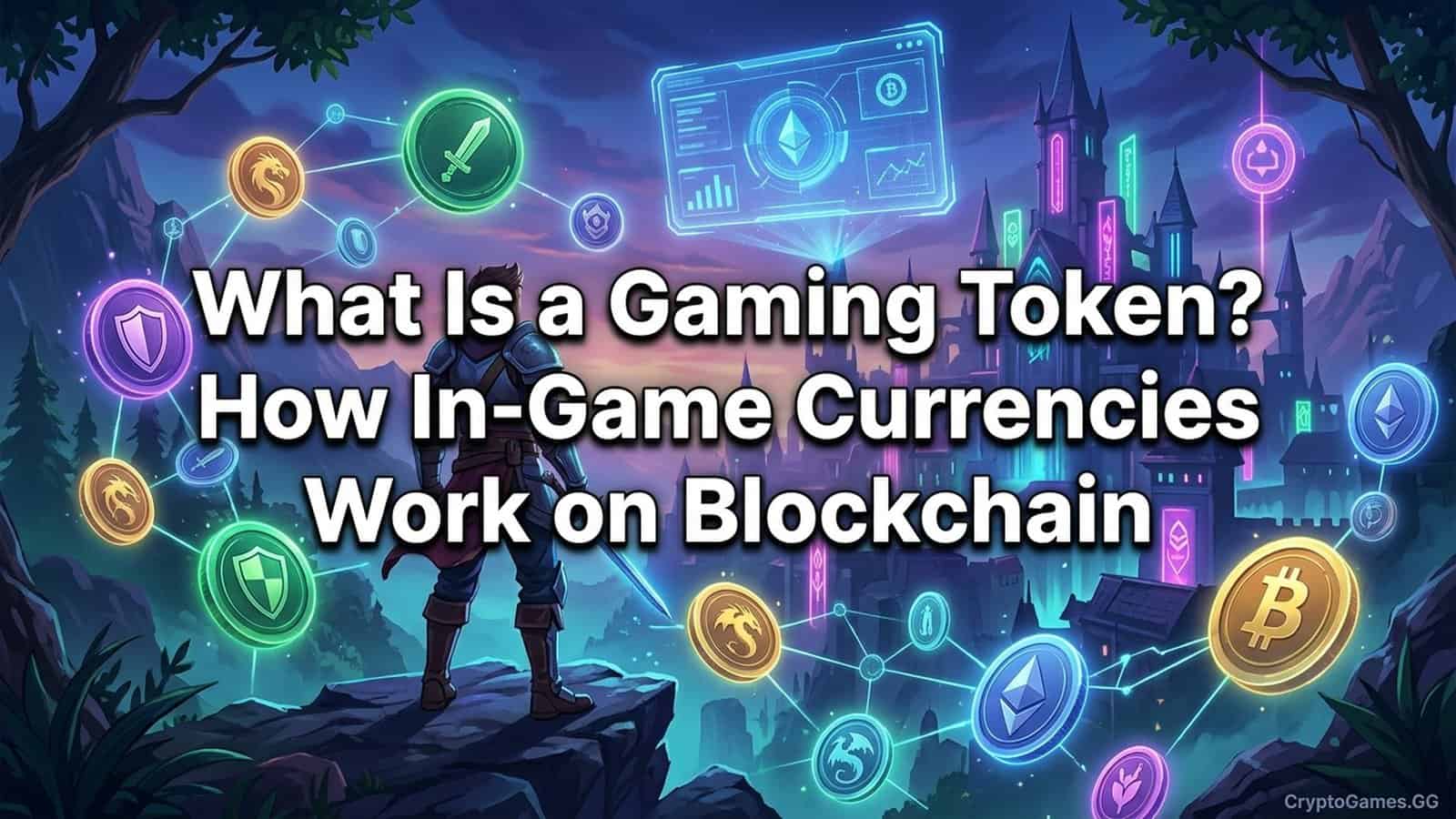




Every major blockchain game has its own gaming token, a cryptocurrency that powers its in-game economy. You earn these tokens by playing. You spend them on in-game actions like crafting, breeding, upgrading, or entering competitions. You can also sell them on exchanges for other cryptocurrencies or cash. Unlike the gold you earn in World of Warcraft, which has no external value, gaming tokens trade on real markets. Understanding how they work is essential before spending time in any crypto game.
Quick Answer: A gaming token is a cryptocurrency issued by a blockchain game that functions as in-game currency. Players earn tokens through gameplay and spend them on in-game activities. Gaming tokens have real market prices on decentralised exchanges. Most crypto games use a dual-token model with a governance token for voting and a utility token for everyday in-game transactions. Token value depends on player demand, token supply, and the strength of the game’s economic design.
Gaming Tokens vs Traditional In-Game Currency
Every online game has an in-game currency. World of Warcraft has gold. Fortnite has V-Bucks. League of Legends has Blue Essence. These currencies exist only within the game’s database and have no value outside it. If the game shuts down, they disappear. If you buy too many V-Bucks and then stop playing, they are worthless. They cannot be legally sold for real money in most cases.
Blockchain gaming tokens are fundamentally different. They exist on a public blockchain, trade on decentralised exchanges at real market prices, and can be converted to other cryptocurrencies or fiat currency at any time. Your token holdings are in your personal wallet, not in a game-controlled account. The value is determined by supply and demand in open markets, not by the developer setting a fixed exchange rate.
This difference creates new opportunities and new risks. The opportunity is real: players in active games earn tokens that convert to meaningful real-world value. The risk is real too: token prices can fall dramatically with broader crypto markets, erasing the dollar value of your earnings even if your token count stays the same.
The Two Types of Gaming Tokens
Most serious blockchain games use a dual-token model with two distinct tokens serving different economic roles.
Governance tokens represent an ownership stake in the game ecosystem. They have a fixed or tightly controlled maximum supply. Holders use them to vote on major game decisions through the game’s DAO: token emission changes, new feature priorities, treasury spending, and significant balance updates. Because governance tokens are genuinely scarce and tied to decision-making power, they tend to hold value better than utility tokens. Examples include AXS for Axie Infinity and GODS for Gods Unchained.
Utility tokens are the everyday game currency. Players earn them freely through completing in-game activities. They are spent on actions like breeding characters, crafting items, upgrading equipment, and entering ranked competitions. Utility tokens have a much higher supply because they are continuously minted as gameplay rewards. SLP in Axie Infinity AXS $1.03 ▼ -17.1% and QUEST in RavenQuest are utility tokens.
The dual-token separation protects governance token value from the inflation that comes with freely minted gameplay rewards. When a game uses only one token for both roles, inflation from gameplay earnings drives down the value of the governance mechanism. Separating them creates a more stable long-term economic structure.
How Gaming Tokens Are Created
Gaming tokens are created through smart contracts deployed on a blockchain. The developer writes the token contract before the game launches. The contract defines the total maximum supply, the initial distribution, how new tokens enter circulation, and what rules govern transfers and approvals.
New tokens enter circulation primarily through gameplay rewards. When you complete a qualifying in-game action, the reward smart contract mints new tokens and sends them to your wallet. Minting is automatic, public, and permanently recorded on-chain. Anyone can see how many tokens were minted today and compare it to yesterday.
Some tokens have fixed total supplies where no new tokens are minted after the initial distribution. These are more similar to Bitcoin’s model. Others have uncapped supplies that mint indefinitely as players earn rewards. Fixed supply tokens tend to appreciate as player demand grows. Uncapped supply tokens require strong sinks to avoid inflation.
How Gaming Tokens Get Their Value
Gaming tokens derive value from three sources: utility within the game, speculative demand from investors, and liquidity in the broader crypto market.
In-game utility is the most sustainable source of value. When players genuinely need tokens to perform actions they want to do in the game, spending demand absorbs the supply of newly minted tokens. A token you must spend to breed rare characters, craft powerful weapons, or enter high-stakes tournaments has intrinsic game demand that independent of market speculation.
Speculative demand comes from players and investors who buy tokens expecting the price to rise as the game grows. This can amplify value significantly during bull markets but collapses quickly when growth slows. Games that rely primarily on speculation rather than genuine gameplay utility for their token value tend to crash hard and recover slowly.
Market liquidity affects how easily tokens can be bought and sold at stable prices. Tokens listed on major exchanges with deep liquidity pools have more stable prices. Tokens only available on obscure decentralised exchanges with thin liquidity experience extreme price swings on relatively small trades.
According to CoinMarketCap’s gaming token rankings, the top gaming tokens by market capitalisation in 2025 and 2026 include AXS, ILV, GALA, IMX, and GODS. Each represents a project with genuine player engagement, not just speculative interest.
Pro Tip: Check a gaming token’s 24-hour trading volume relative to its market capitalization. A healthy ratio is typically above 2%. A token with a $100 million market cap but only $500,000 in daily volume has very thin trading and may be extremely difficult to sell at listed prices. Low volume is a liquidity risk that crashes prices on even modest selling pressure.
Token Sinks: Why They Matter
A token sink is any mechanism that removes tokens from circulation by spending or burning them. Token sinks are the most important variable in whether a gaming token maintains value over time.
Without strong sinks, every token minted through gameplay rewards accumulates in the market. As supply grows and demand stays flat, prices fall. This is the inflation problem that destroyed early play-to-earn economies. Axie Infinity’s SLP token had weak sinks relative to emission rates, causing it to fall from $0.39 to under $0.001.
Strong token sinks include: breeding fees that require burning tokens to create new NFT assets, crafting recipes that consume tokens to produce in-game items, tournament entry fees paid in tokens, land development costs, and guild formation fees. These sinks feel natural within the game’s economy. Players spend tokens because they provide gameplay value, not because the system forces them to.
When evaluating any blockchain game, identify the token sinks before playing. Count them. Assess how much player spending each sink is likely to generate per day relative to the daily emission rate. If emissions consistently exceed sink absorption, the token price will trend down regardless of game quality.
How to Evaluate a Gaming Token Before Playing
These are the five questions to answer before committing time or money to a game’s token economy.
- What is the maximum token supply and current circulation? Check the token’s page on CoinMarketCap or CoinGecko. If most supply is already circulating, future inflation risk is lower. If only 10% circulates and team tokens unlock over three years, significant selling pressure is coming.
- What are the token sinks and how strong are they? Read the game’s whitepaper tokenomics section. List every mechanism that removes tokens from circulation. Estimate whether sink volume can realistically absorb the daily emission rate.
- What is the daily active wallet trend? Check DappRadar. Growing wallet counts create growing demand for natural tokens. Declining wallet counts mean shrinking organic demand regardless of token price.
- Is the token on major exchanges with genuine liquidity? Check 24-hour trading volume relative to market cap. Avoid tokens with less than 1% daily volume ratios unless you are comfortable with very thin markets.
- When do team and investor tokens unlock? Large unlock events create selling pressure. Know the dates and plan your engagement around them.
The Top Gaming Tokens in 2026
AXS (Axie Infinity) is the governance token for the Axie Infinity ecosystem and the Ronin Network that hosts it. AXS holders vote on network decisions and earn staking rewards. The Ronin Network has expanded well beyond Axie to host multiple games, giving AXS broader utility than a single-game token.
GODS (Gods Unchained GODS $0.02122 ▼ -10.1%) is the governance token for Gods Unchained on Immutable X. Players earn GODS through ranked gameplay rewards and stake it for protocol fee distributions. The card game’s consistent player base demonstrates genuine demand for GODS, not speculation.
ILV (Illuvium) is the governance and staking token for the Illuvium ILV $3.36 ▼ -16.1% ecosystem. It distributes protocol revenue to stakers and governs the game’s economic parameters. Illuvium’s AAA production quality ambitions give ILV a long-term utility story distinct from most gaming tokens.
IMX (Immutable X) is not a single game token but the governance and fee token for the Immutable X gaming blockchain. As more games launch on Immutable X, IMX captures value from the entire ecosystem rather than just one title. This broader utility base makes IMX distinct from individual game tokens.
QUEST (RavenQuest QUEST $0.0009878 ▼ -4.9%) is the utility token for RavenQuest on Ronin Network. Its crafting and guild economics create strong natural sinks that have supported token stability through 2025 market conditions. RavenQuest’s genuine MMORPG gameplay creates organic token demand from players who want the items crafting enables.
Risks of Gaming Tokens
Broad crypto market correlation. Gaming tokens generally move with Bitcoin and Ethereum. When the overall crypto market falls, gaming tokens fall too, often more sharply than the broader market. Your in-game earnings in dollar terms are tied to market conditions outside the game’s control.
Team token unlocks create selling pressure. When large allocations of tokens unlock for early investors or the development team, selling pressure can crash prices, even as the game grows. Know the unlock schedule for any game you invest in.
Governance token concentration creates manipulation risk. If a small number of wallets hold a majority of governance tokens, they can control DAO votes to benefit themselves at other players’ expense. Check governance token distribution before trusting any DAO-based governance system.
Tax obligations on earned tokens. In most jurisdictions, gaming tokens earned through gameplay are taxable income at the point of receipt. Keep records. Consult a tax professional if your earnings become meaningful. According to Kraken’s play-to-earn educational resource, tax treatment of gaming tokens varies significantly by country and the regulations are actively evolving in 2025 and 2026.
Frequently Asked Questions
Are gaming tokens the same as cryptocurrency?
Yes. Gaming tokens are cryptocurrencies specifically created for use within a game’s economy. They exist on blockchains, have real market prices, and can be traded on exchanges just like other cryptocurrencies. The only distinction is that gaming tokens have additional in-game utility beyond their pure store-of-value or medium-of-exchange functions.
How do gaming tokens earn value?
Gaming tokens earn value from in-game utility, from players’ need to perform valuable in-game actions, from speculative demand by investors expecting growth, and from market liquidity on exchanges. Tokens with strong in-game utility tend to hold value better through market downturns than those relying primarily on speculation.
Can gaming tokens make you rich?
They can generate meaningful supplementary income for skilled players in active games during favourable market conditions. They are not a reliable path to wealth. Early adopters in successful games like Axie Infinity did earn substantial returns. Most players entering games after the peak earned less. Timing, game selection, and understanding tokenomics matter more than effort alone.
What happens to gaming tokens if the game shuts down?
If a game shuts down, the tokens remain on the blockchain, but they typically lose most or all of their value because demand collapses when there is no game utility. The tokens are yours forever, technically, but they are unlikely to be worth anything practically if the game is dead.
How are gaming tokens different from in-game gold or coins?
Traditional in-game currencies like WoW gold exist only in the game company’s database, have no external value, cannot be legally sold, and disappear if the game shuts down. Gaming tokens exist on a public blockchain, trade at real market prices, can be sold for other cryptocurrencies or cash, and remain in your wallet even if the game closes.
Gaming tokens are the mechanism that makes the earn-through-play model real. When well-designed with genuine gameplay utility and strong sink mechanics, they create sustainable economies where player effort generates lasting financial value. When poorly designed with weak sinks and high emissions, they become inflation traps that reward early players at the expense of those who arrive later. Understanding the difference before you play is the most valuable research you can do.