
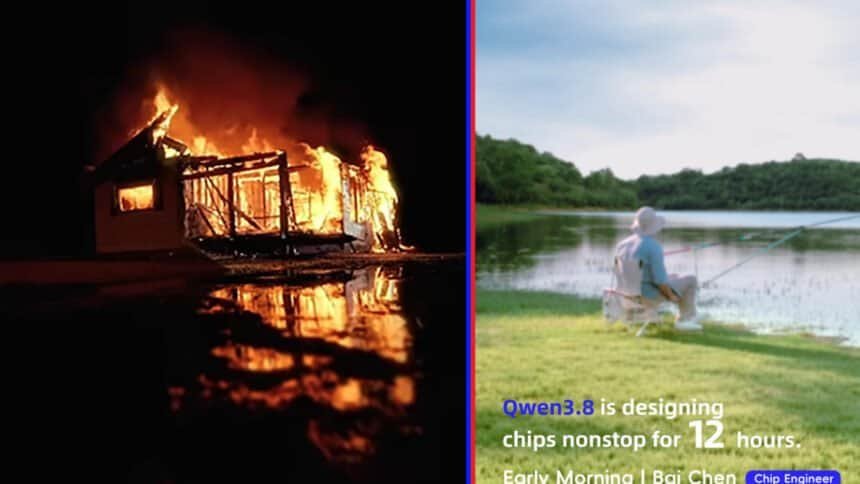
Two AI ads ran within weeks of each other. One opens on a burning house. The other looks like a lo-fi study playlist thumbnail, with a monitor grinding through work while people go rock climbing.
That gap tells you more about where the AI race actually stands than any benchmark chart does. But the benchmarks matter too, so let’s start there.
Alibaba just released its most powerful model yet, and every American tech executive who worries about Chinese labs pulling ahead got another reason to worry.

125 hours of unsupervised work
The model is called Qwen3.8-Max. It carries 2.4 trillion parameters and it’s built for long-horizon agentic tasks, the kind that stretch across days “with minimal human involvement,” as Alibaba described it in the announcement.
Here’s the number that stuck with me. In one internal test, Qwen3.8-Max ran on its own for roughly 125 hours, close to five days, to replicate an experiment described in a research paper. Alibaba handed it the paper and nothing else. The model wrote all the code from scratch, analyzed the data, ran the experiment and reported back.
That’s “exactly the type of work that takes skilled engineers days,” Alibaba wrote.
Five days of autonomous operation is a different claim from a benchmark score. Long agentic runs are where models usually fall apart, drifting off task or looping. Alibaba hasn’t published enough for anyone outside the company to check how clean that run was.
Where it lands against GPT-5.6 Sol and Fable 5
Per the test results in Alibaba’s announcement, Qwen3.8-Max runs neck-and-neck with OpenAI’s GPT-5.6 Sol and Anthropic’s Fable 5 across several benchmarks. It beats both on two: visual reasoning and agentic computer use.
Self-reported numbers from a model’s own maker deserve the usual squint. The open weights release is scheduled for next week, which means independent testing follows shortly after.
The price is the actual weapon
Fable 5 costs $10 per million input tokens and $50 per million output tokens. Qwen3.8-Max will run $2 per million input tokens and $6 per million output tokens, according to Alibaba.
That’s five times cheaper on input and more than eight times cheaper on output. If you’re running agentic workloads that burn tokens for days at a stretch, that spread stops being a line item and starts being the whole budget conversation.
Plenty of U.S. users have already done that math. Many have been dropping their OpenAI and Anthropic subscriptions for cheaper Chinese alternatives.
Alibaba isn’t alone in the chase
Last week, Chinese lab Moonshot launched Kimi K3. Its published test results also showed the model trailing close behind the most advanced American systems.
Fears of a Chinese lead have been climbing through Silicon Valley and the U.S. government for months, as Chinese models, many of them open source, close in on parity with OpenAI, Anthropic and Google.
The ad that opens on a burning house
Anthropic’s ninety-second commercial, “There’s hope in hard questions,” first aired during the World Cup last month. It plays like an A24 horror trailer at the start: discordant notes, chaotic and disturbing imagery, then a slow slide into something like tepid hope.
The apparent goal is to calm viewers by showing that Anthropic grasps the risks and intends to avoid them, steering humanity toward prosperity and well-being instead. A lot of people found the ad tasteless, disturbing or both.
The opening shot is a burning house. It also includes what appears to be a photo of rows of gravestones in Arlington National Cemetery, which is an ethically questionable thing to put in a product ad.
Friend, the American company behind the controversial AI pendant, went to a similar place last week. Its new ad shows two people confiding their personal struggles to the pendant over a soundtrack that doesn’t exactly inspire cheerfulness.
Alibaba’s answer: fishing, tennis, rock climbing
The commercial Alibaba released with Qwen3.8-Max could not be further from that. It’s built like one of those endless YouTube loops titled “Lofi beats to study and relax to.”
A computer monitor fills most of the frame, showing the model working through long-running tasks. Meanwhile the humans, who would presumably be stuck at a desk otherwise, go fishing, play tennis, climb rocks.
One company is selling you safety from the thing it built. The other is selling you the afternoon off.
The polling behind the tonal split
Public mood in China toward AI looks considerably warmer than in the U.S., which likely explains a fair amount of the difference in pitch.
A 2023 poll from accounting firm KPMG International and the University of Queensland measured attitudes across seventeen countries. Chinese respondents were the most positive of any group: 95% called themselves optimistic, against 36% who said they were “fearful.”
Among U.S. respondents, only 41% said they believed AI’s benefits outweigh its risks.
Poll after poll tells a similar story stateside. Most Americans are lukewarm at best about AI’s spread through workplaces, social media, politics and everywhere else, which is not the enthusiasm Silicon Valley was counting on.
What to watch next week
The open weights drop is the moment that matters. Once Qwen3.8-Max is out, anyone can run the visual reasoning and agentic computer use tests themselves rather than taking Alibaba’s word for the two wins it claims.
If those hold up at $2 and $6 per million tokens, the pricing argument gets very hard for anyone to answer with a mood-piece commercial.