


























 George Tsagkarakis
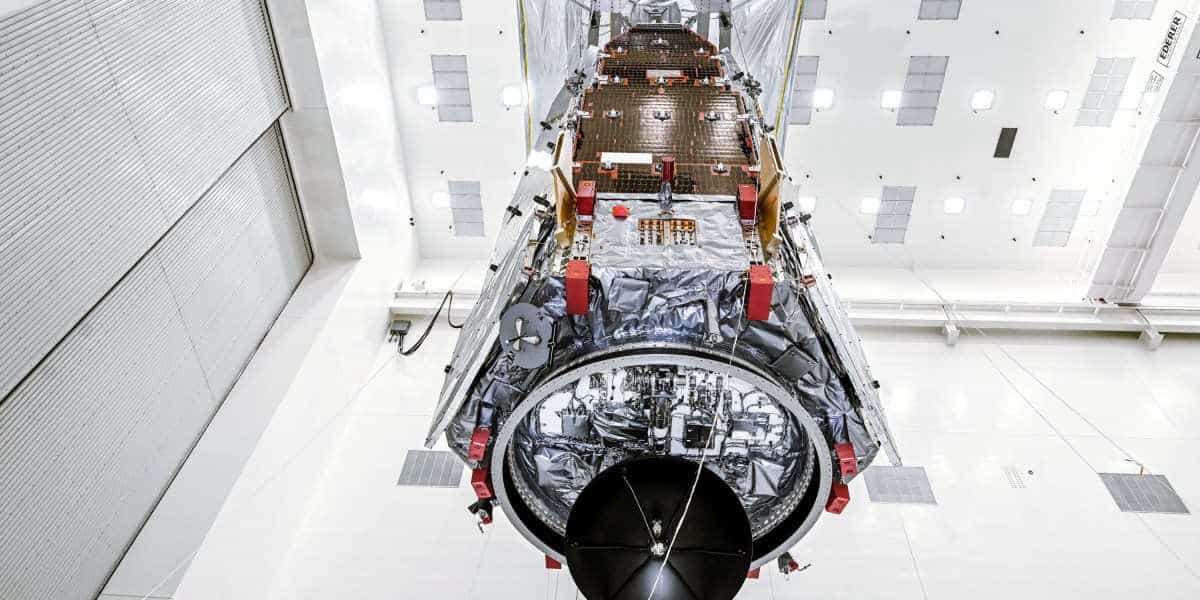
The telescope NASA is launching from Kennedy Space Center at the end of August was designed to chase the two things we understand least in the universe: the dark matter gluing galaxies together and the dark energy pulling the cosmos apart. It may also end up telling us which rock is about to hit a city.
That second job wasn’t in the brochure. The Nancy Grace Roman Space Telescope was built to look through and past our solar system, not at it. But a multi-institutional team of planetary scientists and astronomers will argue in September that the hardware happens to be sitting in exactly the right place, with exactly the right eye, to scan asteroids and pin down their trajectories, sizes and compositions.
A 300-megapixel eye that sees 100 Hubbles wide
Roman, named after NASA’s first chief astronomer, carries a super-wide-angle, 300-megapixel infrared camera. The patch of sky it takes in at once is roughly 100 times larger than what the Hubble Space Telescope sees.
That field of view is what makes the rest possible: thousands of new planets, tens of thousands of exploding stars, more than one billion galaxies surveyed in detail. And while it does all that, it’s staring straight through the neighborhood where the dangerous rocks live.
The proposal, headed to the Europlanet Science Congress at The Hague in The Netherlands, puts a number on it. Roman’s field of view and infrared vision let it pick out small asteroids up to 60 feet long. For scale, that’s comparable to the rock that exploded over Chelyabinsk, Russia in 2013, releasing the force of 500,000 tons of TNT and putting 1,500 people in the hospital.
The origin story involves a budget fight
The planetary defense pitch didn’t come out of a science meeting. It came out of a funding threat. Last summer, Roman was once again threatened with significant funding cuts by the Trump administration.
“My colleague Rick Cosentino [a planetary scientist at NASA] said to me in July 2025 that we need to show what Roman can do for planetary defense as a way to further increase the visibility of the mission with lawmakers and taxpayers,” said Bryan Holler, a researcher at the Space Telescope Science Institute in Baltimore, Maryland.
The software currently throws the asteroids away
Here’s the catch nobody advertises. Roman’s pipeline, as designed, treats a moving rock as noise.
“Streaks, whether caused by cosmic rays or glitches or asteroids, are caught by the software and discarded,” said Andy Rivkin, a planetary scientist and planetary defense researcher at Johns Hopkins Applied Physics Laboratory in Laurel, Maryland.
So the telescope needs tweaking before it spies anything. Astronomers could go in, study those discarded streaks and pull out the ones that turn out to be asteroids.
It’s a support player, not a lead
Even with the adjustments, Roman won’t be an asteroid-finding wunderkind on its own. Its value is in what it does alongside the James Webb Space Telescope, which was also built to look at distant galaxies and stars but can lock onto a single asteroid when asked. JWST did exactly that last year, playing a key role in tracking 2024 YR4, briefly the most dangerous asteroid ever discovered.
“But Roman’s field of view is much bigger,” said Rivkin.
Which means volume. “Roman can provide infrared observations of more asteroids than JWST could hope to observe in a reasonable amount of observing time,” said Holler.
Find a benign traveler and you move on. Find something that might hit us and other telescopes, JWST included, take the handoff and work out the likely damage, or whether it’s worth launching a mission to shove the thing aside.
“Roman will sample such a large volume of the cosmos that we’ve long known it will offer vast opportunities for a range of additional science,” said Alise Fisher, the astrophysics communications lead at NASA Headquarters in Washington D.C.
The numbers that keep planetary defense people up at night
NASA’s Planetary Defense Coordination Office and its partners worldwide are chiefly worried about asteroids 460 feet long and larger. An estimated 25,000 of those have near-Earth orbits. Just over half haven’t been found.
One hitting a city would destroy or irreversibly damage much of it in a heartbeat.
Then there’s the smaller tier: roughly 230,000 asteroids about 165 feet long in orbits close to Earth, and astronomers have located less than 10 percent of them. One of those wouldn’t annihilate a city. It would deliver a force comparable to a large atomic bomb, minus the radiation.
Deflecting them by ramming a spacecraft into one, or vaporizing them with a nuclear weapon, are both theoretically on the table. Neither works if you don’t know where the rock is. That’s the entire reason NASA funds a network of ground-based telescopes hunting for them. They do the job, but they can only cover so much of the night sky, and Earth’s atmosphere keeps getting in the way.
NEO Surveyor is the one built for this
NASA is launching the Near-Earth Object Surveyor space telescope in 2027, and unlike Roman, it has no other job. Parking itself between Earth and the Sun lets it catch asteroids ground-based telescopes simply cannot see.
It also works in infrared rather than visible light, which matters more than it sounds. Asteroids show up more clearly, and infrared gives scientists a considerably better measure of how big they are. Within a matter of years it could find 90 percent of the city-killer-size asteroids in near-Earth orbits.
NEO Surveyor won’t work alone either. It’ll coordinate with Roman and JWST, both of which conveniently have infrared scopes, and with the Vera Rubin Observatory, which just started a 10-year survey of the entire night sky from a mountaintop in Chile. Rubin is expected to turn up 89,000 near-Earth asteroids as part of its inventory.
How the handoff actually plays out
Picture NEO Surveyor catching an asteroid that, on a handful of observations, has some chance of hitting Earth. Then five more like it. The orbits are all deeply uncertain at that stage.
Roman gets pointed at the corner of sky holding all six. Within days, the precision on those orbits improves by several orders of magnitude.
Geometry helps too. Roman sits in a different part of space than both NEO Surveyor and Rubin. “Those slightly different viewing angles will also help narrow orbits down more quickly than if all objects were looking from the same place,” said Holler.
Maybe five of the six get cleared for the foreseeable future. The one that can’t be ruled out is where JWST and other telescopes get called in for a closer look.
“Telescope resources, whether in space or on the ground, are typically oversubscribed and will not be available to follow up on all [near-Earth asteroids] with a non-zero impact probability when they are first discovered,” said Holler. Roman’s job is helping scientists “make sure we follow-up on the correct targets.”
Infrared tells you what the rock is made of
Size isn’t the only thing Roman’s infrared scope can estimate. It can distinguish a stony rock from a puffy, watery carbon-rich one from a metallic one.
“This in turn provides strong clues to the composition and thereby the density and mass of the asteroid, which are important when estimating the impact damage or, less ghoulishly, the effort required to nudge it out of its current orbit,” said Holler.
Roman was never going to be the telescope that saves Earth. NEO Surveyor gets that title. But while Roman is out cataloging supernovas and planets circling other stars, the streaks its software was built to throw away may turn out to be worth keeping.