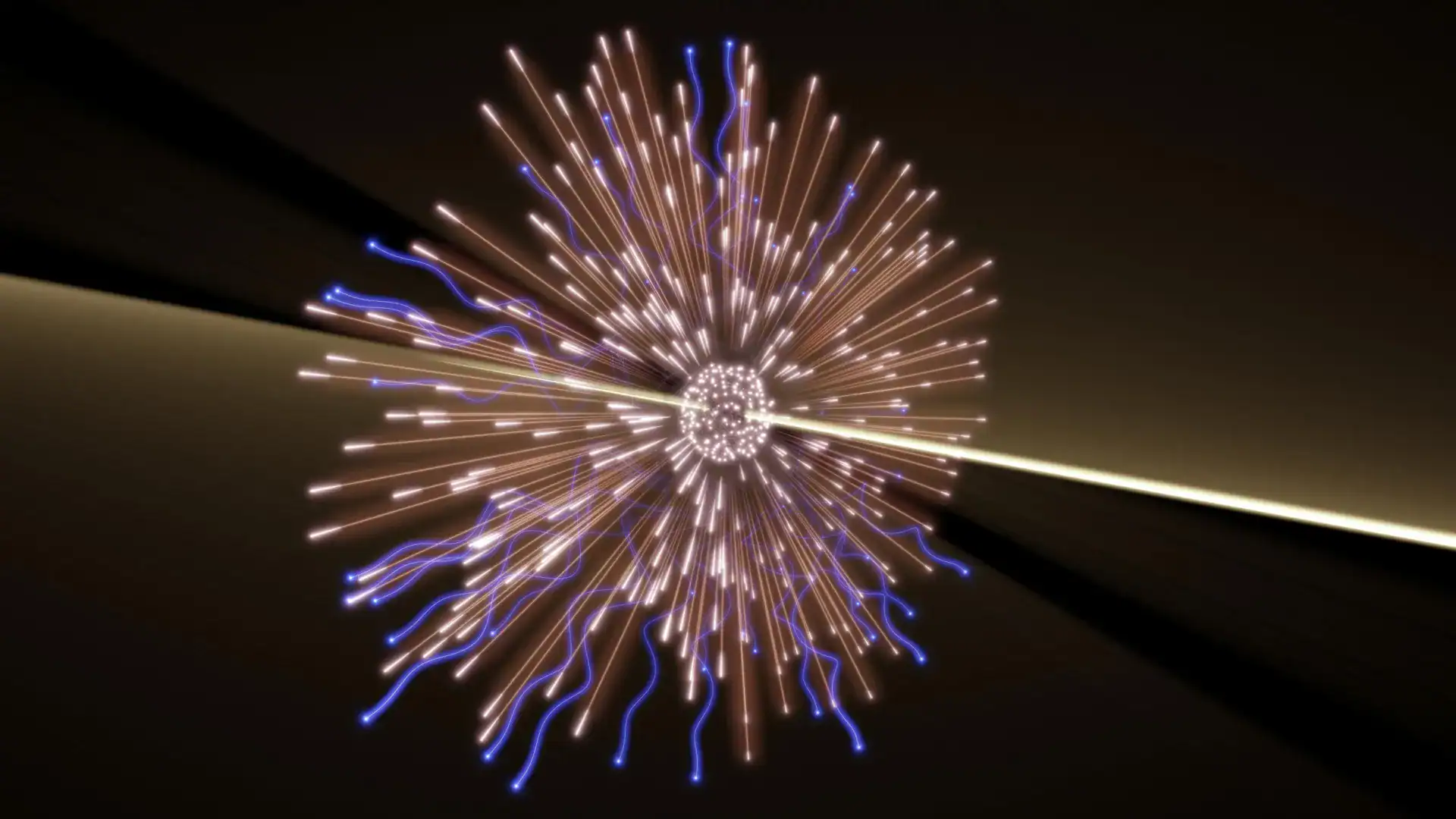

Switch off a nuclear reactor and the core doesn’t go quiet. It goes dim.
Long-lived radioactive fission products keep decaying inside the fuel for months, sometimes years, leaking a thin stream of antineutrinos through the pressure vessel, the shielding and everything else in their way. Nobody had ever measured that leftover trickle. Now the Double Chooz collaboration has, using 17.2 days of data recorded while both reactors at the Chooz plant in northern France sat completely off.
The count over those 17.2 days: roughly 100 antineutrino candidate events. That’s about six a day, from a detector holding more than 30 cubic meters of liquid scintillator, buried underground about 400 meters from the two reactor cores.
Why almost nobody bothers with reactor-off data
Antineutrinos are the lightest and most elusive particles we know of, and they pass through a reactor and its shielding with barely any interference. That’s what makes them useful and what makes them miserable to catch.
Running reactors throw off a flood of them, which is why reactor antineutrino physics has spent decades pointed at cores that are switched on. The shutdown signal is a rounding error by comparison.
“Antineutrinos interact only extremely rarely with matter. However, when one interacts within the Double-Chooz detector, a characteristic double-light signal is produced that can be distinguished from background events,” said Thierry Lasserre of the independent research group OMINA, based at the Max Planck Institute for Nuclear Physics in Heidelberg, Germany. That double flash is the whole trick. Without it, 100 events over two and a half weeks would vanish into the noise.
The simulation got it right, which is the actual news
The measured signal matched detailed simulations that accounted for the remaining nuclear fuel inventory and the decay of long-lived fission products. First direct experimental confirmation of predictions that, until now, existed only on paper.
That matters more than the detection itself. A signal you can predict is a signal you can use as a baseline, and a baseline is what turns a physics result into an instrument.
The events trace back to residual radioactivity in the cores and in the nearby spent-fuel cooling pools. Both contribute. Both were modeled.
Years of background work, not a lucky run
“Until now, reactor antineutrino experiments have mainly focused on operating reactors, where the antineutrino flux is much larger. Detecting the tiny residual signal after shutdown required exceptionally low backgrounds and careful analysis techniques developed by the Double Chooz collaboration over many years,” said Anthony Onillon, who led the work with Lasserre at the Max Planck Institute for Nuclear Physics. The paper was published recently in Physical Review Letters.
Double Chooz isn’t alone here anymore. Initial results from JUNO-TAO, presented at Neutrino 2026, show researchers using reactor-off data to study the faint antineutrino signal from spent nuclear fuel. TAO is still working to isolate that emission. Double Chooz got the first published benchmark for the residual signal from shut-down reactors and spent-fuel pools.
What a safeguards inspector might do with this
The practical pitch is reactor monitoring. If a detector can register a core during maintenance and after shutdown, not just at full power, you get a way to independently confirm reactor status and track spent-fuel inventories without taking anyone’s word for it.
Emphasis on could. This is 100 events from one detector at one plant, 400 meters from the cores, and the paper establishes that the signal exists and behaves as predicted. Turning that into a deployable safeguards tool is a different engineering problem, and the research doesn’t claim otherwise.
Still, the direction is clear enough. Antineutrinos don’t care about shielding, paperwork or declarations, which is exactly the property a verification regime wants.
The detector was built to do something else entirely
Double Chooz was originally constructed to investigate neutrino oscillations, and it played a key role in measuring the neutrino mixing angle θ13, the parameter describing how neutrinos change from one type to another as they travel. That measurement helped open the door to research into matter-antimatter asymmetries in the neutrino sector.
Now the same underground tank has logged a second first: the glow that keeps coming out of a reactor after the reactor stops.
If you want a number to hold onto, hold onto 17.2 days. That’s how long two idle reactor cores had to sit there, doing nothing anyone could see, before physics 400 meters away could prove they weren’t done.