


In February, traders on Polymarket gave the Digital Asset Market Clarity Act an 82% chance of being signed into law. On Saturday, that number sat at roughly 19%.
And Galaxy Digital is more pessimistic than the betting market. Its estimate for passage this year is 10%, less than half of what Polymarket traders think.
That’s the number hanging over the White House meeting scheduled for Aug. 19, where President Donald Trump and the heads of the two agencies that would split crypto oversight under CLARITY are expected to sit down with the executives who have spent years paying lobbyists to get the bill written in the first place.
Who’s actually in the room
According to reports, the guest list includes executives from Coinbase, Andreessen Horowitz, Ripple, Chainlink, Kalshi and Paradigm, plus representatives from the Digital Chamber. Kraken, Gemini, the New York Stock Exchange and Nasdaq have also been invited.
Trump and Commodity Futures Trading Commission Chair Michael Selig are among those expected to participate. Securities and Exchange Commission Chair Paul Atkins is also set to attend. The final attendance list remains subject to change.
Note the mix. Two federal regulators, a sitting president with his own crypto ventures, a prediction market currently fighting a state in court and two of the largest traditional exchanges in the country. That’s not a policy briefing. That’s a negotiation.
The bill had the votes. Then it didn’t.
CLARITY started this year with something most crypto legislation never gets: real bipartisan backing in both chambers.
The House passed H.R. 3633 by 294-134 in July 2025, with 78 Democrats voting yes. The Senate Banking Committee then advanced the legislation 15-9 on May 14, with Democratic Sens. Ruben Gallego and Angela Alsobrooks joining all 13 Republicans.
That coalition came apart over the summer, and mostly not over the substance of how to regulate token markets.
Talks soured over restrictions on crypto activities by senior government officials, limits on stablecoin rewards and protections against illicit finance. Banks leaned on lawmakers to curb rewards from stablecoin platforms, warning that yield-bearing products could pull deposits out of the traditional banking system.
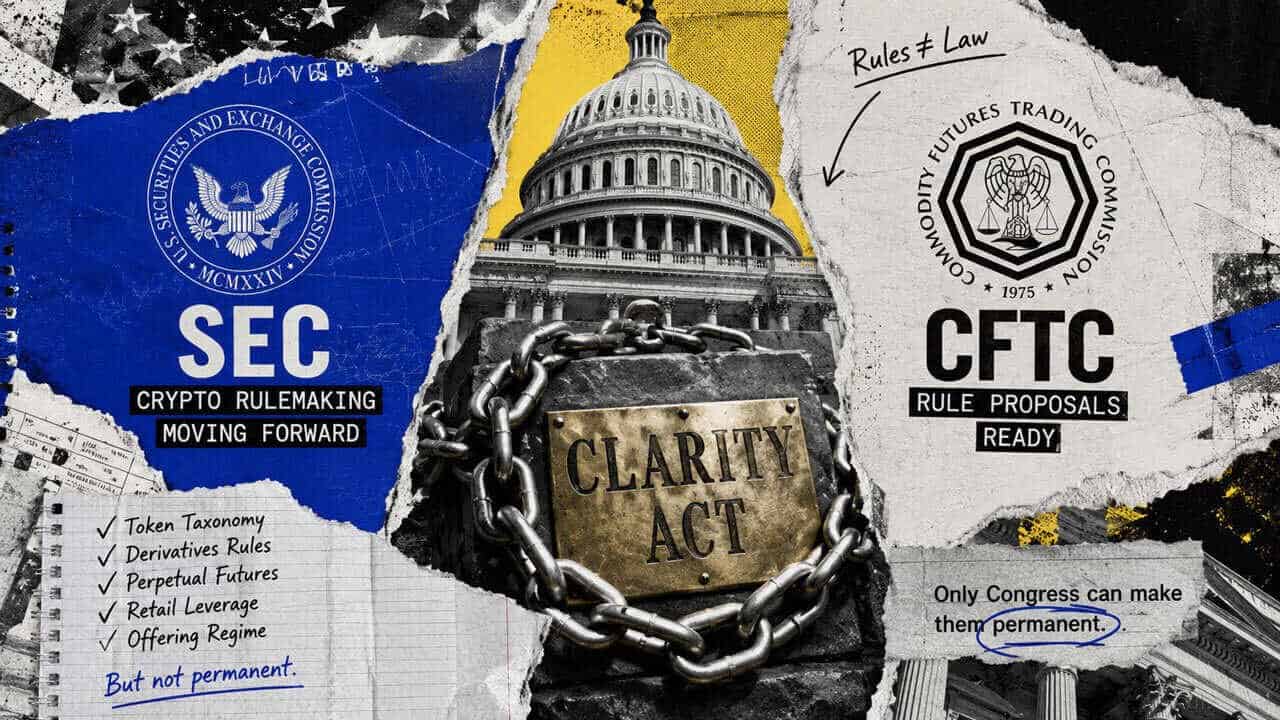
The largest obstacle now is the ethics fight over Trump's own crypto businesses. A bipartisan group of senators sent the White House a proposed ethics framework on July 30. The administration hasn’t publicly agreed to it.
Galaxy Digital said the legislation has effectively shifted from a policy negotiation into a political one. Without a compromise, Galaxy said supporters may have no viable path to the 60 Senate votes needed to advance the bill.
The calendar is the real problem
The stalemate pushed CLARITY past the Senate’s August recess with no floor vote. Senate Majority Leader John Thune did file cloture on the motion to proceed before lawmakers left town, which sets up an early test when the Senate returns Sept. 14.
Here’s where the math gets unforgiving. The Senate is expected to be in session only about three weeks before members leave Washington around Oct. 2 to campaign for the midterms.
Galaxy estimates CLARITY would need to start moving almost immediately, and eat a substantial chunk of those three weeks, to have a realistic shot at clearing the chamber this year. One more breakdown and there’s no room left on the schedule.
Meanwhile, the regulators aren’t waiting
Both agencies are already testing how much of Washington’s crypto agenda they can push through under laws that exist today.
The SEC has two initiatives in development under Atkins: Reg Crypto, a tailored framework for certain crypto offerings, and an Innovation Exemption that would permit limited experimentation with tokenized securities and onchain trading.
Progress has been choppy. The commission had an Aug. 14 vote on the crypto-offering proposal on the calendar, then canceled the meeting a day ahead without scheduling a replacement. The Innovation Exemption has also slipped amid resistance from parts of the traditional securities industry.

Both proposals take on questions CLARITY is meant to settle more permanently, including how digital assets get issued and traded and which federal rules apply. The stop-start rollout is a fair measure of how far regulators can actually go while Congress stays split.
The CFTC is moving faster and picking fights
Selig said the agency needs to hear directly from the companies building new financial products if regulators are going to keep pace with innovation. The CFTC holds its first Innovation Advisory Committee meeting on Aug. 20, pulling in executives, entrepreneurs and market participants to talk about where financial regulation goes next.
That follows a more forceful move. On Aug. 11, the CFTC invoked emergency authority after Kalshi warned that a lawsuit brought by New York could disrupt its federally regulated event-contract market nationwide.
Selig ordered the exchange to keep operating under federal derivatives rules and has argued that states can’t override the national framework governing CFTC-regulated markets. It’s one front in a wider fight between the commission and several states over whether prediction contracts belong under federal derivatives law or state gambling rules.

Neither agency can reproduce the full scope or permanence of CLARITY through exemptions, rulemaking and reinterpretations of existing statute. Both are building pieces of the framework anyway.
That’s the tension the executives walk into on Wednesday. But the meeting isn’t the tell. The cloture vote when the Senate comes back Sept. 14 is, and by then there will be about three weeks left on the clock.




[…] said the change reflects a wallet infrastructure overhaul during its integration with Coinbase. Roughly 90% of client assets have moved into Coinbase custody arrangements since Coinbase acquired […]