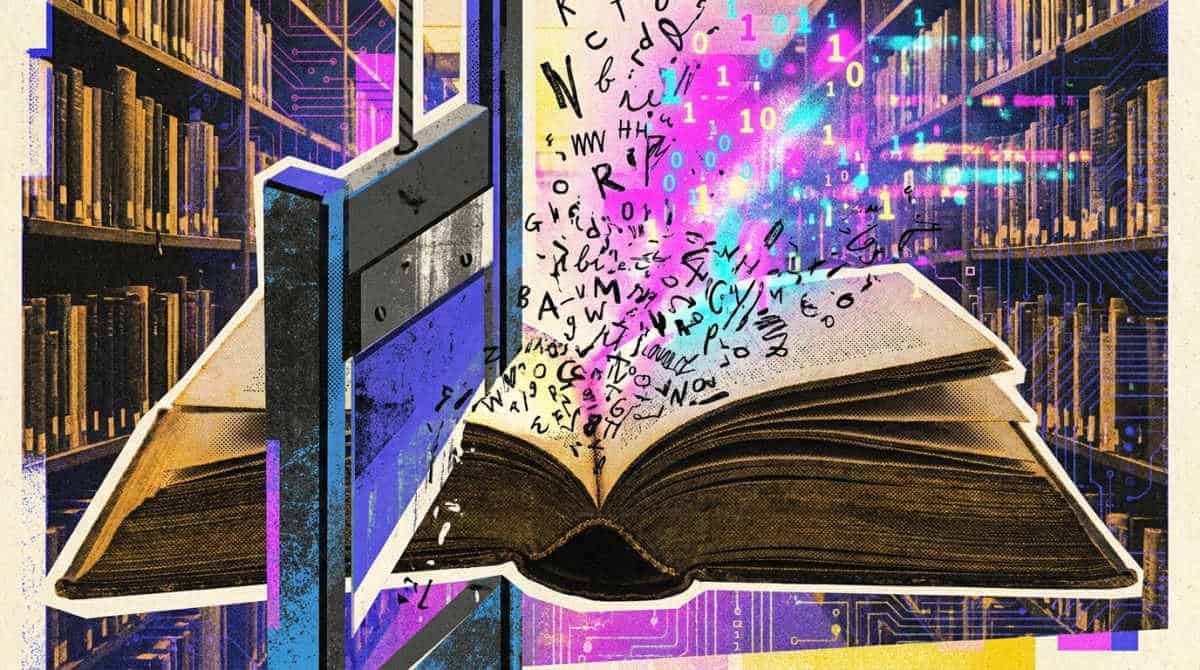

Somebody hid an AirTag inside a shipment of rare books and watched it travel across the country. The tracker stopped at an Amazon warehouse in Las Vegas. The books, as far as anyone can tell, never left it intact.
That’s the finding of an investigation by 404 Media, which used the tracker to follow a bulk book purchase to its destination. Amazon buys printed books in bulk, scans them for AI training data, and destroys them in the process.
The team with a T. rex holding a book
The Las Vegas facility is home to a group called VGT3. Its logo is a Tyrannosaurus rex holding a book, which is either a joke about extinction or a joke about eating them, and neither reading is flattering.
Workers there say they cut off book spines to speed up scanning. A spine-off book feeds through a sheet scanner fast. It also stops being a book.
Amazon uses the scanned data to train its Nova models. A spokesperson said the company buys books through commercial channels to improve its products.
Why printed books are the good stuff
Booksellers suspect AI companies are working through books systematically by ISBN number, title by title.
The appeal isn’t nostalgia. Printed texts often don’t exist online at all, so they’re not already sitting in a scraped web corpus that every lab has. And most of them predate 2022, which means they’re free of AI-generated content. In a training pipeline increasingly poisoned by machine-written text, a 1970s print run is clean data.
Anthropic did it first, and a judge said fine
Amazon isn’t alone here. Anthropic ran a similar operation.
A lawsuit by book authors revealed its “Project Panama,” in which Anthropic bought books on marketplaces, cut off their spines and digitized them. Same method, different company.
The judge in that case ruled the scanning qualified as fair use and didn’t violate copyright. Part of the reasoning: the printed originals were destroyed, so they weren’t copied and resold.
Read that again. Destroying the book helped the legal argument. The cheapest way to stay on the right side of the ruling is to make sure the physical copy no longer exists.
What actually gets lost
Both companies are turning sometimes rare books into private training material. The controversy isn’t the scanning. It’s that the originals may be irreplaceable, and once the spine comes off there’s no putting it back.
Knowledge that sat on a public shelf, findable by anyone with a library card or $12 on a used-book marketplace, ends up locked inside the closed AI models of a single corporation. The text survives. Your access to it doesn’t.
If you sell rare books in bulk, you now have a reason to ask who’s buying and a cheap way to find out. An AirTag costs less than most of the books in the box.