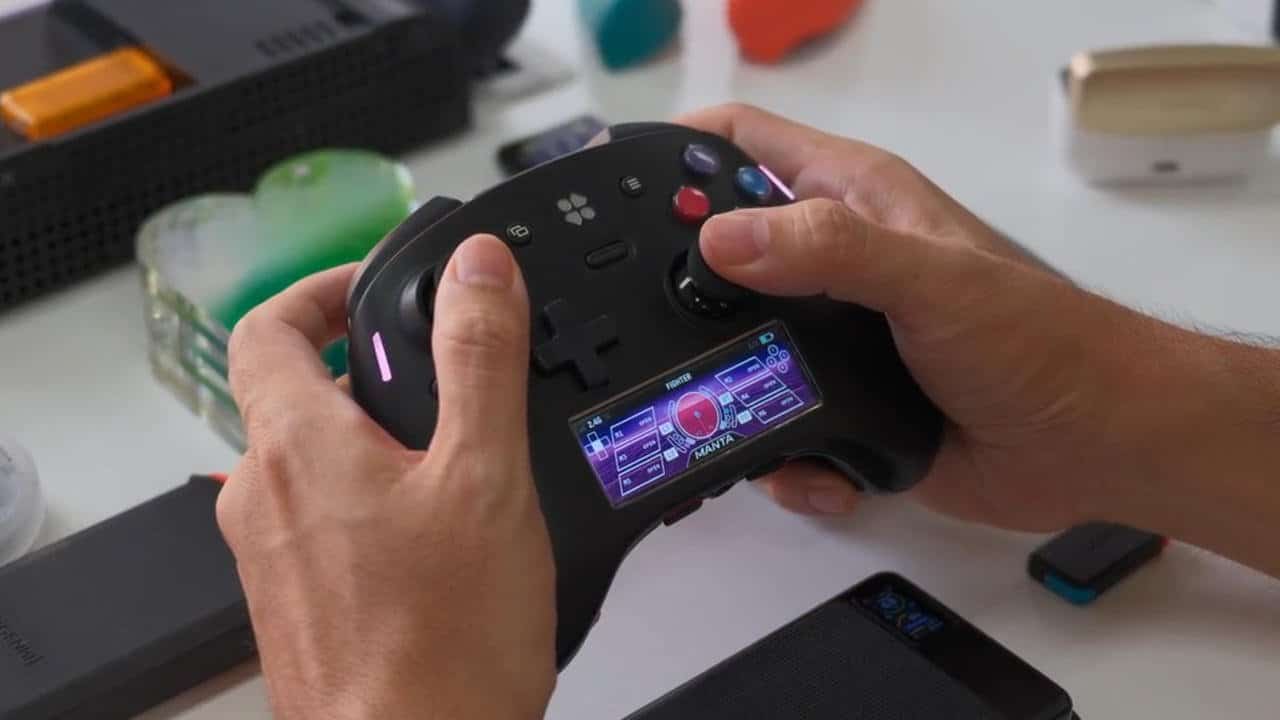

A controller with an operating system inside it. That’s the pitch for the Genki Manta, and at $279, it had better be more than a gimmick.
Genki, the company behind some of the better Switch 2 and Switch accessories out there, has launched a Kickstarter for what might be the most over-engineered controller I’ve ever seen. The Manta crams in the features you’d expect from the top tier of the category: TMR sticks, adjustable triggers, advanced haptics. Then it keeps going, with a full operating system and a digital display built into the controller body.
I’m all for peripherals that push their category forward. I’m just not sure who needs a controller this advanced.
The design choices that actually make sense
The screen sits centered below the thumbsticks rather than above them, the way the Turtle Beach Stealth Ultra does it. Better call. And you can dial in thumbstick tension on the fly, literally, by twisting the stick itself.
But at some point you have to ask whether we’ve hit overkill.
Genki knows what it’s doing here. “We refused to cut corners,” the Kickstarter reads. “It is, frankly, a spec monster.”
What’s under the hood
The Manta connects to PC over USB-C wired or 2.4 GHz wireless through a dongle, and to Switch 1 and 2, mobile and other devices over Bluetooth. The layout is standard Xbox-style with offset sticks and all the usual inputs. There’s a 2,400 mAh user-replaceable battery, though the Kickstarter page doesn’t estimate how long it lasts between charges. It can remotely wake a paired Switch 2, which is a small mercy.
The face buttons are “Analog Pulse Buttons” that track their full travel rather than only registering at the bottom. That means you set your own actuation point, anywhere from a quick rapid-reset for burst inputs to a deeper press that demands intent.
Triggers get three modes. Digital gives you short travel and a crisp click. Rapid is fully analog with short, smooth travel. Analog goes the full distance with proportional control.
Then there’s the rest of the pile: “maglev haptics” (better than traditional rumble, apparently), a nine-axis gyroscope/accelerometer/compass for motion controls, six extra inputs, and a D-pad that swaps between a traditional cardinal layout and an eight-point satellite dish design. The extra inputs break down as two buttons tucked up top beside the bumpers, two integrated back buttons and two removable back paddles.
The part where I changed my mind
MantaOS uses the color display to handle everything a driver or companion app usually would. Profile swapping, macros, input adjustments, RGB lighting. All of it lives on the controller.
That alone would be a neat trick. What sold me was the small button next to the right thumbstick.
Press it and an “On-the-Fly KBM” appears, turning the screen into a QWERTY or Compass Quick Type keyboard. Hold it and the whole controller becomes a gyro-controlled mouse. Suddenly you’re navigating the Windows desktop, blowing past login screens and game launchers without reaching for anything else. It’s the same friction-killer that makes the Steam Deck and Steam Machine easier to live with than a handheld or PC running Windows, except Genki solved it on the controller side instead of leaning on SteamOS.
Somewhere in the middle of writing this, my read shifted from “unnecessarily over-engineered” to “wait, that’s actually awesome.”
Macros that record how you played, not just what you pressed
The macro action timeline goes past the usual input-and-delay recording. It tracks analog stick paths, trigger pressure and more, so you can capture an entire gameplay sequence and replay it. A brutal boss runback, for instance. (I’m looking at you, Bilewater.)
The screen also runs customizable dashboards for your active profile, polling rate, battery and connection status.
There’s a programmable layer too, running on a dual-core Raspberry Pi RP2350, that loads external apps onto 16 MB of internal storage. The Kickstarter includes a clip of a side-scrolling space shooter running on the built-in screen and floats the idea of a “Genki Forge” where users develop and share homebrew apps for MantaOS. Someone will have Doom running on this thing within days.
The money
The Kickstarter is live and, as of this writing, sits at around 1,800 backers and more than $400,000 pledged. That’s four times the $100,000 goal.
Retail price lands at $279, but a Super Early Bird tier drops it to $189, which puts the Manta in the same conversation as the DualSense Edge. It’s still close to double the $100 Steam Controller, which has its own tricks but skips most of the advanced hardware here.
Genki wants to ship to backers this coming January and conservatively estimates a delivery window of January through April 2027. Which gives everyone plenty of time to decide whether a controller needs its own homebrew scene.