
In Brief:
- Prophecy Social opened a closed beta for Venues, letting projects and communities run their own branded prediction market venues on Somnia.
- Venues are spun up through an agent, and every market shares liquidity across the whole Prophecy protocol no matter which venue created it.
- Prophecy has reported more than 31,000 users and 15,000 markets in its first month, with AI agents resolving every outcome onchain.
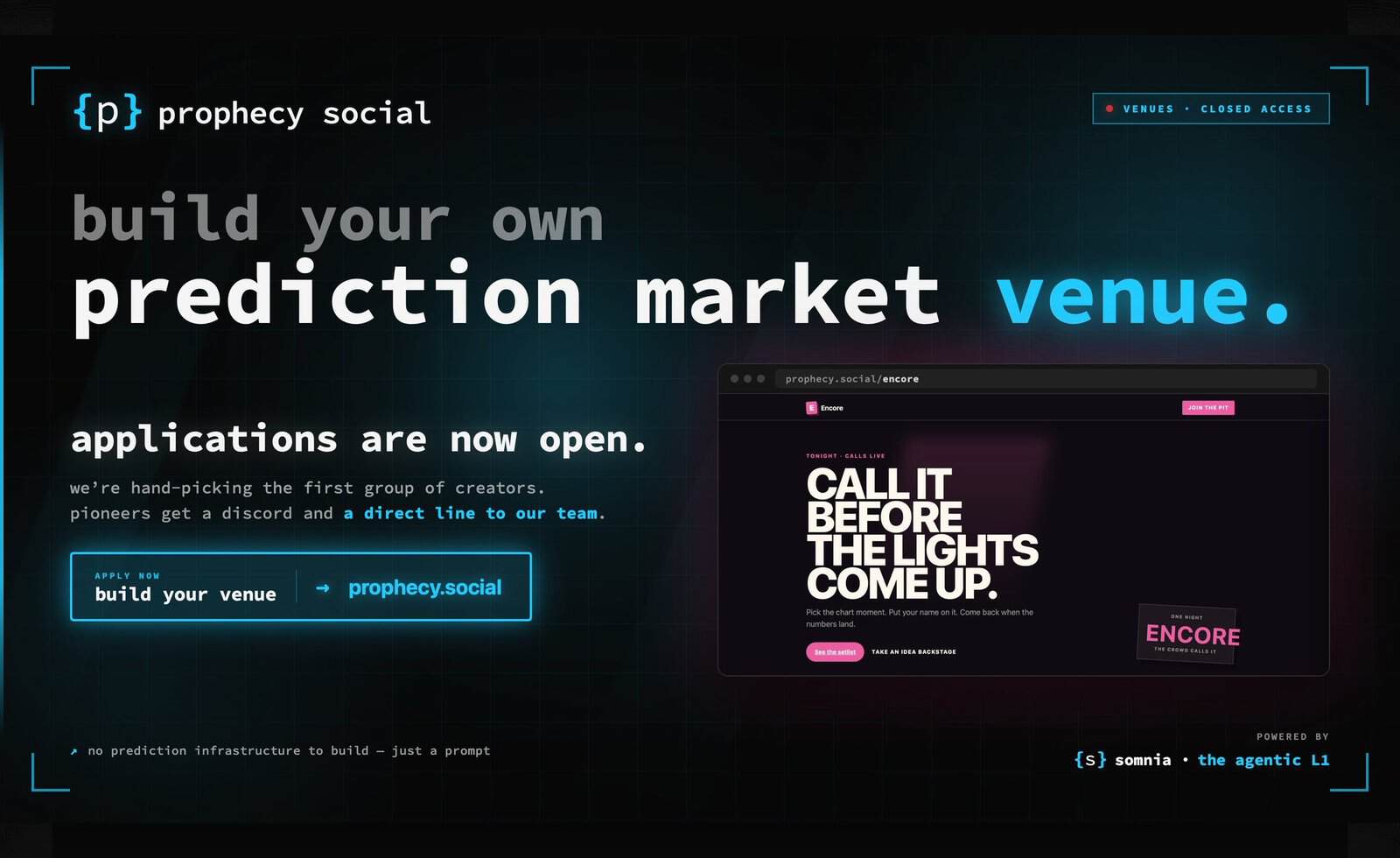
Prophecy Social has opened a closed beta for Venues, a product that lets outside projects and communities run their own prediction market venues instead of posting markets inside Prophecy’s flagship app.
“It’s time to build your own venue,” the project said in the announcement. “Prophecy Social Venues gives you a place to bring your project, community or ideas to life through prediction markets.”
Prophecy Social is introducing custom prediction venues to the Somnia ecosystem through a closed beta.
Projects and communities can quickly create their own custom venue using an agent, with their own branding, markets and experience.
Market creation and resolution are
Operators pick their own markets, apply their own branding and shape the experience around whatever their community cares about. “No prediction infrastructure to build,” the project said.
Somnia, which Prophecy runs on, said projects and communities can create a custom venue using an agent.
Shared liquidity is the pitch
The economics matter more than the branding. Every market on Prophecy shares liquidity across the entire protocol regardless of which venue it was created on, so a new venue doesn’t have to bootstrap its own book from zero.
Accounts work the same way. The one-time PST grant that arrives at sign-up is tied to the account rather than the venue, meaning anyone who already registered through another venue won’t get a second grant. The daily bonus is also cross-venue, capped at one claim per day across every venue in the ecosystem.
Points carry across venues too. Users predict on any venue, earn points toward a public leaderboard and collect SOMI rewards at the end of each season. Only the first 20 calls each day score, and correctly calling an outcome the crowd missed is worth more than piling onto favorites. Creating crypto and football markets earns creator points based on the trading those markets attract.
What a venue actually gives operators
Prophecy’s documentation describes a venue as a brand’s name on a live prediction platform, with its own markets, leaderboard and categories. Operators get a dashboard covering total predictions, accuracy rates, most active players and top markets, and the top predictors are ranked publicly each week.
The docs frame it as “not a sponsorship slot.” They also describe onboarding as a hands-on process in which the Prophecy team builds the venue alongside the partner, who chooses the brand, the categories and the first batch of markets.
Builders who’d rather do it themselves can fork the repo and deploy against the protocol directly, using Prophecy’s contracts, resolution agents and token mechanics. The protocol sits at prophecypredict.xyz. The consumer app is at prophecy.social.
Agents do the settling
There’s no human moderator or dispute committee. When a market’s countdown hits zero, multiple independent AI agents pull evidence from news APIs, price oracles and public data feeds, assess it against the market’s resolution criteria and each produce a vote with the reasoning attached.
The consensus threshold is shown on every market before a user takes a position. Once it’s reached, the outcome is written to Somnia and winners can claim immediately.
Those agents run inside Somnia’s execution environment under the same consensus guarantees as any other transaction, so resolution is verified by validator nodes rather than produced by an outside service. Somnia’s sub-second finality means markets settle as soon as outcomes are confirmed.
Markets are graded at creation. A score called Caliber rates each one on how cleanly it can be resolved and how reliable its data source is.
The numbers so far
Prophecy signed up more than 5,000 users and saw more than 2,000 markets go live in its first week, all created and resolved without manual intervention. That week produced 3.6 million points counting toward SOMI rewards.
By the one-month mark the project reported more than 31,000 users and 15,000 markets. Stocks were added later, including markets on whether AAPL closes above or below a set price on a given day.
The platform is free to play. Trading runs on PST, which can’t be transferred, traded, sold or converted into any currency, and Prophecy and Somnia sponsor the trading fees.
Closed beta access has been rationed before. Top 100 finishers in Season 1 or Season 2 got first access to a redesigned interface, gated through Discord.