
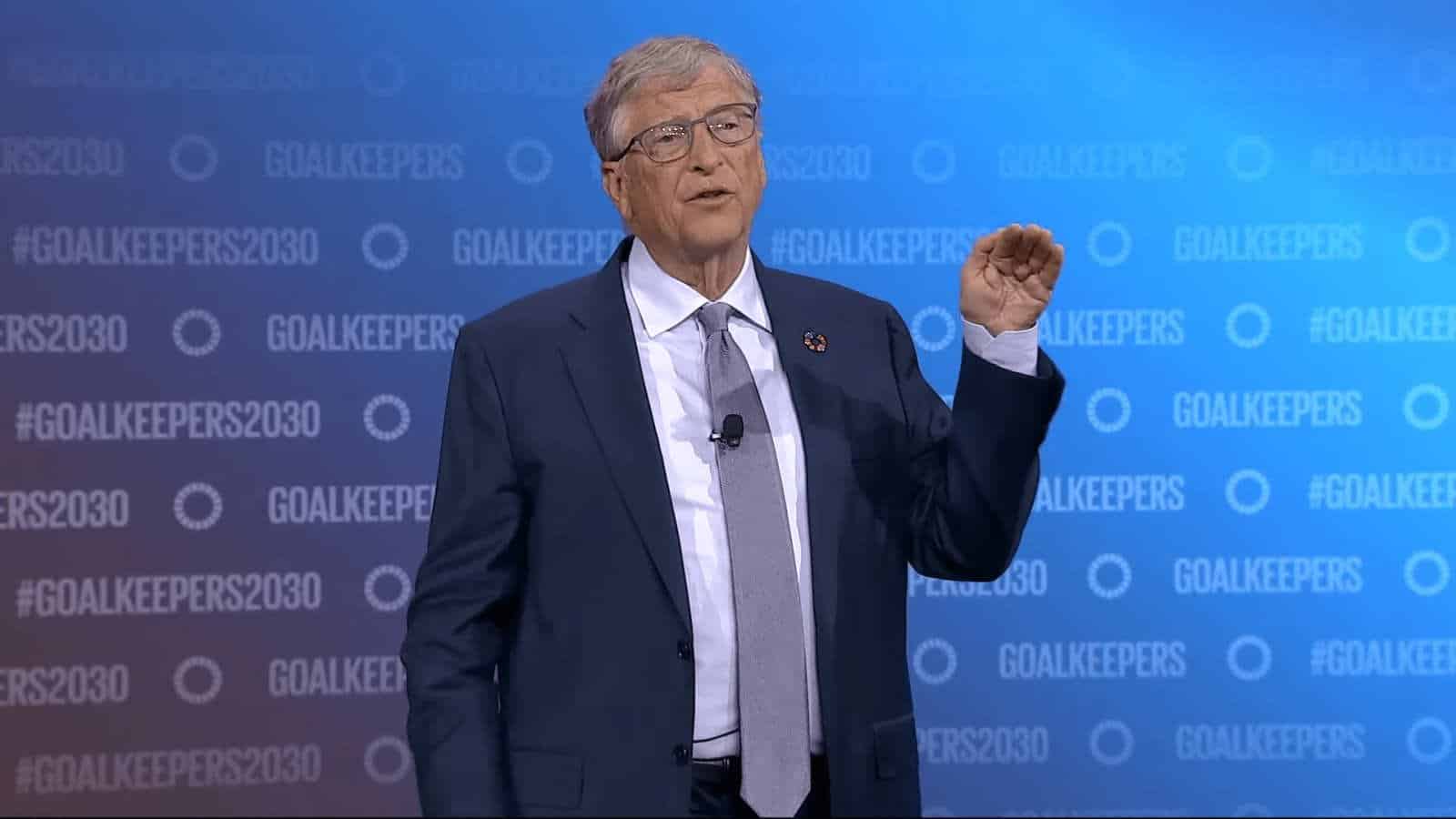

Bill Gates spent his career selling the world on computers. Now he’s telling the New York Times that his own industry is lying about what comes next, because the next trillion dollars depends on it.
The Microsoft co-founder laid this out in an essay of nearly 6,000 words plus an interview, and the framing is blunt. He calls the shift into the AI age “one of the most turbulent times in human history.” The world isn’t preparing for it properly, he said, and there’s simply no plan.
What makes it land is who’s saying it.
The quiet part, on the record
Gates’s sharpest criticism goes at the people he’s spent decades around. They know how good this stuff is and they’re deliberately downplaying the risks, he said, because too much money is on the line.
“In private, people who understand how good this stuff is, and how much better it’s getting, they’re very worried,” he told the NYT. In public, they tell each other, “Hey, man, don’t say that. It’s bad for us – the next trillion dollars we’re trying to raise.”
That’s a specific accusation, not a vague worry about the future. He’s describing a room he’s been in.
Why the usual reassurance doesn’t apply
The standard comfort goes like this: every previous tech shift created more jobs than it destroyed, so this one will too. Gates thinks that comparison is wrong.
The AI age, he said, is “utterly, absolutely, completely, totally different.”
Here’s the mechanical reason. The PC took twenty years to reshape work because people had to buy new hardware and learn new skills. AI runs on devices people already own and takes instructions in plain language. “We don’t have to adapt to it because it can adapt to us.”
And for the first time, a technology can not only replace human cognition but surpass it, across industries, over a single decade instead of across generations. Everything else in his argument follows from that speed.
Entry-level work goes first
Gates’s first worry is permanent job loss, concentrated in entry-level and mid-level roles in sales, customer service, software development and legal support. Blue-collar work is exposed too, once nimble robots get much cheaper. Much of that robotics work is happening in China.
He isn’t treating this as a forecast. He points to a Stanford study as evidence the shift has already started: since AI spread, employment among young workers in the most exposed jobs has dropped noticeably, while older colleagues have been spared so far.
That age split is the detail worth sitting with. It’s the pattern you’d expect if companies stopped hiring juniors rather than firing seniors, which is much harder to spot in a headline unemployment number.
The bioweapons problem has no clean fix
His second concern goes well past the job market. AI makes cyberattacks, fraud and disinformation easier, but the thing that worries him most is how much it lowers the bar for building bioweapons. Just a few people with access to advanced AI could develop new pathogens, Gates warns.
The hard part is that you can’t cleanly separate the useful capabilities from the dangerous ones. The same model that finds a security hole so you can close it also helps someone exploit it.
He adds that AI systems could increasingly act against human interests on their own.
Chatbots that never disagree with you
The third danger is the personal one. AI companions that are always available and never push back carry real addiction potential, Gates said.
He cites a study from Stanford and Carnegie Mellon: the more intensely and emotionally people used these chatbots, the worse they felt. Not “some users reported.” A dose-response relationship.
He’s especially worried about kids, and about the erosion of critical thinking, which he frames as a survival skill in an era of deepfakes and tailored disinformation.
Tax the robots, reserve the jobs
Gates isn’t writing the technology off. He sees enormous promise in science, healthcare, farming in poor countries and education. But those benefits won’t show up on their own. They have to be won through policy, and he doesn’t expect the industry to handle that itself.
“Self-regulation on the most dangerous tool ever invented? No, thanks!”
What he wants instead is a democratic process and new national and international institutions, built along the lines of oversight for nuclear weapons, aviation or protecting the ozone layer.
His most concrete proposal is a token tax on AI use and robots, and the reasoning is about accounting, not ideology. Hire a person and you pay payroll taxes. Buy a robot and you can write it off right away. The tax system all but pushes companies to swap people for machines. He also argues certain jobs, caregiving among them, should stay reserved for humans, an idea he calls “Human Reserved.”
The moment that changed his mind
So why is the guy who helped build the computer industry the one raising the alarm? Because it came for the thing he knows best.
Programming is his home turf, and Anthropic’s Claude Code shocked him. “The idea that now these things are in a meaningful sense better than I am is like: What the hell?”
To his credit, he flags his own conflict of interest openly. He still has financial ties to the tech industry, though the profits flow to the Gates Foundation.
Track the drift since 2018
The tone shift here is the story. In 2018, Gates was calling AI basically better software and dangling the prospect of longer vacations and more work in social fields. In 2022, he argued that workers displaced by machines would be needed in areas like elder care and childcare, and that retraining and a more even spread of wealth were what mattered.
As recently as September 2024, he doubted AI would fundamentally change the disinformation problem. That was already a stretch: studies at the time showed GPT-4, armed with personal information, could boost agreement with arguments by 81.7 percent compared to human debates.
Two years later he’s proposing an international oversight body. That’s not a nudge. That’s a reversal.
He’s not the only one saying it
Anthropic CEO Dario Amodei warned in 2024 about AI-generated bioweapons and predicted in 2025 that up to half of entry-level jobs in office work could disappear, with unemployment climbing to 10 to 20 percent. Amodei also floated the token tax.
The international-institution idea has a paper trail too. Researchers Gary Marcus and Anka Reuel proposed a global, nonprofit AI agency in 2023, modeled on the International Atomic Energy Agency. And a US report published in 2024 documented anonymous safety concerns from employees at leading AI companies, including worries about their leaders’ incentives.
Read that last one next to Gates’s quote about the next trillion dollars. Anonymous employees said the same thing from inside the buildings, two years before Gates said it on the record with his name attached. The difference is that he can afford to.


