 George Tsagkarakis
At least 11 of Liquid’s 15 functionaries signed the transaction. That’s the number to sit with, according to blockchain security firm Bitslab, because it means nobody stole a key. Eleven independent signers looked at the same withdrawal and each one said yes.
The result was roughly $320 million in Bitcoin leaving the Liquid Network’s federation reserve through an abnormal peg-out, and a sidechain that stopped moving.
Liquid disabled its bridge nodes. SideSwap suspended swaps, peg-ins and peg-outs. Exchanges paused or prepared to pause L-BTC deposits and withdrawals while operators investigated.
Four thousand L-BTC that shouldn’t have existed
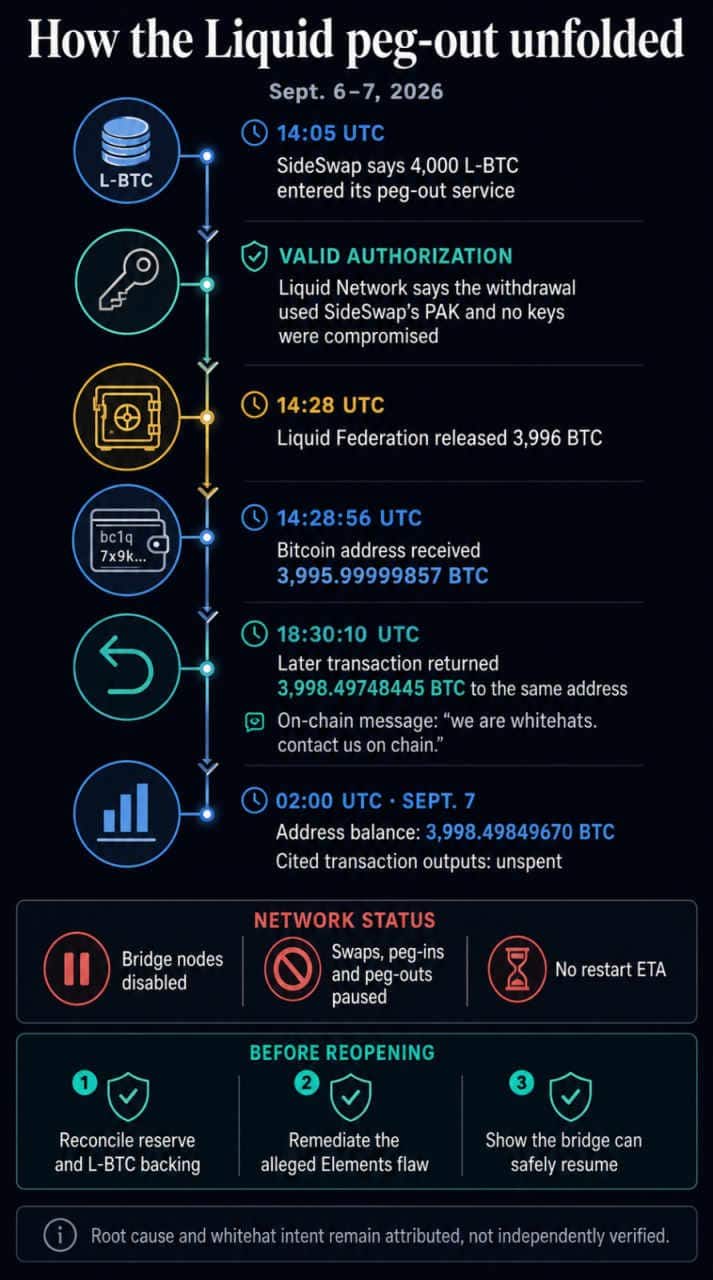
It started Sept. 6, when a customer sent 4,000 L-BTC to SideSwap’s peg-out service, the mechanism that converts Bitcoin represented on Liquid back into BTC on the main chain.
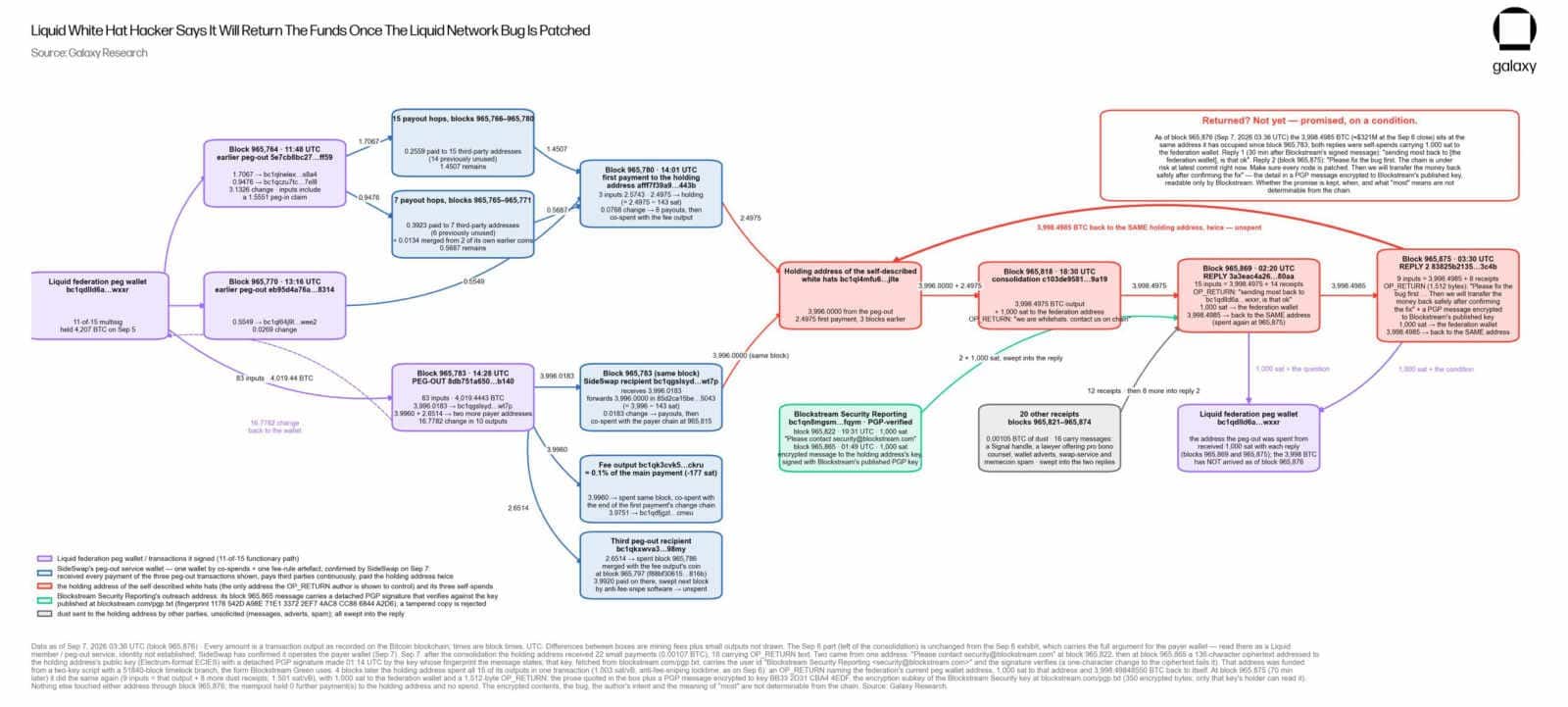
SideSwap said the request cleared the normal authorization process, and the Liquid Federation released about 3,996 BTC. That Bitcoin later landed at an address holding roughly 3,998.5 BTC at the latest check.
Liquid is built on a simple promise: one BTC held in the federation reserve for every L-BTC in circulation. A normal peg-out burns the L-BTC and releases an equivalent amount of Bitcoin.
Here the burn happened. The backing never did. SideSwap said a software bug created L-BTC with no Bitcoin behind it, and those tokens still walked through a valid peg-out, after which federation functionaries treated the withdrawal as legitimate and released real BTC.
SideSwap said Blockstream traced the 4,000 L-BTC presented for redemption to a flaw in Elements, the software Liquid runs on. If that holds up, the failure happened before anyone signed a Bitcoin transaction.
The keys worked exactly as designed
Both Liquid and SideSwap say no signing credentials were stolen. The withdrawal used SideSwap’s valid Peg-out Authorization Key, or PAK, and Liquid said neither that key nor other federation keys were compromised.
That makes this a different animal from the bridge hacks the industry has learned to pattern-match. Secure keys buy you very little when every signer is handed the same invalid state and accepts it.
No independent technical postmortem or detailed patch description was public at the latest check, which leaves the precise cause resting on what Liquid and SideSwap have said about it.
Negotiating in OP_RETURN messages
The actors holding the Bitcoin identified themselves on-chain as “whitehats” and said they intended to return most of the funds once the underlying bug was fixed across the network. They’ve been talking to Blockstream through Bitcoin transactions carrying OP_RETURN messages.
Galaxy Digital research head Alex Thorn said Blockstream first sent a message asking the holder to contact its security team. The holder replied that it planned to send “most” of the Bitcoin back to the federation.
A later message attached a condition: Blockstream fixes the bug and confirms every node is patched, then the funds come back.
So the eventual financial loss may end up small. The question that stays open is how almost 4,000 BTC left the federation without an apparent key compromise.
Patching is the easy half
Liquid has to find and fix the Elements flaw, push that fix to affected nodes, and then show that a second batch of invalid L-BTC can’t take the same path through authorization.
And it has to square the books. The allegedly bug-created L-BTC was burned on the way out, but about 3,996 real BTC left the federation wallet and hasn’t come back.
Until those funds return or the accounting is restored some other way, Liquid still owes the people holding legitimate L-BTC proof that their tokens are backed one-for-one. The bridge nodes stay disabled while that work continues.