


NASA just handed Blue Origin a $700 million contract to build, launch and operate a communications spacecraft at Mars. On Friday, the company that lost filed a protest with the US Government Accountability Office.
That company is Rocket Lab, and it isn’t being subtle about why.
“NASA’s award decision appears to be inconsistent with the eligibility criteria mandated by Congress,” the company said on X. “In addition, the agency’s punitive review of Rocket Lab’s technical volume was inconsistent, making incorrect assertions and conclusions.”

Punitive. That’s a strong word to put in writing about your biggest customer.
On paper this is not an exotic piece of hardware. You build a spacecraft, you fly it to Mars, you park it in orbit, and it relays transmissions back and forth to the big dishes on Earth. Straightforward, as deep space missions go.
The procurement of that straightforward spacecraft has become one of the year’s better soap operas at the space agency.
The congressional language everyone is arguing about
The Mars Telecommunications Network orbiter exists because of the supplemental funding package in the “One Big Beautiful Bill” that Congress passed in 2025. Nobody in the space community saw it coming. It was welcome anyway, since the American spacecraft currently circling Mars are getting old.
The legislation, led by Sen. Ted Cruz (R-Texas), came with unusual strings. The orbiter had to be selected from US companies that “received funding from the Administration in fiscal year 2024 or 2025 for commercial design studies for Mars Sample Return; and had proposed a separate, independently launched Mars telecommunication orbiter supporting an end-to-end Mars sample return mission.”
Read that second clause again. It’s the whole fight.
The first half is defensible. “Commercial design studies” refers to the faster, cheaper sample return concepts NASA picked in 2024 and 2025, and eight companies qualify on that basis: Rocket Lab, Blue Origin, L3Harris, Lockheed Martin, Northrop Grumman, SpaceX, Quantum Space and Whittinghill Aerospace. All of them had done real concept work with the agency.
The second half is where Capitol Hill sources started asking questions. Why does a bidder for a plain communications orbiter need to have previously proposed an orbiter inside an “end-to-end” sample return architecture? What does one have to do with the other?
The clause looks like it was written for one bidder
According to sources, that “end-to-end” language was meant to favor Rocket Lab and its telecommunications orbiter proposal. Rocket Lab appeared to share that read. Around the time the legislation passed, the company seemed to believe it was the only bidder with a qualifying end-to-end mission, a claim it made to shareholders during its Q2 2025 investor update.
Sources said Cruz’s office owned the language overall, with Sen. Roger Wicker (R-Miss.) involved specifically in the Mars Telecommunications Network wording. Why it was drafted that way remains the most interesting open question here.
NASA went with Blue Origin’s Blue Ring platform instead.
Two plausible reasons NASA went the other way
One possibility: the agency didn’t believe Rocket Lab could finish both the spacecraft and its Neutron rocket by late 2028, when the mission is due to launch. That’s an aggressive schedule for a rocket that hasn’t flown.
The other: selection officials simply judged Blue Ring the more capable spacecraft for what the agency needs.
Both are guesses, and that’s the problem. NASA hasn’t released its source selection statement, the document that lays out the technical rationale behind an award. Nearly two weeks after the decision, it’s still not public.
So the only account of NASA’s technical review we have in public is Rocket Lab’s, and Rocket Lab’s account is that the review was punitive and inconsistent. That’s an unhealthy information vacuum for a contract this size.
Why a boring orbiter matters more than it looks
The contest has already played out in technical proposals, in political maneuvering and on social media, where Rocket Lab and Blue Origin have been sniping at each other.
Here’s the part worth holding onto. This is the first time NASA has used a fixed-price contract to pick a US company to build a spacecraft, launch it and operate a network around another planet. The agency isn’t buying a vehicle. It’s buying a service, at another world.
Blue Origin won that precedent. For now, it also holds first-mover advantage on however NASA chooses to explore the rest of the Solar System.
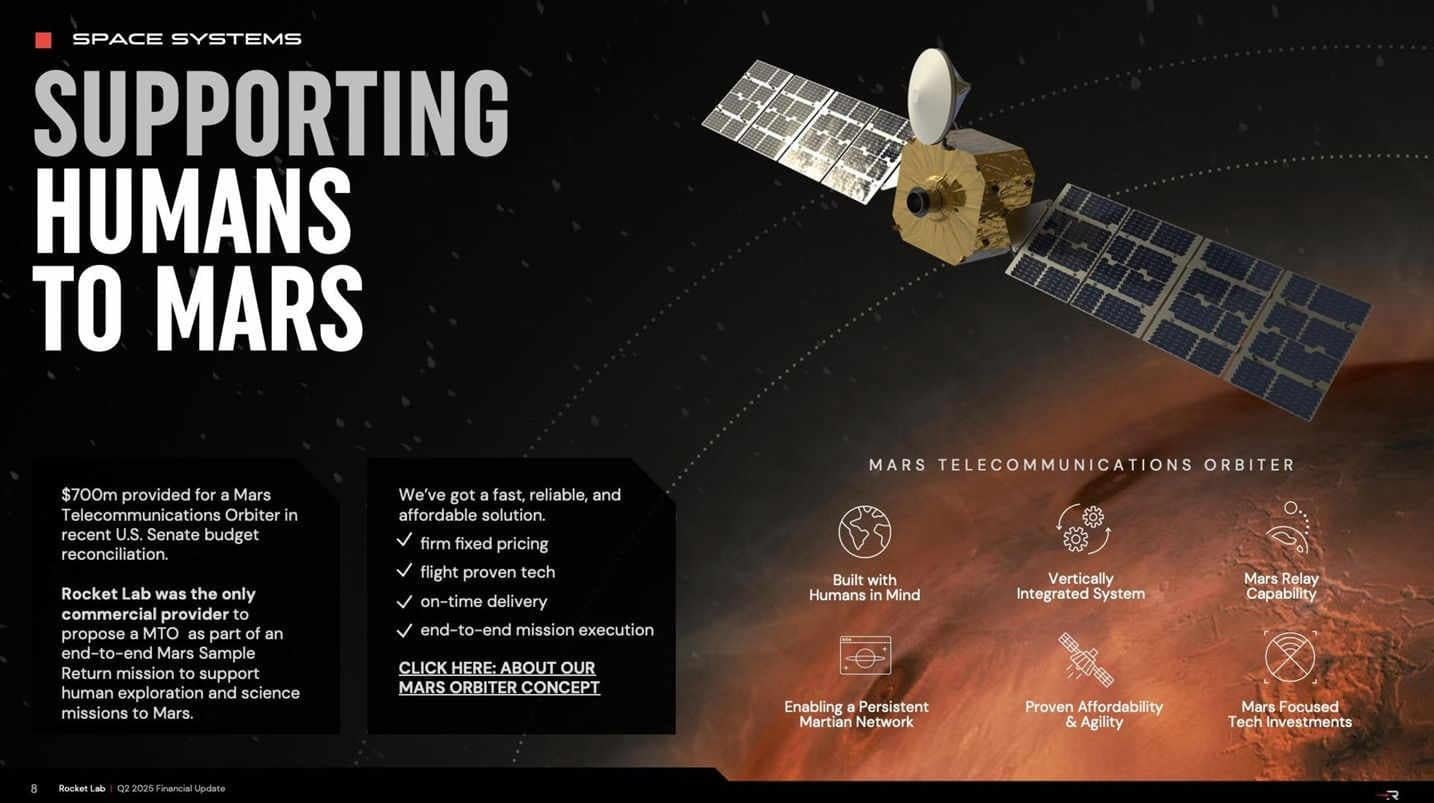
The GAO protest puts all of it on hold. And the single document that could settle whether Rocket Lab has a case, or whether it’s a losing bidder venting at its customer, is sitting unreleased at NASA.