
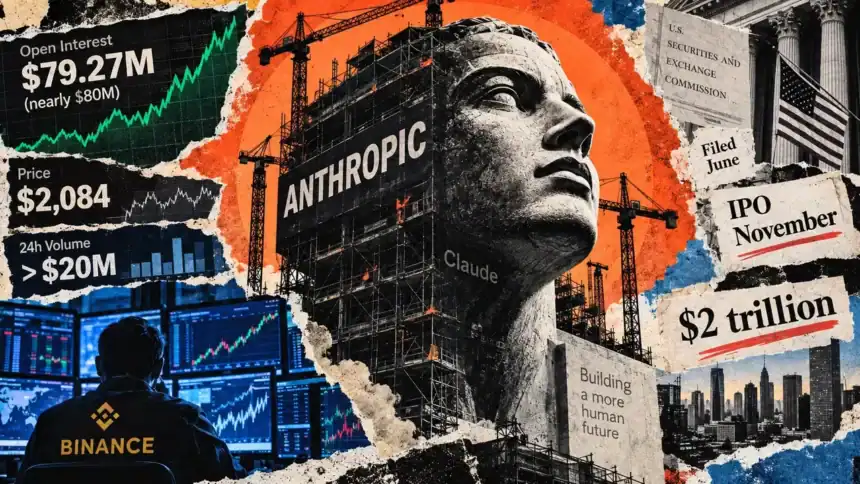
Anthropic hasn’t set a share price, a share count or a final valuation. Crypto traders have put nearly $80 million on the line anyway.
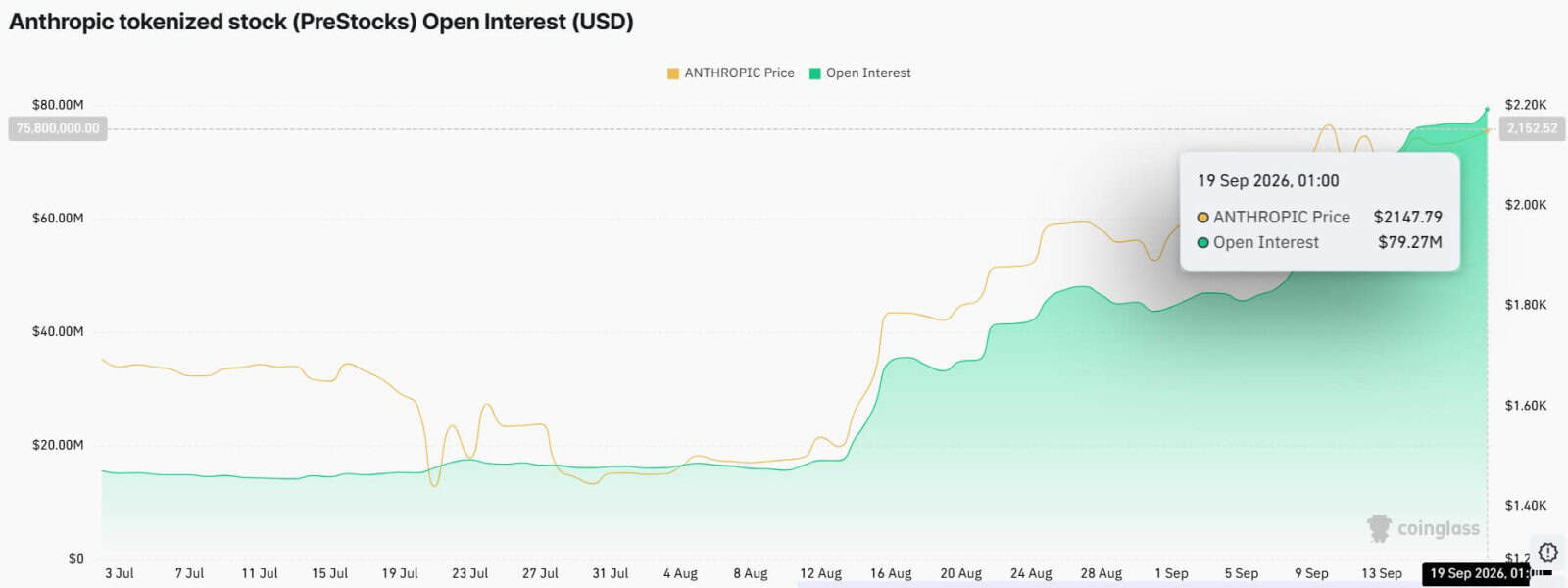
Open interest in futures tied to the Claude developer sits at about $79.27 million, just shy of the record $80 million, as traders position around what could become one of the largest initial public offerings ever attempted. All of that has built up while the company remains private and its confidential draft filing with the US Securities and Exchange Commission stays sealed.
What the $2,147 contract does and doesn’t represent
CoinGlass data showed the ANTHROPIC pre-stock contract trading around $2,147, with more than $20 million in futures volume changing hands over 24 hours. Binance is the largest venue, accounting for roughly 40% of activity.

Read the fine print before treating that number as a share price. The contract isn’t Anthropic stock. CoinGlass lists no circulating supply and no spot market for the instrument, and Anthropic still has no publicly traded shares for it to track. What you’re looking at is a derivatives market guessing at the value of exposure to a company you can’t buy yet.
That distinction matters more each month as crypto exchanges build markets around some of Silicon Valley’s most valuable private companies. In practice, price discovery starts before traditional equity investors get a look at the underlying shares.
From $1 million to $160 million in five months
Anthropic isn't a one-off. Open interest across Anthropic and OpenAI pre-IPO perpetuals passed $160 million this month, up from roughly $1 million in April and 179% higher than a month earlier, according to Binance Research. The two companies took about 95% of pre-IPO perpetual volume during the first 14 days of September.

These instruments differ from tokenized stocks, which are backed by real securities. Pre-IPO perpetuals are cash-settled derivatives referencing an anticipated public valuation or share price. Binance Research said no underlying shares are required to support the contracts, so traders are simply taking opposite sides of a bet on what the company could eventually be worth.
That structure lets crypto markets react to corporate news almost immediately. OpenAI-linked instruments rose after the company released its Astra model earlier this month and fell after Chief Executive Sam Altman signaled that its IPO could be delayed, Binance Research said.
Why open interest isn’t a bullish signal on its own
It’s tempting to read a near-record $80 million as a crowd betting Anthropic goes up. That’s not what the number says. Every futures position has a long and a short side, so rising open interest mainly shows more participation and more borrowed exposure, not which direction the crowd leans.
What it does establish is a continuously traded crypto reference price for Anthropic before Wall Street has an official IPO price to work with. Whether that reference is any good is the open question.

The November timetable and the $2 trillion number
Anthropic confidentially filed a draft registration statement with the SEC in June. The company said at the time that it hadn’t determined the number of shares or their price.
Reuters reported earlier this month that some investors were discussing a $2 trillion valuation, which would make the offering one of the largest ever attempted. The Wall Street Journal reported that Anthropic now plans to stage the IPO in November, later than the October timetable investors had expected. The company is also considering releasing another AI model ahead of the listing as competition with OpenAI intensifies.
Circle’s CEO wants Anthropic to stop waiting
The speculative market is growing while Circle Chief Executive Jeremy Allaire publicly pushes Anthropic to finish the move into public markets.
“Take the leap, Anthropic,” Allaire said, arguing that concerns about volatile markets, valuation and AI safety strengthen rather than weaken the case for exposing the company to greater scrutiny.
Allaire has a reference point. Circle took the USDC issuer public in June 2025, pricing its IPO at $31 per share, with the total offering reaching about $1.2 billion including shares sold by existing shareholders and the full exercise of the underwriters’ overallotment option.
He said going public imposed audited financial reporting, quarterly disclosures, independent board governance and Sarbanes-Oxley controls that made Circle easier for banks, governments and enterprise customers to evaluate.
Frontier AI companies are approaching a similar point as their technology becomes embedded across businesses and economic infrastructure, Allaire argued. Model capabilities, safety procedures, computing commitments, revenue concentration and corporate governance are increasingly matters of public interest, he said, yet much of that information stays inside privately held companies.
An IPO would force Anthropic to disclose far more about its finances, dependencies and risks, and expose management decisions to investors, regulators and recurring reporting requirements. Allaire also said an IPO can’t substitute for AI regulation, pointing to stablecoins, where he argued public-market discipline and clearer rules developed alongside each other.
Two markets, one unanswered question
Anthropic is now approaching the public markets from two directions at once. Traditional investors are waiting for a prospectus and the financial disclosures they need to judge whether a valuation near $2 trillion holds up. Crypto traders have skipped the waiting and built nearly $80 million in outstanding futures positions on a market trying to answer that question in real time.
The gap should narrow once Anthropic makes its registration documents public. That’s the moment the pre-IPO contracts get tested. Traders will be able to set the assumptions baked into a $2,147 print against the revenue, costs, risks and share structure Anthropic presents to prospective shareholders. Until then, the crypto price is a wager on a filing the public hasn’t seen.