

Coinbase’s stock tokens have cleared about $1.02 billion in cumulative trading. That number looks reassuring until you try to sell. The pools that would absorb your exit held about $12.97 million combined on Sept. 23.
Those two figures measure different things. Volume counts trades that already happened. A pool balance shows capital sitting in the market right now. If you hold one of these tokens, the second number is the one that decides what you get paid, especially when US stock markets are closed.
A $100,000 sell got priced. That’s not the same as depth
A premarket check on Sept. 23 asked KyberSwap for indicative routes to buy and sell about $100,000 of each of Coinbase's 10 stock tokens on Base. Every token got a quote.

On the sell side, estimated proceeds came in 0.06% to 0.71% below KyberSwap’s own dollar valuation of the tokens being sold. That’s a tight range for orders of that size in pools this small.
But the quotes come with a limit. Each route prices one order at one moment. None of them shows how the market would handle many holders heading for the exit together, and none of them records a completed trade.
Order size mattered. At roughly $10,000 per token, sell-side quote gaps ran 0.01% to 0.12%. Moving up to $100,000 generally widened them.
Some of the better $100,000 prices had help. Several routes pulled from Aerodrome and other liquidity sources at once, so the quote reflects how far the router can reach and not what a single pool can take. That outside liquidity comes from market makers and providers who may change their offers quickly.
What $12.97 million in pools can’t tell you
The 10 main Aerodrome stock/USDC pools ranged from roughly $818,700 for MSFTc to $2.11 million for NVDAc during the check.
Each of those balances mixes two assets: the stock token and USDC. A headline total can’t tell you how much USDC is available to buy your tokens inside a given price band. So the $12.97 million figure is where the analysis starts. It doesn’t settle anything.

The volume side has its own caveat. Dromos Kitchen’s stock-token dashboard put cumulative volume at about $1.02 billion and total tokenized value at $19.82 million on Sept. 23. It’s community-built, and it carries a warning that its data may be incomplete. Turnover also piles up with every trade, so it can’t be read as a fresh line of buyers waiting to take a large sell order.
How the numbers were gathered
The quote gap here is internal to the router. It measures how far KyberSwap’s estimated output value fell below its own valuation of the input. It doesn’t compare the token with the underlying share’s exchange price.
Pool balances came from the 10 matching Aerodrome Slipstream 3 stock/USDC records at about 08:00 UTC. KyberSwap GET route summaries were captured from 08:02:01 to 08:02:42 UTC. Sell sizes approximated $100,000 at displayed token prices, and KyberSwap’s own input marks varied slightly.
Values are rounded and gas is separate. No trades were sent. KyberSwap’s API needs a separate step to build an actual transaction.

The liquidity is paid to be there
Those pool balances didn’t show up on their own. Part of what keeps them in place is what liquidity providers get paid.
Aerodrome’s gauge rules create a trade-off. Providers who stake their pool positions to earn AERO emissions give up direct swap-fee rewards, which go to the voters who direct those emissions. Fees and the AERO stream are separate parts of the pool’s economics.
Launch subsidies added more. At the August launch, Beefy said Coinbase was supplying USDC incentives through Merkl in two-week periods and Beefy was adding its own boosts alongside Aerodrome emissions. That describes how liquidity was encouraged at launch. It isn’t a verified current return for every stock pool.
Providers follow the payout. If incentives or votes move elsewhere, they can reassess their positions, and a billion dollars of past trading won’t stop them.
After hours, the price reference freezes
This setup matters most when tokens keep trading after the underlying stock market closes.
Base says Coinbase’s tokens are backed by underlying shares held in regulated custody and are available only in eligible jurisdictions outside the United States. Its developer documentation describes secondary token trading as permissionless, subject to address controls. Primary minting and redemption of the underlying shares are restricted to authorized participants.
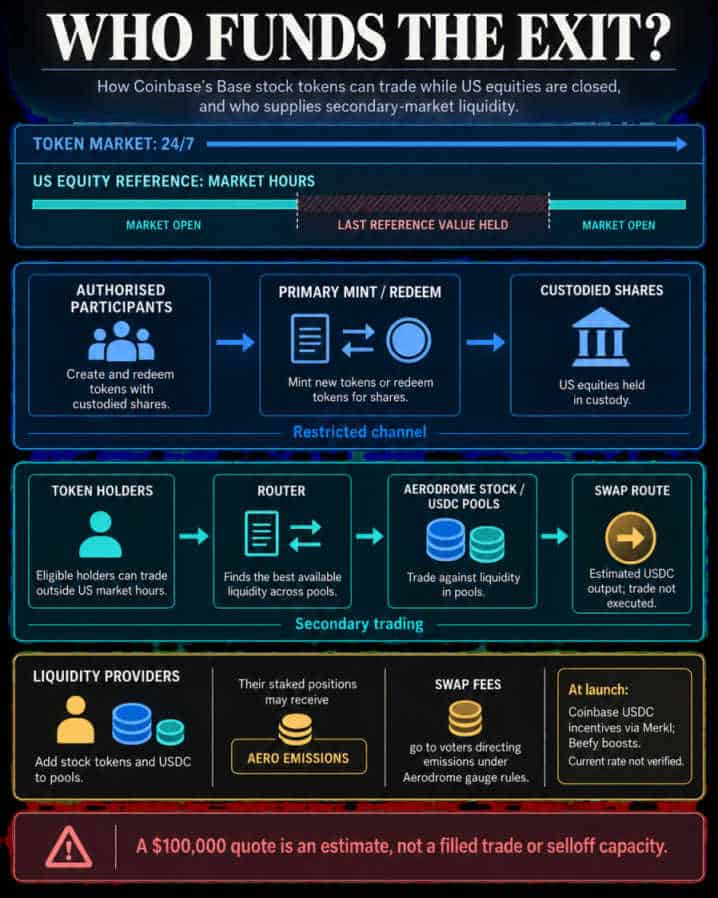
The same documentation says the Chainlink equity feed holds its last value outside market hours while onchain token trading can continue. If you sell at night, you’re trading in a live token market while the equity reference may still reflect the prior session.
You also can’t redeem your way out. Authorized participants control share creation and redemption, which leaves secondary-market liquidity providers to set the price of any immediate exit.
What to watch before you sell
The Sept. 23 routes show that $100,000 individual orders got indicative prices even with modest displayed pools. That’s a snapshot from a quiet premarket window.
A shift in AERO votes, a pullback in provider capital or after-hours stock news could change those routes while the equity feed sits on its last value. If you’re holding NVDAc or MSFTc outside US trading hours, check the live route for your actual size before you sell. The volume chart won’t tell you what that sale will cost.