


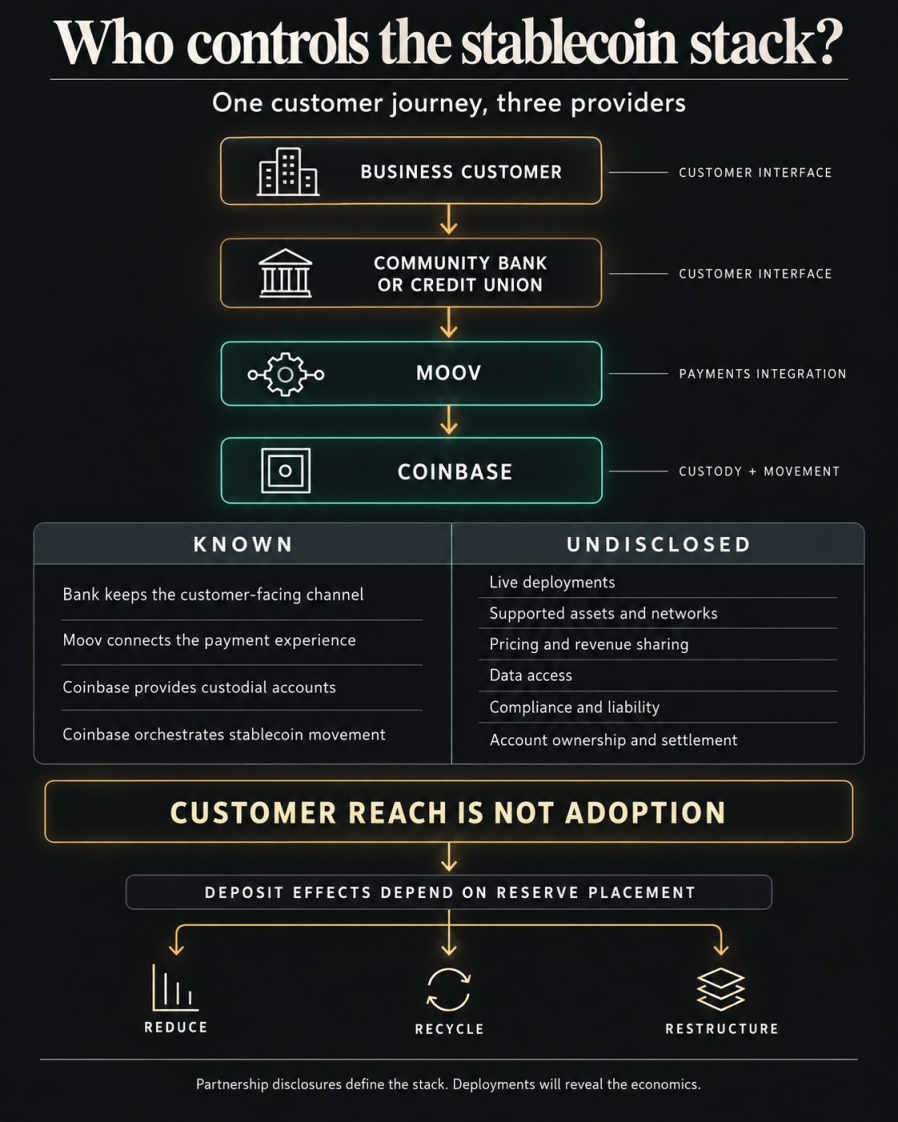
Three parties now sit between a small-town business and a stablecoin rail. The bank or credit union owns the customer conversation. Moov supplies the payments-platform connection. Coinbase provides the custody and movement components it announced. The customer sees one bank-facing product.
That’s the shape of the deal Coinbase announced Sept. 10 with payments platform Moov, and the shape matters more than the announcement.
What the banks actually get
Moov will integrate Coinbase’s stablecoin payments infrastructure into its existing platform for financial institutions. Coinbase said its CDP Custodial Wallet accounts will provide fund custody and its Payments API will orchestrate stablecoin movement. Moov connects those functions to the systems its bank and credit-union customers already run.

The pitch to a community institution is straightforward. You keep the account relationship. You get a service that would otherwise require building your own crypto stack.
Moov CEO Wade Arnold put the demand bluntly: business customers asked to accept stablecoins currently go outside their primary financial institution. Moov and Coinbase want that service to show up inside the institution’s existing payments experience instead.
The number in the press release isn’t the number that matters
Coinbase’s announcement said Moov has a customer base of more than 1,000 community banks and credit unions. That’s a distribution footprint, not adoption.
Live institutions, contracted institutions and pilots all remain unquantified. Neither company gave an implementation timetable. So the 1,000 figure tells you how many doors Moov can knock on, and nothing about how many have opened.

Read the documentation, not the quote
Coinbase’s standard payments documentation describes a custodial-account stack where crypto can enter an account, be held and reconciled there, and leave through fiat or crypto transfers. Separate custodial wallet documentation says Coinbase provides custody for assets in those accounts on behalf of the CDP entity.
Those are the general platform docs. They’re the clearest public evidence of how material Coinbase’s role is behind the bank’s interface.
What the partnership record doesn’t say is longer. Each institution’s supported stablecoins, networks, custodial-balance ownership and fiat-settlement route are all unspecified. Fees, revenue sharing, transaction-data access, compliance allocation and liability sit outside public view entirely.
Every one of those blanks determines who captures the value.
A bank-facing wrapper doesn’t change the legal claim
Here’s the part that should give a community bank CFO pause. Putting a stablecoin inside a bank channel leaves the stablecoin’s legal status exactly where it was.
In an April 2026 proposed rule, the Federal Deposit Insurance Corporation said deposits held at banks as reserves for a payment stablecoin would be insured as corporate deposits of the stablecoin issuer, subject to applicable limits. Stablecoin holders would receive no pass-through deposit insurance under the proposal.
The same proposal draws a line around tokenized deposits. An instrument meeting the statutory definition of a bank deposit stays a deposit regardless of the technology or recordkeeping used.
So a payment stablecoin and a tokenized deposit can hand a customer the same digital-dollar experience while representing different legal claims. A qualifying tokenized deposit remains the issuing bank’s liability. Access to a third-party stablecoin keeps the payment experience inside the bank’s channel while the customer’s converted funds may stop being a deposit at that bank.
Deposits don’t drain on a fixed schedule
The doomsday version of this story assumes dollar-for-dollar deposit flight. The Federal Reserve doesn’t.
A Fed analysis published in December 2025 said stablecoins can reduce, recycle or restructure deposits. Which one happens depends on who buys them, what assets get converted and where issuers place their reserves.
Domestic customers converting transaction-account balances can reduce deposits, and that effect sharpens when issuers hold reserves outside banks. If issuers keep reserves in bank deposits, more funding stays in the system, though it can migrate from dispersed retail accounts toward concentrated, uninsured wholesale balances.
For any single community bank, the question is narrower still: does reserve money come back to that institution, or does it pool with larger custodial and settlement banks?
The Fed named this exact playbook
The same analysis listed partnerships, custody services, settlement accounts and white-label infrastructure as ways banks can stay connected to digital payment flows. The Moov arrangement is that list in product form.
But the Fed also described the deeper tension. Stablecoins may separate the payment relationship from the deposit-funded lending model banks have historically used to serve households and businesses.
Both possibilities live inside one product design here. A bank may keep the customer conversation. Coinbase may gain transaction and custody activity while customers reach stablecoins through their primary institution. Where the deposits and the revenue land stays unsettled.
What to watch when the first banks go live
Adoption counts will show whether Moov’s network converts into real demand. Supported assets, account ownership and settlement paths will show whether stablecoin activity returns value to the same institution or routes it somewhere else.
The commercial disclosures carry equal weight. Pricing and revenue sharing determine whether the bank earns from the service or mainly supplies distribution. Data access and compliance responsibilities determine who gets to deepen the customer relationship and who eats it when monitoring or processing fails. Liability terms determine how much operational control translates into financial risk.
Coinbase has offered community banks a bridge into stablecoin payments with its custody and payment infrastructure underneath. That structure may keep the bank from vanishing from the customer’s view. The test that counts is how much of the payment relationship, balance-sheet value and decision-making power stays with the bank once the customer gets stablecoin access through it.