

A cryptography paper accepted to Crypto 2026 does something narrow and, for once, honest about it: it deletes a clock.
Not a clock in the wall sense. A randomness beacon, the kind of always-on service that hands every participant in a protocol a fresh public random value at regular intervals. Prior constructions in this line of work assumed that service existed. This one says you don’t need it.
What the paper actually removes
The University of Edinburgh research record lists Damiano Abram, Marshall Ball, Juan Garay and Aggelos Kiayias as authors of “Permissionless consensus from a common random string.” Crypto 2026 runs Aug. 17 through Aug. 20 in Santa Barbara.
The problem they’re attacking is old and stubborn. How do parties reach Byzantine agreement when nobody knows in advance who’s participating, beyond an upper bound on the number of them, and there’s no public-key infrastructure to lean on? Bitcoin helped motivate this research line. But nothing in the public record frames the new work as a Bitcoin upgrade or a change to any live network, and you should be suspicious of anyone who tells you otherwise this week.

The 2024 version needed a heartbeat
A 2024 construction by Ball and collaborators combined proofs of work with fine-grained complexity assumptions. Its model also gave every participant access to a beacon delivering a fresh public random value at regular intervals. That’s the recurring service, the heartbeat the whole thing was quietly synced to.
The new paper replaces it with d-wise independent distributed samplers. In plain terms, the samplers are built to keep multiple executions secure at the same time, without a beacon that has to keep producing new public randomness on a schedule.

Setup doesn’t disappear, it changes shape
This is the part that gets lost when a result like this travels. Removing the beacon doesn’t mean removing assumptions.
Participants still use a common random string. The abstract says it doesn’t need to be structured or sampled precisely when the protocol begins, which is a meaningful loosening, not an elimination. The sampler constructions rely on the decisional Diffie-Hellman and learning with errors assumptions.
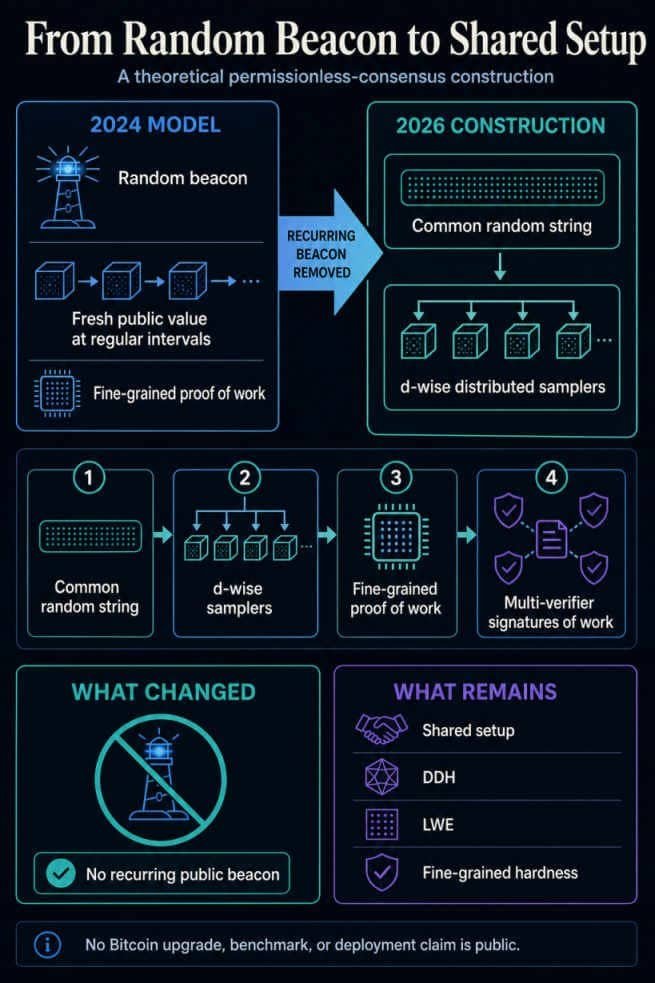
The authors then combine those samplers with proofs of work grounded in fine-grained complexity to build multi-verifier signatures of work, which the consensus protocol uses as a modular component. So one dependency in the earlier design got swapped out. The cryptographic assumption stack is still standing.
What nobody can tell you yet
The result remains theoretical for permissionless consensus, and the gaps in the public material are specific ones worth naming.
There’s no stated numerical corruption threshold for the 2026 protocol. No exact synchrony and communication conditions. No concrete costs. No benchmark performance. And details from the 2024 construction can’t be assumed to carry forward just because the same names appear on both papers.
Which means the available evidence doesn’t support comparisons with Bitcoin’s security model, and it doesn’t support anyone claiming this is ready for deployment. If you see a thread this week doing either, it’s running ahead of the paper.
You can’t read it yet, and that matters
The accepted manuscript stays embargoed until Aug. 20 at 00:00 BST, according to the Edinburgh record. That’s the final day of the conference, which is a fairly narrow window between the talk and the text.
Until then, here’s the whole claim, stripped of the parts people will want to add to it: a recurring randomness beacon gets replaced by distributed samplers and a common random string, while DDH, LWE and fine-grained proof-of-work assumptions stay in the construction.
Mark Aug. 20 and read the corruption threshold and the synchrony conditions first. Those two numbers will tell you more about whether this construction means anything practical than any abstract will.