

In Brief:
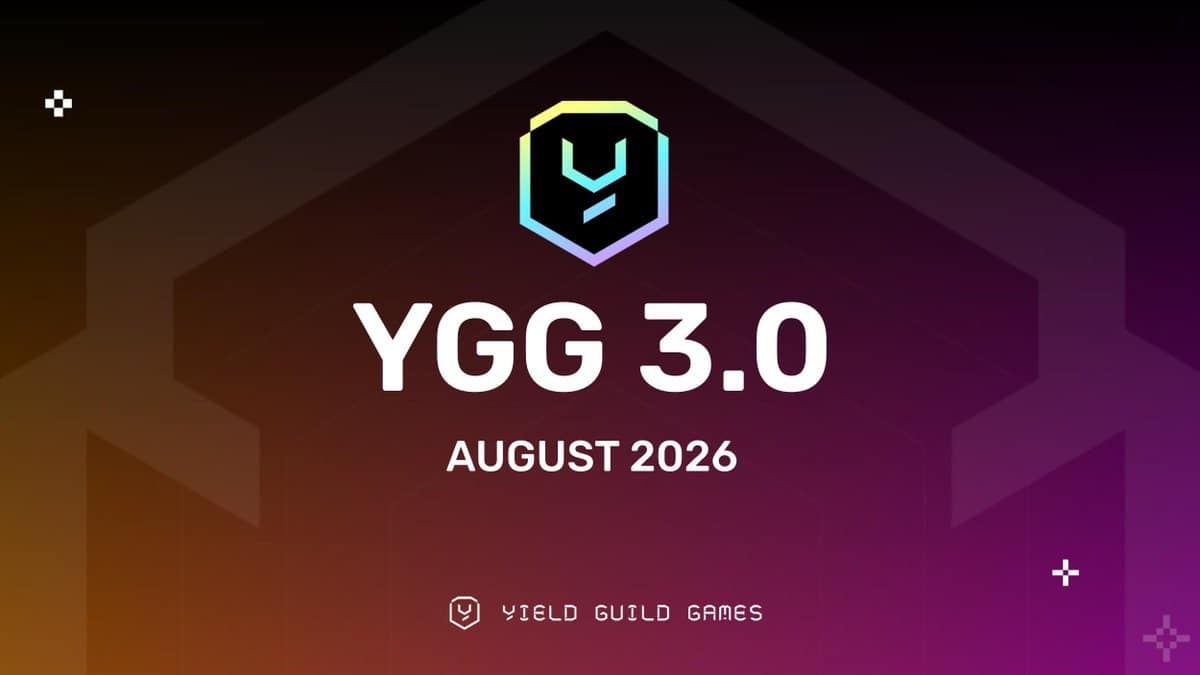
- Yield Guild Games said YGG 3.0 is live, recasting the guild as a sector-agnostic infrastructure layer rather than a Web3 gaming operation.
- The Guild Protocol is the center of the pitch, with YGG aiming its onchain guild network at human-in-the-loop intelligence, data verification and model alignment for AI.
- The relaunch follows the July 31 shutdown of publishing arm YGG Play and 35 job cuts, leaving a treasury of $16.1 million as of June 30.
Yield Guild Games declared YGG 3.0 officially live, formalizing its exit from the guild model it defined during the Axie Infinity (official site) boom.
“We are evolving from a pioneer in Web3 gaming into a sector-agnostic infrastructure layer,” the guild said, describing the result as a platform “for any community to organize human effort, skill and capital across the digital economy.”
Our new direction for @YieldGuild explained here – come and take a look!
The Guild Protocol carries the weight of that claim. YGG frames it as a standard for Onchain Guilds built from three parts: the guild, the assets it owns and its onchain activity, with soulbound tokens serving as the non-transferable credential layer. Modules cover work management, multisig treasury wallets and NFT issuance, so a guild can mint its own badges and run its own quests.
Those quests now include AI data labeling and game testing alongside user acquisition campaigns. The YGG token remains the protocol’s native asset, used to activate and access the coordination systems.
Three eras, one repositioning
YGG splits its own history into phases. From 2018 to 2020, co-founders Gabby Dizon, Beryl Li and Owl of Moistness set up the guild to distribute digital assets. From 2021 to 2025, it standardized what it calls decentralized labor coordination at scale, organizing players into autonomous onchain communities backed by verifiable reputation.
For 2026 and beyond, the Guild Protocol network becomes what YGG calls a core operational layer for the AI economy. The updated whitepaper on yieldguild.io leads with “Real Human Intelligence and Verified Data.”
The commercial version is a B2B pipeline selling gaming behavioral data to AI labs training world models. In-game choices, reactions and emergent player behavior feed systems with applications in robotics and in-game agents. Dizon has described it as a return of play-to-earn where the payout isn’t a token funded by speculative liquidity.
What got shut down
YGG Play ceased operations July 31. The launchpad, Community Questing, LOL Land (official site) and Waifu Sweeper all closed, with remaining player balances snapshotted for conversion to YGG. GIGACHADBAT and Ragnarok Breaker keep running under original developers Delabs Games and Planetarium Labs, each with a new redemption flow for in-game rewards.
The unit booked more than $9.6 million in lifetime revenue, including over $541,000 in the second quarter. It peaked at $3 million a month in October 2025. Community Questing onboarded more than 24,000 users after its August 2025 launch before retiring with the platform.
Cutting it sharply reduced monthly burn. YGG says the remaining treasury, which held over $4.7 million in stablecoins, Treasury bills and large-cap tokens at the end of June, gives it runway well into 2028.
The Philippines pipeline
YGG rebranded YGG Alerts as AI Alerts, a board for verified remote AI training work aimed at its roughly one-million-strong Philippine community. It drew 27,000 applications in its first five days.
A companion program, GIG Rewards, runs through a partnership with one of the country’s largest telcos, which YGG has not named publicly. It covers collection, annotation, RLHF, embodied AI data, QA and provenance from a single operating layer.
AI Alerts found that 72% of Philippine companies already use AI while only 17% say they can find enough qualified workers.
The groundwork predates the pivot. Season 6 of the Guild Advancement Program had questers training models and refining data sets, with partners including Sapien, Navigate and Syne.
Elsewhere in the portfolio
YGG launched vibecode.game in June as a permissionless launchpad and editorial site for vibe-coded games. Its first VibeBlitz jam, run with Minds by Animoca Brands, registered over 250 creators and took 72 finished games by the July 27 deadline. Winners were announced Aug. 10, with top projects getting access to the Minds Investment Programme and Animoca’s 600-plus portfolio companies.
The token has not rewarded any of it. YGG traded near $0.020 after hitting an all-time low of $0.01673 on July 29, down more than 99% from its $11.50 peak in November 2021. A further 3.42 million tokens, 0.34% of supply, unlock Aug. 27.
Dizon didn’t dress up the decision that cleared the way for all this. “Sunsetting YGG Play is a heavy decision, but it is a market decision, not a product decision,” he said.