

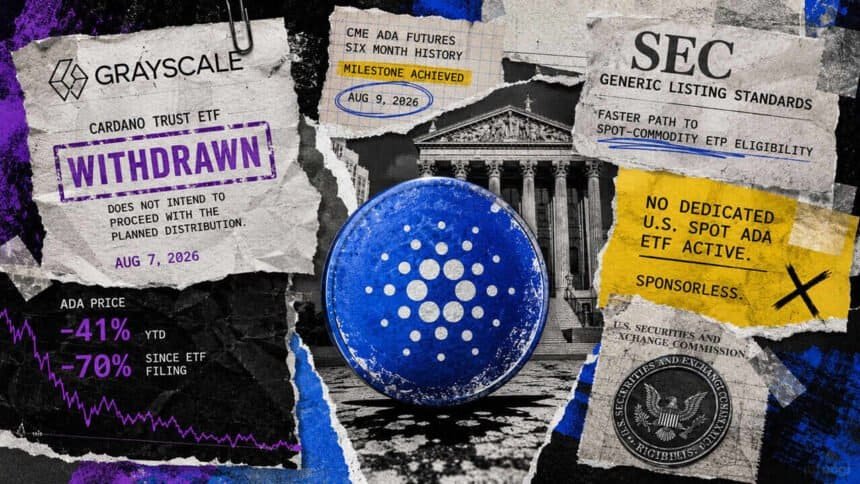
Grayscale pulled its Cardano Trust ETF registration on Aug. 7. On Aug. 9, ADA hit the six-month CME futures mark that would have let a spot ETF skip the slowest part of SEC review entirely.
Forty-eight hours. That’s the gap between the only dedicated US spot ADA filing walking out the door and the rule that would have made its life easier switching on.
The withdrawal itself was thin on explanation. Grayscale told the SEC only that it “does not intend to proceed with the planned distribution.” No reasoning, no market commentary. The move was voluntary.

Three minutes, three tokens
Cardano wasn’t singled out. Grayscale filed parallel withdrawals for Hedera and Polkadot within roughly three minutes of each other that same afternoon, which reads less like a verdict on ADA specifically and more like someone clearing a shelf.
What survived is the interesting part. Bittensor, Aave, BNB, NEAR and Zcash registrations were still active and preliminary the next day. That’s a portfolio decision, not a purge. Grayscale hasn’t confirmed why it walked.
ADA’s chart doesn’t help its case. The token is down more than 41% year-to-date and roughly 70% since Grayscale’s original ETF filing. That fits the broader cooling on altcoin products, but it isn’t evidence of what Grayscale was actually weighing.
Nothing to unwind, which is the point
Here’s a detail worth being precise about: the Grayscale Cardano Trust ETF registration never became effective. The filing states plainly that no securities were issued or sold under it.
So there was no operating fund. No ADA sitting in a vault getting liquidated. Nobody got redeemed out. The thing that died was a permission slip, not a product.
Which matters more than it sounds. A live spot ETF converts brokerage and institutional demand into actual ADA purchases every time new shares get created. That’s the channel that just went dark, and with no other single-asset spot filing currently on record, it stays dark until someone else files.
The substitutes don’t substitute
There is a Cardano ETF on the market. Volatility Shares runs one built primarily on CME ADA futures, and its own prospectus says the fund does not invest directly in ADA.
Its scale tells you how much demand that structure is absorbing. Combined net assets across the standard and leveraged versions came to roughly $1.26 million as of July. ADA’s market cap is around $7.1 billion. Do that division and the futures wrapper rounds to nothing.
The basket products are thinner still. Grayscale’s own CoinDesk Crypto 5 ETF dropped ADA in its January rebalance, swapping it for BNB after the underlying index reselected its five components. Franklin Templeton’s Crypto Index ETF still holds ADA, but at 0.69% of net assets, about $70,709 worth as of the end of last year.
Neither structure lets ADA demand arrive on its own terms. In a basket, ADA gets whatever weight the index says it gets.
What a real fund would move
Run the numbers against the current $7.1 billion cap and the size of the missing channel gets concrete. A $25 million ADA ETF is about 0.35% of market cap. A $100 million fund reaches roughly 1.4%. At $250 million you’re approaching 3.5%, and a $500 million fund crosses 7%, which is where ADA becomes a visible allocation product rather than a line item.
Creations, hedging and secondary trading all muddy the direct relationship between fund inflows and spot buying. But the ladder still shows you the scale of what nobody is currently building.
The shortcut Grayscale left on the table
The SEC’s generic listing standards let qualifying commodity-based trust shares list without the exchange filing a separate Section 19(b) proposed rule change for that individual product.
That’s the expensive part being skipped. The bespoke 19b-4 track, under Exchange Act Section 19(b)(2), runs from an initial 45-day review period out to as long as 240 days if proceedings get instituted and extended. Six months of regulated CME futures history is one accepted path to qualifying, and ADA hit that on Aug. 9.
Cardano’s only dedicated spot applicant left the building right before the rule that could have shaved months off its timeline took effect.
Two ways this goes
The bull version is a handoff. Another issuer files on the strength of ADA’s now-qualifying futures history, using the same six-month CME record Grayscale had sitting there. A new application inherits the faster review window and doesn’t rebuild the regulatory case from scratch. Grayscale’s exit costs ADA time, not the path.
The bear version is quieter and more plausible if you’ve watched issuer behavior this year. Sponsors aim at tokens with clearer demand, Solana, XRP, Dogecoin and BNB among them, and nobody picks up Cardano. Futures wrappers stay near their current size, baskets keep ADA at a rounding-error weight or drop it, and the absent spot filing starts getting read as a statement about ADA’s institutional standing rather than an accident of timing.
ADA is down 3.88% over the past 24 hours and sits at rank #14 by market cap.
Cardano cleared the bar the SEC built to make a spot ETF possible. The open question isn’t regulatory anymore. It’s whether a single sponsor looks at a $7.1 billion asset with a qualifying futures record and decides the paperwork is worth filing.