
Shaun builds a lab in a windmill. That’s the whole engine of this movie, and it’s more than enough.
Aardman Animations turns 50 this year, and the conversation tends to default to Wallace & Gromit. Fine. But the studio’s quieter MVP has always been the sheep who wandered in through 1995’s Academy Award-winning short A Close Shave and never left. Shaun and the Mossy Bottom flock have since carried multiple series, shorts and a trilogy of features. The third of those, Shaun the Sheep: The Beast of Mossy Bottom, hits theaters September 18, and it’s built out of Universal Monsters affection and silent-era visual comedy.
The pumpkin patch was doomed from the first frame
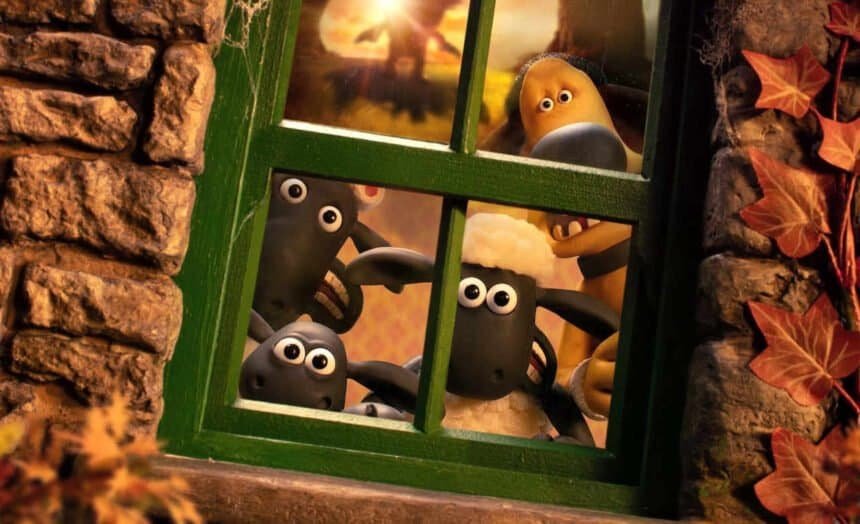
Like 2015’s Shaun the Sheep Movie and 2019’s A Shaun the Sheep Movie: Farmageddon, this one keeps its world small and legible. The Halloween story opens on the farm run by the clueless Farmer and his sharper sheepdog with the exaggerated overbite, Bitzer (both voiced by comedian John Sparkes). Out in the fields, Shaun (Justin Fletcher) leads a flock that has correctly assessed the Farmer as a liability and hidden a secret pumpkin patch from his eyes and his clumsy feet, nurtured to perfection for their Halloween Hoedown.

He ruins it anyway. Obviously.
A despondent Shaun finds a handmade science book in the barn and goes full mini-Frankenstein, windmill lab included, cooking a serum for the pumpkin seeds so little Timmy and the flock still get their party. The seeds grow back. Uncontrollably. Which puts Shaun on the back hoof fixing his fix.
The Farmer’s hairline gets its own subplot
Running alongside that: the Farmer has a crush on the local Vet (Nina Sosanya) and is self-conscious about his retreating hairline. He finds an old bottle of hair growth formula, newly topped off with the excess of Shaun’s serum, and figures it’ll give him the confidence to ask the lady doc out. You can guess how hairy things get.
What makes Mark Burton and Giles Pilbrow’s screenplay work, and what makes most Shaun and Aardman features work, is that the escalating disasters never come from plot machinery. They come from characters doing things and those things knocking into other things. Dominoes. Younger viewers can follow it cleanly while older ones get the classic-movie scaffolding underneath.
And the frames are packed. Horror easter eggs, sight gags stacked on sight gags, character performances doing work that dialogue usually handles. The film is nearly dialogue-free, and first-time feature directors Steve Cox and Matthew Walker pull it off by keeping the spine clear and layering in gags that reference today’s horrors right alongside bits from James Whale’s Frankenstein and Steven Spielberg’s Jaws.
Every hair on that Sasquatch was placed by hand
The directors also push past the farm gate into the unsettling woods of Mossingham, give the windmill real set-piece weight, expand the Mossingham citizenry and stage an entire sequence at sea. That scale keeps the pokey farm from feeling too cramped for a theatrical story, and it stretches what the Aardman team can do with stop-motion.
Consider what the animators took on here: enormous amounts of moving hair as the Farmer goes full Sasquatch, plus spritzing water and aquatic critters. It’s easy to forget that every character and every locale is handmade and moved by hand, frame by frame. That’s the patience and craftsmanship this studio keeps proving it has.
Natalie Holt’s score deserves its own line. In what amounts to a silent film, she and her orchestra carry the emotional load, landing jokes with flourishes in the Carl Stalling tradition of the Looney Tunes and Merrie Melodies compositions, then building whole feelings in the gaps between grunts and gibberish.
Where it sits in the trilogy
The Beast of Mossy Bottom is a strong addition to the farm trilogy and to Aardman’s larger run. It was clearly made by silent-era horror nerds working alongside some of the quickest punsters in the business, and the studio’s commitment to stop-motion while honoring the horror genre’s history is worth something.
It isn’t as slick or elevated as Wallace & Gromit: Vengeance Most Fowl. Maybe not the best of the three, either. But the simple narrative gives kids something to hold onto while the horror literacy underneath rewards parents and animation fans, and there are enough laughs and animation feats to justify the theater. Not yet available for streaming, so the theater is the only option anyway.
Go for the windmill lab. Stay for the hair.