
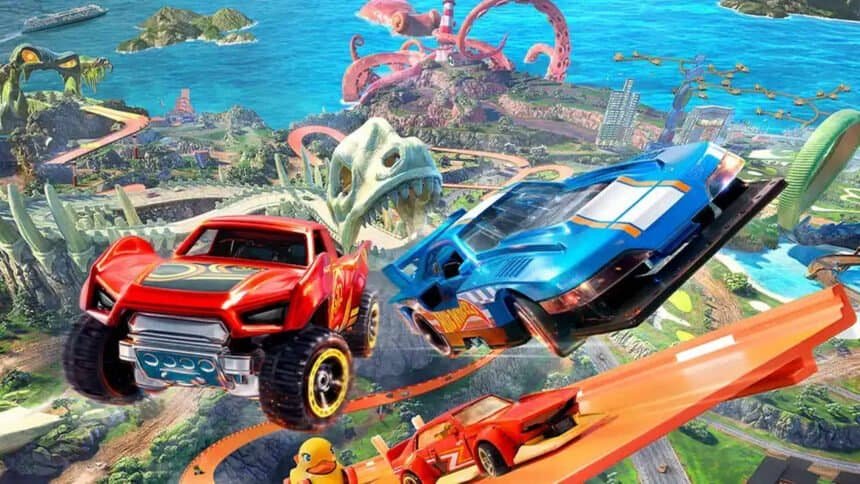
The waypoint says 800 metres away. The car is, ostensibly, three inches long. That math doesn’t add up, and the wobble in it explains most of what’s gone wrong with Hot Wheels Infinite Rush.
Milestone took the toy-car racer it built across two Hot Wheels Unleashed games and rebuilt it as an open-world thing, with Burnout Paradise as the obvious north star. Said out loud, that sounds fabulous. Criterion’s classic is one of the most revered arcade racers in the business, even if it turned out to be the last proper Burnout we ever got.
Said with a controller in your hands, it’s a different story. Infinite Rush gives up far too much of what made the Unleashed games eye-catching and zany, and what’s left is fine without ever being interesting.

The cars still look real
You know it’s a Milestone Hot Wheels game within seconds, because nobody else renders these castings like this. From zinc to plastic, every surface gleams with the right kind of authenticity.
It’s been this way since the first game landed in 2021 and it still gets me. They just look real.
So why don’t they get scratched anymore
Here’s the change that bugs me most. The cars no longer accumulate wear and tear. Cross the finish line and your model looks exactly as factory fresh as it did on the grid.
The scratches, rubs, scuffed plastic and kerb rash that piled up in the Unleashed games did real work. Making a car look like it had tumbled down the driveway a dozen times seated it into the world and sold it as an actual play-worn toy. Infinite Rush feels glossy and consequence-free by comparison.
Am I missing a hidden setting somewhere? An intentional call, or a licensor change of heart? Whatever the reason, it’s a weird step back and I’m not a fan.
A garage tilted toward the toy aisle
Roughly a third of the 150-car roster appears to be new rather than recycled, which is welcome. There are almost 60 years of castings to pull from, so wheeling out the same models forever doesn’t make much sense.
The balance is still off, though. New and recent models dominate, with a decent smattering of early to mid-2000s castings including AcceleRacers, but the ’70s, ’80s and ’90s stay woefully underrepresented. There’s nothing here for Gen X parents or grandparents to share with a kid.
Older players aren’t the primary audience of a licensed Hot Wheels game, I get that. But my sons’ collection is like a core sample of Hot Wheels history: recent cars, my childhood cars, old cars from their uncles and even their great uncle. I suspect that’s pretty common. Infinite Rush sometimes feels less like a rummage through the toyline’s past and more like a catalogue of what’s currently hanging on a peg at the shops.
The pop culture cars that were fixtures in Unleashed are gone too. Ferrari’s presence is neat, given the Prancing Horse sat out the real-life Hot Wheels line-up from 2015 to 2025, but the total absence of movie and TV cars feels cheap.
Four classes, and one of them is the good one
The class system carries over from Unleashed 2, trimmed from six to four: Versatile, Speeder, Drifter and Titan. Each one asks you to drive around its quirks.
Titans are strong but bulky, with extra long boost meters to compensate. Drain one to zero and your default speed gets strangled for a moment while the engine coughs back to life. Versatile racers burn their drift bar in chunks, so you can’t cancel a boost once it starts, which makes them awkward in the grid-like urban stretches where you need to point yourself somewhere specific mid-charge.
Drifters are my pick, because they’re the easiest to sling sideways and that’s what an arcade racer should be about. The other classes are less satisfying to slide, and there sometimes seems to be a speed penalty for doing it properly. On more than one corner it was overtly faster to Hail Melon my way around, Ross Chastain-style, than to drift it. In an arcade racer, that shouldn’t happen.
Four islands that blur into one
The real problem is how generic the open world makes everything feel. There’s no single large map to explore the way Burnout Paradise or Forza Horizon 6 do it. Instead you get four separate, modestly sized islands, each themed a little differently.
Wheelswood is a commercial, downtown-inspired map. Tentacle Bay is another city environment with a bit more countryside around the edges. Gearville is a desert industrial zone, and Drifty Temples goes East Asian-inspired. Familiar bits of plastic track thread through otherwise unmemorable slabs of scenery and basic city blocks.
I mostly find myself blazing through, smashing bushes and benches. There’s some imagination on display, and the huge Hot Wheels Mount Rushmore on Gearville is genuinely cute, but almost nothing grabs me. Not even the big plastic animals.
The scale is the whole point, and it’s missing
In the Unleashed games you raced through half-built skyscrapers above the clouds. You stared up at arcade cabinets that loomed like towers over your tiny car, down there on the sticky carpet.
Infinite Rush has none of that. Its maps aren’t quite believable dioramas, even stuffed with moulded plastic props, and they aren’t quite real places either, even though the game measures your next waypoint in metres.
The side activities that exist to justify all this space are mostly busywork. Photograph challenges tell you exactly where to stand. Checkpoint collections would be far less trivial if you had to dodge traffic, which you don’t, since smashing through cars barely slows you down.
There was a better version of this idea
You could take this series open world without torching its sense of scale. Build the desert map on a beach. Lay another one out across the foyer of a toy store. Make more of the architecture out of household objects, cereal box buildings standing beside Hot Wheels garage playsets, painted roads filling the gaps between the orange track pieces.
Any of that would have given these backdrops the size they’re missing. 2023’s LEGO 2K Drive handled the approach better overall, though that game is already completely delisted from digital stores.
The upgrades landed in the wrong game
What stings is that Infinite Rush improves in real ways elsewhere. Four-player splitscreen is here, and it would have been a riot in the wilder Unleashed maps. AI can now race on your custom tracks, which would have added serious longevity to the older games. I’d have loved to watch the computer attempt the insane leaps I’ve built in the past, especially since Infinite Rush is far more restrictive on height than the multi-level Unleashed maps and their piles of vertical space.
Customisation now lets you swap wheels, which speaks directly to me as a 40-odd-year-old diorama-building dork. Fine, the cars I’ve been attacking with a power drill aren’t strictly mine, but my boys aren’t using them anymore. Don’t tell them.
The racing itself holds up, with difficulty tuned for total beginners and arcade veterans alike, a generous stack of activities and a huge pile of photo-realistic models to collect. The track and car creation tools remain excellent and reverent to what this hobby actually is.
None of it saves the maps. This is the least compelling Hot Wheels game Milestone has made, and it’s lost most of its toy-like personality on the way to an open world. A large plastic gorilla can’t fix that. Neither can the octopus.


![The Sony and Kojima drama, plus that gorgeous Zelda remake [FRAMERATE]](https://cryptogames.gg/wp-content/uploads/2026/09/the-sony-and-kojima-drama-plus-that-gorgeous-zelda-remake-framerate-150x150.webp "The Sony and Kojima drama, plus that gorgeous Zelda remake [FRAMERATE]")